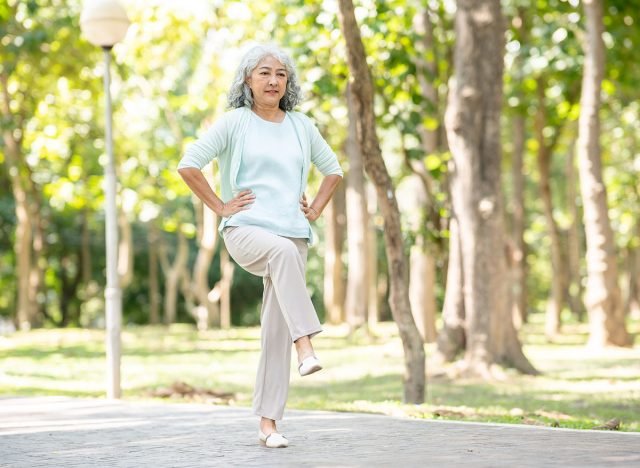
Balance begins to change as we age, especially if we don’t assess or address lingering issues. You may notice it when you step off a curb, turn too quickly, or catch yourself reaching for something nearby. None of that means you’re losing your edge, but it may mean that your balance deserves more attention.
The single-leg stand is a simple way to check where you are that’s simple and, most importantly, reliable. You stand tall, lift one foot, and see how long you can stay steady without grabbing for support. It looks basic, but it asks your body to control weight on one leg while your foot, hip, and core keep making small adjustments.
For this test, 45 seconds per side with clean form is a top-tier goal after 60. The number only counts if you stay tall and controlled without using any other body parts for assistance. Below, we’ll cover why the single-leg stand is such a useful balance test, how to do it safely, what your time says about your balance, and how to build toward a stronger hold.
RELATED: 5 Exercises That Undo 10 Years of Sitting Faster Than Yoga After 55
Why the Single-Leg Stand Is a Strong Balance Test After 60

Standing on one leg clearly shows your balance because it removes your wide base and asks your body to rely on a single support. Both feet on the ground give you more room to shift. One foot makes the task more precise. Your body has to keep you centered without letting the ankle, knee, hip, or trunk drift too far.
The science here is simple enough to feel. Your brain uses feedback from your eyes, inner ear, and the nerves around your feet to keep you upright. When you lift one foot, that feedback has to work faster. Small corrections happen the whole time, even when you look still from the outside.
The test also shows how well each side supports you on its own. That’s useful because daily movement rarely loads both legs the same way. Walking, stepping up, and changing direction all ask one leg to take charge for a moment. A longer single-leg stand shows your body can stay steady through those moments with more control.
RELATED: 5 Morning Exercises That Restore Knee Strength Faster Than Squats After 60
How to Do the Single-Leg Stand Test
Do this test near a wall, counter, or sturdy chair for safety. You shouldn’t need to hold on until necessary, but keep support close enough to use if you need to reset. The goal is controlled balance, without risk.
How to Do It:
- Stand tall with your feet hip-width apart.
- Place your hands on your hips or let them rest at your sides.
- Shift your weight into one foot.
- Lift the opposite foot a few inches off the floor.
- Keep your standing knee soft without letting it cave inward.
- Hold the position while breathing normally.
- Stop the timer when your lifted foot touches down, your standing foot moves, or you grab for support.
- Repeat on the other side.
Movement Standard: Your time counts when you stay upright, keep the standing foot planted, and avoid holding on for support. Light wobbling is fine as long as you stay in control.
Best Variations: Supported Single-Leg Stand, Standard Single-Leg Stand, Eyes-Closed Single-Leg Stand, Single-Leg Stand With Head Turns.
RELATED: 5 Standing Exercises That Banish Bat Wings in 30 Days After 50
Single-Leg Stand Test After 60: What Your Time Means
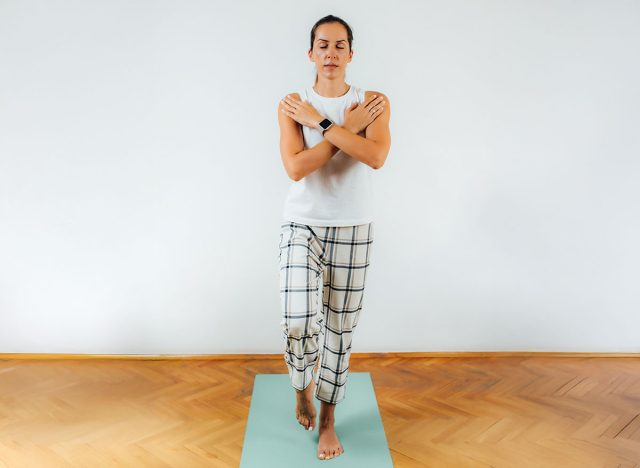
Test both sides and record each score. Your weaker side gives you the most useful information because it shows where your balance needs more work. Use the same setup each time so you can easily track your progress.
- Under 10 seconds: Building Your Base
Start with support nearby and keep the hold short. Your first goal is to feel steady for a few seconds at a time. Small wins here matter. - 10 to 25 seconds: Solid Starting Point
You’re showing better control and more trust in your standing leg. Keep practicing both sides, especially if one side feels less steady. - 26 to 44 seconds: Strong Balance After 60
This is a strong range. You can control your body on one leg, make small corrections, and stay composed as the hold gets harder. - 45+ seconds per side: Stronger Than 90% of Peers
Holding 45 seconds or longer on each side is an impressive benchmark after 60. It shows strong balance, steady leg control, and the confidence to support your body on one side at a time.
RELATED: 5 Daily Exercises That Trim Waist Overhang Faster Than Gym Workouts After 50
How to Improve Your Single-Leg Balance After 60

Better balance comes from regular practice. You don’t need long sessions or risky drills. A few focused holds near support can make a big difference when you do them consistently.
- Start with one hand near support: Use a wall or counter so you can correct quickly if needed.
- Practice short holds often: Try several 10- to 20-second holds instead of forcing one long attempt.
- Train both sides: Give the less steady side extra attention without turning it into a struggle.
- Keep your foot active: Let your toes and arch work instead of gripping the floor too hard.
- Add strength work: Step-ups, calf raises, and chair stands help your legs support longer holds.
- Progress slowly: Move from fingertip support to no support before adding harder variations.
- Retest every few weeks: Track each side separately so you can see what’s improving.
A strong single-leg stand after 60 is a great sign. If you can hold 45 seconds per side with control, your balance is ahead of most peers. More importantly, you’ve built a skill that helps you move through the day with more confidence.
References
- Wang, Jixian et al. “Age-Related Dysfunction in Balance: A Comprehensive Review of Causes, Consequences, and Interventions.” Aging and disease vol. 16,2 714-737. 24 Jan. 2024, doi:10.14336/AD.2024.0124-1
- Wei, Fangxin et al. “Effects of balance training on balance and fall efficacy in patients with Osteoporosis: A systematic review and meta-analysis with trial sequential analysis.” Journal of rehabilitation medicine vol. 55 jrm00390. 17 May. 2023, doi:10.2340/jrm.v55.4529
The post If You Can Hold a Single-Leg Stand This Long After 60, Your Balance Is Stronger Than 90% of Peers appeared first on Eat This Not That.


