Before I hand someone a heavier weight, I want to see how well they can move their own body. That goes for every client I coach, at every age. When you can press, lunge, bridge, march, and hold steady positions with control, you have a foundation that makes the rest of your strength training more productive.
Possessing a foundation of strength becomes especially valuable after 60, when fitness equals improved independence. Bodyweight strength helps you stand from a chair, climb stairs, push yourself up from a surface, and stay steady throughout the day. The exercises may look simple, but clean reps build confidence fast.
Bands and bodyweight movements also make strength training easier to start. A sturdy chair, a resistance band, a mini-band, and a raised surface give you plenty to work with at home. You can adjust the range, support, and tension right away, so the workout meets you where you are.
This routine starts with approachable upper-body strength, moves into leg and hip work, then finishes with posture and core control. Each exercise gives you a clear way to build strength you can feel during daily movement.
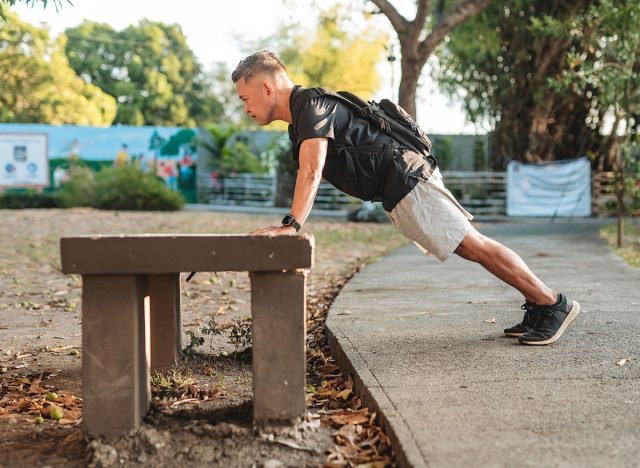
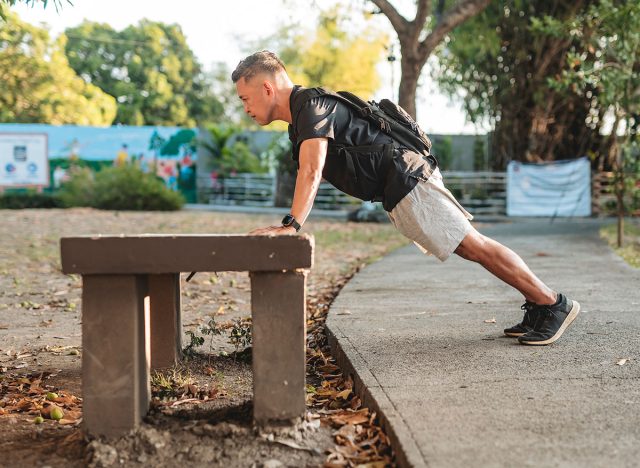
Incline Push-Up
Raise your hands, and the push-up becomes much easier to control. The incline lets you train your chest, shoulders, and triceps while keeping your body in a strong line. For clients who want upper-body strength but feel limited by floor push-ups, this is usually the version I start with. Start closer to the surface, then move your feet back as the reps feel stronger.
Muscles Trained: Chest, shoulders, triceps, abs.
How to Do It
- Place your hands on a sturdy counter, bench, couch, or chair.
- Step your feet back until your body forms a straight line.
- Brace your abs lightly.
- Bend your elbows and lower your chest toward the surface.
- Press through your hands to return to the top.
- Repeat with steady control.
Recommended Sets and Reps: Perform 2 to 3 sets of 6 to 12 reps.
Best Variations: Higher-hand incline push-up, slower incline push-up, close-grip incline push-up.
Form Tip: Keep your hips from sagging as you press.
RELATED: 5 Wall Exercises That Firm Sagging Arms Faster Than Gym Classes After 60
Supported Reverse Lunge
Balance often decides how much leg work someone can actually use. A chair, wall, or counter gives you enough support to focus on the working leg instead of fighting for stability. Step back into a comfortable range, keep the front foot planted, and press through the floor to stand tall. You should feel the front leg and glute doing the main work.
Muscles Trained: Glutes, quads, hamstrings, calves, core.
How to Do It
- Stand next to a sturdy chair, counter, or wall.
- Hold the support lightly with one hand.
- Set your feet under your hips.
- Step your right foot back.
- Bend both knees and lower into a comfortable lunge.
- Press through your front foot to stand, then complete your reps before switching sides.
Recommended Sets and Reps: Perform 2 to 3 sets of 6 to 10 reps per side.
Best Variations: Smaller-range reverse lunge, supported split squat, bodyweight reverse lunge.
Form Tip: Use the support for balance while your front leg does the work.
Standing Band Row
Pulling strength deserves daily attention because it helps your upper back support better posture. The standing band row trains your back, arms, and shoulder blades without needing a machine. Anchor the band in front of you, pull your elbows toward your ribs, and pause when your upper back tightens. Keep the rep clean enough that your shoulders stay relaxed.
Muscles Trained: Upper back, lats, rear delts, biceps.
How to Do It
- Anchor a resistance band at about chest height.
- Hold one end of the band in each hand.
- Step back until the band has light tension.
- Stand tall with your knees slightly bent.
- Pull your elbows back toward your ribs.
- Return your arms forward with control.
Recommended Sets and Reps: Perform 2 to 3 sets of 10 to 15 reps.
Best Variations: Lighter band row, paused band row, single-arm band row.
Form Tip: Pull with your elbows and squeeze your shoulder blades gently at the end of each rep.
RELATED: The 7-Day Step-Up Challenge That Restores Leg Power After 60
Mini-Band Glute Bridge
Add a mini-band to the bridge, and keep your hips more active throughout the rep. The band gives your outer hips feedback while your glutes lift your hips off the floor. This is a good way to train the muscles that help you stand, walk, and keep your knees from collapsing inward. Press out gently against the band, lift with control, and squeeze your glutes at the top.
Muscles Trained: Glutes, hamstrings, outer hips, core.
How to Do It
- Lie on your back with your knees bent.
- Place a mini-band above your knees.
- Set your feet flat on the floor about hip-width apart.
- Gently press your knees out against the band.
- Lift your hips until your glutes tighten.
- Lower your hips with control.
Recommended Sets and Reps: Perform 2 to 3 sets of 10 to 15 reps.
Best Variations: Bodyweight glute bridge, paused glute bridge, smaller-range band bridge.
Form Tip: Keep light tension on the band as your hips lift and lower.
Standing Marching
Marching looks simple, but it tells you a lot about hip strength and posture. Each knee lift asks one leg to move while the other side keeps you steady. That makes it useful for walking strength, stair control, and balance practice. Stay tall, lift each knee with control, and lower the foot softly before switching sides.
Muscles Trained: Hip flexors, quads, glutes, calves, abs.
How to Do It
- Stand tall with your feet under your hips.
- Hold a chair or counter lightly for support.
- Brace your abs gently.
- Lift your right knee toward waist height.
- Lower your foot with control.
- Switch sides and continue alternating.
Recommended Sets and Reps: Perform 2 to 3 sets of 30 to 45 seconds.
Best Variations: Supported march, lower-knee march, slower march.
Form Tip: Keep your torso tall and tight as you drive your knee up.
RELATED: 4 Simple Dumbbell Exercises That Rebuild Total-Body Muscle After 60
Incline Plank
Finish with a hold that teaches your body to stay strong from shoulders to hips. The incline plank keeps the position more approachable than the floor version while still training your abs, shoulders, and glutes. Place your hands on a raised surface, step back, and breathe through the hold. Move your feet closer if your lower back starts to take over.
Muscles Trained: Abs, shoulders, chest, glutes, upper back.
How to Do It
- Place your hands on a sturdy counter, bench, couch, or chair.
- Step your feet back until your body forms a straight line.
- Brace your abs lightly.
- Squeeze your glutes.
- Hold the position while breathing steadily.
- Step forward to exit the plank safely.
Recommended Sets and Reps: Perform 2 to 3 holds of 20 to 40 seconds.
Best Variations: Higher-hand incline plank, shorter plank hold, incline plank shoulder tap.
Form Tip: Squeeze your hips and belly tight as you brace your core.
RELATED: The 10-Minute Chair Routine That Trims Belly Overhang After 65, According to a Trainer
How to Restore Strength With Bodyweight and Band Exercises After 60
A strong daily strength plan should feel easy to start and strong enough to repeat. Use these exercises three to five days per week, or rotate them into short blocks throughout the day. Keep the first week controlled, then add reps, band tension, or longer holds once the movements feel steady.
- Start with clean reps: Smooth movement builds better strength than rushing through a set.
- Use support early: A chair, counter, or wall can help you train the right muscles with more confidence.
- Add band tension gradually: Choose a band that lets you finish each rep without changing your posture.
- Build your push-up angle over time: Start with your hands higher, then lower the surface as you get stronger.
- Keep marching tall: The knee lift should come from your hip, not from leaning back.
- Progress one piece at a time: Add reps, another set, or a tougher band once the current version feels solid.
References
- Keller, Karsten, and Martin Engelhardt. “Strength and muscle mass loss with aging process. Age and strength loss.” Muscles, ligaments and tendons journal vol. 3,4 346-50. 24 Feb. 2014
- Burtscher, Johannes et al. “How much resistance exercise is beneficial for healthy aging and longevity?.” Journal of sport and health science vol. 12,3 (2023): 284-286. doi:10.1016/j.jshs.2022.11.004
The post 6 Daily Exercises That Restore Strength Better Than Lifting Weights After 60 appeared first on Eat This Not That.


