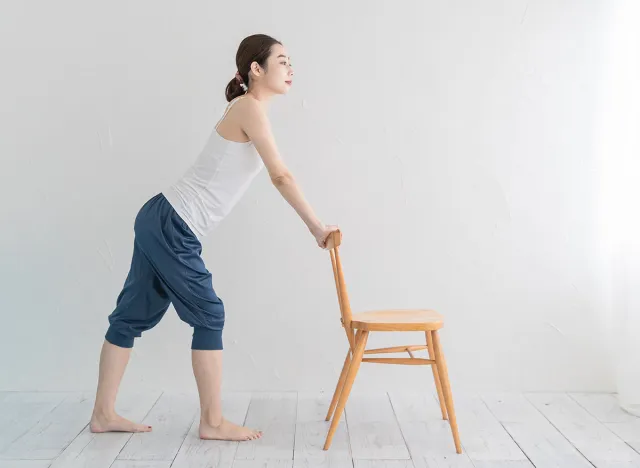
Give me ten minutes, a sturdy chair, and a mini-band, and I can make your legs work. The routine looks simple on paper, but five rounds of controlled lunges and lateral walks add up quickly when every rep has purpose.
Leg strength after 65 should help you move with more confidence during the day. Standing from a chair, stepping backward, walking across uneven ground, and keeping your balance all ask your legs and hips to work together. A standing routine makes that practice feel more natural because your feet stay on the floor and your body has to control each position.
When I coach older clients, I like pairing supported strength work with side-to-side hip work. The support helps the lunge feel steady, while the mini-band teaches the hips to stay active during each step. You get lower-body strength, hip control, and balance practice without turning the workout into a long session.
This article gives you the full 10-minute setup, the round structure, and the coaching cues that make these two exercises more effective. You’ll learn how to keep the reps controlled, use support effectively, and adjust the routine to match your current strength level.
The 10-Minute Standing Leg Strength Routine
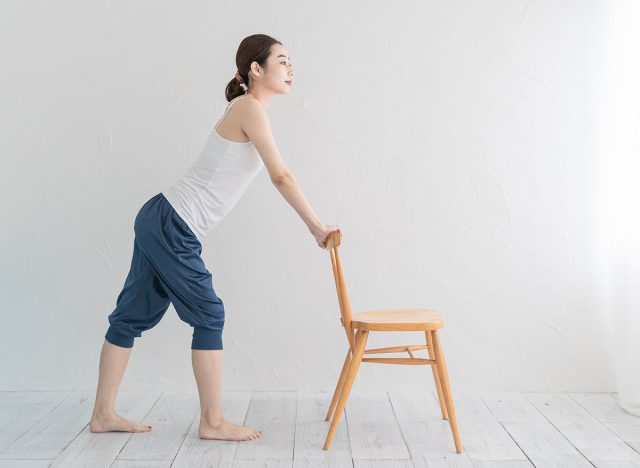
What you need: A sturdy chair, wall, or counter for support and one mini-band.
The Routine:
- Supported Reverse Lunge: 5 rounds of 5 reps per side.
- Mini-Band Lateral Walk: 5 rounds of 5 steps per side.
Directions:
Perform 5 sets of each movement, alternating between the two for a superset. You’ll perform 5 reverse lunges each side, then rest. Next, you’ll perform 5 mini-band lateral walks per side, then rest.
Move at a steady pace, resting 15 to 30 seconds between rounds as needed. The routine should take about 10 minutes when the reps stay controlled, and the transitions stay simple. Read on for the detailed instructions.
RELATED: 5 Exercises That Undo 10 Years of Sitting Faster Than Yoga After 55
Supported Reverse Lunge
Stepping backward is a skill worth keeping sharp. The supported reverse lunge trains one leg to lower, push, and stand tall while the chair or counter provides balance support. That makes the exercise useful for rebuilding leg strength without feeling rushed. Keep the step short at first, press through the front foot, and make the front leg do most of the work.
Muscles Trained: Quads, glutes, hamstrings, calves, core.
How to Do It
- Stand beside a sturdy chair, wall, or counter.
- Hold the support lightly with one hand.
- Set your feet under your hips.
- Step your right foot back.
- Bend both knees and lower into a comfortable lunge.
- Press through your front foot to stand, then complete 5 reps before switching sides.
Recommended Sets and Reps: Perform 5 rounds of 5 reps per side.
Best Variations: Smaller-range reverse lunge, supported split squat, bodyweight reverse lunge.
Form Tip: Keep your front foot planted as you lower and stand.
RELATED: 4 Daily Exercises That Flatten Apron Belly Faster Than Sit-Ups After 65
Mini-Band Lateral Walk
The outside of the hips can make a big difference in how steady your legs feel. Mini-band lateral walks train those muscles with small, controlled steps. You should feel the glutes working along the sides of your hips as you step, especially if you keep light tension on the band the whole time. This pairs well with lunges because it strengthens the hip support that helps your knees track well during lower-body movement.
Muscles Trained: Glutes, outer hips, quads, hamstrings, core.
How to Do It
- Place a mini-band above your knees or around your ankles.
- Stand tall with your feet about hip-width apart.
- Bend your knees slightly.
- Gently press your knees out against the band.
- Step to the right for 5 controlled steps.
- Step to the left for 5 controlled steps.
Recommended Sets and Reps: Perform 5 rounds of 5 steps per side.
Best Variations: Band-above-knees lateral walk, smaller lateral steps, supported lateral walk.
Form Tip: Keep tension on the band as you step side to side.
RELATED: If You Can Hold a Single-Leg Stand This Long After 60, Your Balance Is Stronger Than 90% of Peers
How to Get More From This 10-Minute Leg Routine

A two-exercise routine works when the reps stay clean. Use this workout three to five days per week, especially on days when you want focused leg work without a full gym session. Start with a shorter lunge and a lighter band, then add range or band tension once the movement feels steady.
- Use the support lightly: Hold the chair or counter enough to stay balanced while your legs do the work.
- Keep the lunge short at first: A shorter step helps you control the lower and stand back up smoothly.
- Make the front leg work: During reverse lunges, press through the front foot instead of pushing off the back leg.
- Take small band steps: Smaller steps keep tension on the outer hips and prevent the band from pulling you out of position.
- Stand tall between reps: Reset your posture before the next lunge or lateral step.
- Increase difficulty slowly: Add lunge depth, a stronger band, or shorter rest once all 5 rounds feel strong.
References
- Frith, Emily, and Paul D Loprinzi. “The Association between Lower Extremity Muscular Strength and Cognitive Function in a National Sample of Older Adults.” Journal of lifestyle medicine vol. 8,2 (2018): 99-104. doi:10.15280/jlm.2018.8.2.99
- Steves, Claire J et al. “Kicking Back Cognitive Ageing: Leg Power Predicts Cognitive Ageing after Ten Years in Older Female Twins.” Gerontology vol. 62,2 (2016): 138-49. doi:10.1159/000441029
The post The 10-Minute Standing Routine That Rebuilds Leg Strength After 65 appeared first on Eat This Not That.


