
Leg strength directly affects how capable you feel during the day. After 65, stronger thighs and hips make it easier to climb stairs, get up from a low seat, and stay steady when you change direction. Losing some of that strength can make normal tasks feel more tiring long before you’d ever think of yourself as “weak.”
That’s why I like simple lower-body work that gives the muscles more to do than regular walking. A staircase already gives you a built-in way to raise the difficulty because every step asks one leg to lift or lower your body against gravity. You can also use the railing when needed, which lets you train the legs hard enough without balance getting in the way.
Ten minutes is plenty of time to get meaningful strength work in if the exercise choices are solid. When I coach older adults, I’d rather see a few focused sets with good control than a longer session filled with rushed reps. The goal here is to give the legs enough resistance to adapt while keeping the routine simple enough to repeat consistently.
You only need three exercises for this one. Move from one to the next with short breaks, and the full routine should take about 10 minutes. If you need a little more rest at first, take it and let the workout run slightly longer.
The 10-Minute Stair Workout

Complete the exercises in order. Rest about 30 seconds between sets and another 30 seconds as you move to the next exercise.
- Stair Step-Ups: 2 sets of 8 to 10 reps per side
- Lateral Step-Downs: 2 sets of 6 to 8 reps per side
- Supported Calf Raises: 2 to 3 sets of 10 to 15 reps
Keep the reps controlled and use the railing whenever it helps. As the routine gets easier, progress the exercise itself before adding a lot more volume.
RELATED: 4 Daily Exercises That Keep Your Muscles 10 Years Younger After 65
Stair Step-Up
Step-ups put more workload on one leg at a time, making them a strong choice for rebuilding lower-body strength. Your quads and glutes must produce enough force to lift your body onto the step. Use the railing lightly if it helps you keep the effort in the working leg.
Muscles Trained: Quads, glutes, hamstrings, calves.
How to Do It
- Stand facing a low stair.
- Place your right foot fully on the step.
- Press through that foot.
- Step up until you’re standing tall.
- Lower yourself with control.
- Finish your reps, then switch legs.
Recommended Sets and Reps: Perform 2 sets of 8 to 10 reps per side. Rest for 30 seconds between sets.
Best Variations: Supported step-up, lower step-up, dumbbell step-up.
Form Tip: Let the leg on the stair lift you instead of pushing hard off the floor.
Lateral Step-Down
The lowering phase is where this exercise earns its place. Your standing leg controls your body as the knee bends, putting a lot of work through the thigh without added weight. Keep the range short enough that every rep stays smooth.
Muscles Trained: Quads, glutes, calves.
How to Do It
- Stand sideways on a low stair.
- Keep your inside foot fully planted.
- Let your outside leg hang off the edge.
- Bend the knee of your standing leg.
- Lower your free heel toward the floor.
- Press through the standing foot to return.
Recommended Sets and Reps: Perform 2 sets of 6 to 8 reps per side. Rest for 30 to 45 seconds between sets.
Best Variations: Short-range step-down, supported step-down, slower step-down.
Form Tip: Lower only as far as you can control without the working knee collapsing inward.
RELATED: 4 Wall Exercises That Flatten Lower Belly Faster Than Crunches After 65
Supported Calf Raise
The calves still need direct strength work, especially if most of your lower-body training focuses on the thighs. A stair gives you extra range, letting your heel drop below the step before you rise onto the ball of your foot. Holding the railing keeps you balanced and prevents the set from cutting short.
Muscles Trained: Calves, ankles.
How to Do It
- Stand with the balls of your feet on the edge of a stair.
- Hold the railing lightly.
- Lower your heels slightly below the step.
- Press through the balls of your feet.
- Rise as high as you comfortably can.
- Lower slowly and repeat.
Recommended Sets and Reps: Perform 2 to 3 sets of 10 to 15 reps. Rest for 30 seconds between sets.
Best Variations: Floor calf raise, paused calf raise, supported single-leg calf raise.
Form Tip: Pause at the top instead of bouncing through the reps.
RELATED: Not Walking or Yoga: The 5 Exercises Trainers Say Matter Most for Balance After 70
Keep the Routine Getting Harder
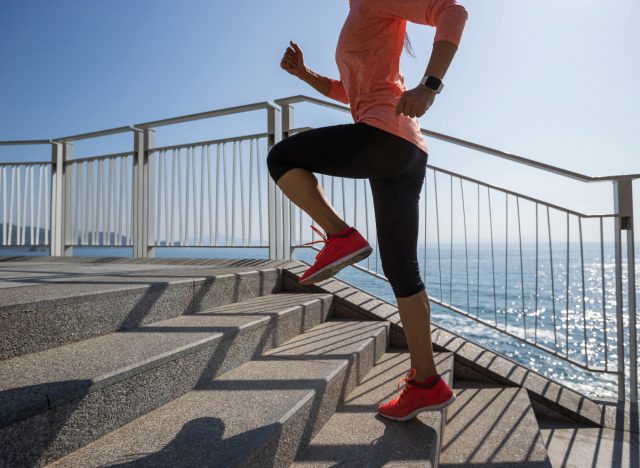
Once the workout feels comfortable, make the exercises a little more demanding instead of just adding more reps.
- Increase the step height: A slightly taller step gives the thighs and glutes more range to work through. Make the change gradually so you can still control both the way up and the way down.
- Add resistance: Hold a light dumbbell for step-ups once bodyweight reps stop feeling challenging. A small load increase can make a big difference.
- Slow the lowering phase: Taking two or three seconds to lower during step-downs gives the quads more time under tension without adding weight.
- Use less support when you’re ready: Keep the railing as long as you need it. As your balance improves, use a lighter touch so your legs do more of the work.
- Repeat the routine consistently: Two to three sessions per week gives the legs regular strength work while still leaving enough time to recover.
References
- Frith, Emily, and Paul D. Loprinzi. “The Association between Lower Extremity Muscular Strength and Cognitive Function in a National Sample of Older Adults.” Journal of Lifestyle Medicine vol. 8,2 (2018): 99-104. doi:10.15280/jlm.2018.8.2.99
- Reid, K. F et al. “Lower extremity muscle mass predicts functional performance in mobility-limited elders.” The Journal of Nutrition, Health & Aging vol. 12,7 (2008): 493-8. doi:10.1007/BF02982711
The post The 10-Minute Stair Routine That Rebuilds Leg Strength After 65 appeared first on Eat This Not That.


