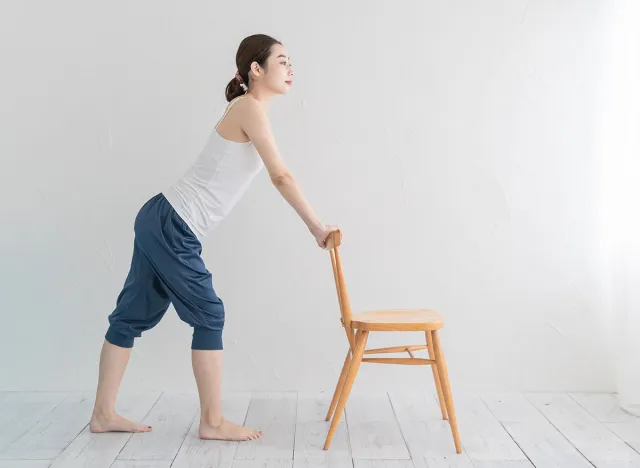
Everyone has a chair sitting around, right? So, why not use it for a workout? A chair routine can surprise people with how easy and effective a simple household item can be for boosting your fitness. I’ve coached plenty of clients who expected chair exercises to feel light, then felt their hips working within the first few sets. When the movement is focused, a sturdy chair becomes a useful tool for rebuilding strength at home.
Traditional squats build a strong base, but hip strength often benefits from more targeted programming. The outer hips, glutes, and hip flexors all help you walk, climb steps, and stay steady when your body shifts position. Training those muscles from seated and supported positions can make the work feel clear from the first rep.
This routine keeps the setup simple and the effort focused. You’ll use the chair for support, balance, and a consistent starting point while your hips do the work. The goal is smooth movement, strong reps, and a workout that feels easy to come back to during the week.
Below, you’ll find the full 10-minute chair routine, the timing, and the four exercises that make it effective. Each move targets a different part of hip strength, so the session feels complete without needing a gym machine.
The 10-Minute Chair Hip Strength Routine
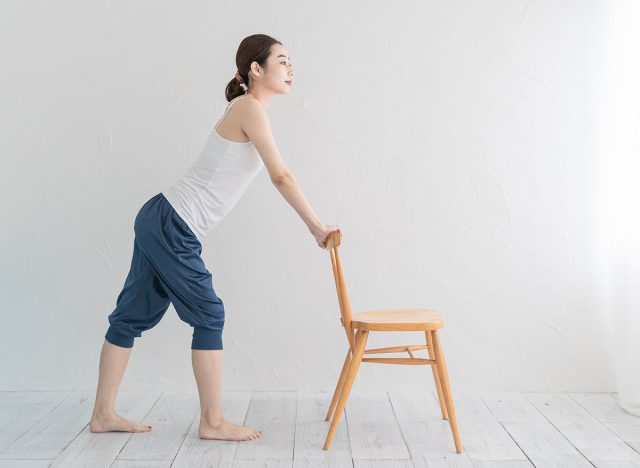
What you need: A sturdy chair that doesn’t roll or slide. A mini-band helps for the first exercise, but you can do the routine without one if needed.
The Routine:
- Seated Band Abduction: 2 rounds of 45 seconds
- Chair Box Squat: 2 rounds of 45 seconds
- Chair-Supported Hip Extension: 2 rounds of 45 seconds
- Seated March: 2 rounds of 45 seconds
Directions
Set a timer for 10 minutes. Perform each exercise for 45 seconds, then use about 15 seconds to switch positions and reset. Move through all four exercises, then repeat the same sequence one more time.
The work adds up to about eight minutes. Use the extra time to set up the band, switch sides, take a quick breath, or make sure the chair feels secure before the next exercise. Read on for the detailed instructions.
RELATED: 5 Home Exercises That Firm Belly Overhang Faster Than Gym Sessions After 65
Seated Band Abduction
Your abductors, aka the outer hip muscles, play a big role in how steady your legs function when you walk, stand, or shift weight. Seated band abductions allow you to train these muscles right away from a comfortable position. Pressing into the band gives your hips clear feedback, so it’s easy to feel the right muscles working. Keep the reps smooth, and pause briefly when the band is under tension.
Muscles Trained: Outer hips, glutes, hip stabilizers, core.
How to do it:
- Sit tall near the front edge of a sturdy chair.
- Place a mini-band above your knees.
- Set your feet flat on the floor about hip-width apart.
- Brace your core lightly.
- Press your knees apart against the band.
- Bring your knees back in with control.
Best Variations: Lighter band abduction, band-above-knees abduction, paused band abduction.
Form Tip: Keep your feet planted as your knees press outward.
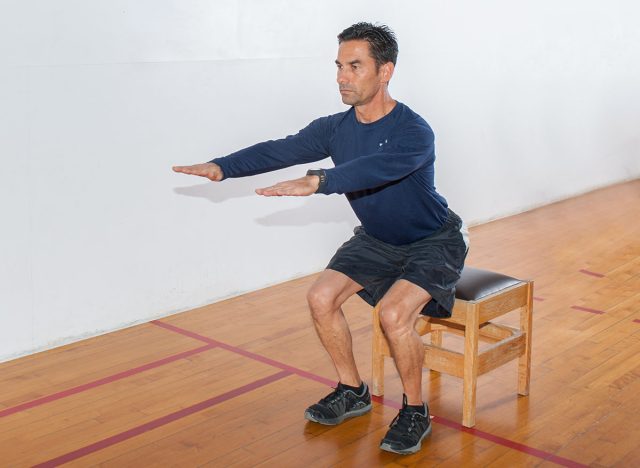
Chair Box Squat
Your glutes and thighs do most of the heavy lifting when you sit down, stand up, or climb steps. Chair box squats, a more welcoming variation than normal squats, let you train specific strength with a clear target underneath you. The chair helps you find the same depth each rep, so it’s easier to stay controlled and feel your hips working. Keep the touch light, then stand tall and squeeze your glutes at the top.
Muscles Trained: Glutes, quads, hamstrings, core.
How to do it:
- Stand in front of a sturdy chair.
- Set your feet about shoulder-width apart.
- Reach your hips back toward the chair.
- Bend your knees and lower with control.
- Lightly touch the seat.
- Press through your feet to stand tall.
Best Variations: Taller chair squat, hands-assisted chair squat, slow-tempo chair squat.
Form Tip: Lightly touch the chair, then stand back up with control.
RELATED: If You Can’t Do These 3 Exercises After 60, Your Strength May Be Declining Faster Than You Think
Chair-Supported Hip Extension
This is where your glutes really come into play, giving them more direct attention. Hold the chair, extend one leg behind you, and squeeze the glute at the top without turning the move into a big kick. A smaller lift often works better because it keeps the movement in the hip. Stay tall and let the chair help you keep your balance.
Muscles Trained: Glutes, hamstrings, core.
How to do it:
- Stand behind a sturdy chair.
- Hold the back of the chair lightly.
- Shift your weight onto one leg.
- Extend the opposite leg behind you.
- Squeeze your glute briefly.
- Lower the leg with control and switch sides halfway through the interval.
Best Variations: Smaller-range hip extension, alternating hip extension, banded hip extension.
Form Tip: Lift the leg only as far as you can without arching your lower back.
Seated March
Seated marching gives your hip flexors focused work from a steady position. Those muscles help lift your knees when you walk, climb stairs, or step over something in your path, so they deserve direct attention. The chair lets you sit tall, control each lift, and feel the front of the hip working without rushing. Keep the pace even on both sides, and pause briefly at the top so each rep feels intentional.
Muscles Trained: Hip flexors, abs, quads, core.
How to do it:
- Sit tall near the front edge of the chair.
- Place your feet flat on the floor.
- Hold the sides of the chair lightly.
- Lift one knee toward your chest.
- Lower your foot with control.
- Switch sides and continue alternating.
Best Variations: Smaller-range seated march, paused seated march, banded seated march.
Form Tip: Stay tall as your knee lifts.
RELATED: 5 One-Dumbbell Exercises That Rebuild Total-Body Muscle Faster Than Gym Machines After 60
How to Keep Building Hip Strength After 65
A strong chair routine works best when it feels easy to start and worth repeating. Use this workout three to five days per week, especially on days when you want a short session that still feels focused. Start with controlled reps, then add a third round or a little more band tension once the movements feel smooth. Your hips should feel like they’re doing the work without your lower back taking over.
- Use a sturdy chair: A stable chair keeps the setup secure and helps you focus on the working muscles.
- Start with light band tension: A lighter band usually helps you feel the outer hips without changing your posture.
- Pause during the hard part: A brief pause during abductions, squats, and hip extensions helps each rep feel more effective.
- Train both sides with care: Move slowly enough to keep the less steady side clean and controlled.
- Walk most days: Walking gives your hips regular practice supporting each step outside the workout.
- Add challenge gradually: Increase reps, band tension, or total rounds once the current version feels strong.
References
- Klempel, Natalie et al. “The Effect of Chair-Based Exercise on Physical Function in Older Adults: A Systematic Review and Meta-Analysis.” International journal of environmental research and public health vol. 18,4 1902. 16 Feb. 2021, doi:10.3390/ijerph18041902
- Lanza, Marcel B et al. “Systematic Review of the Importance of Hip Muscle Strength, Activation, and Structure in Balance and Mobility Tasks.” Archives of physical medicine and rehabilitation vol. 103,8 (2022): 1651-1662. doi:10.1016/j.apmr.2021.12.008
The post The 10-Minute Chair Routine That Restores Hip Strength Faster Than Squats After 65 appeared first on Eat This Not That.


