Leg strength fades without most people noticing, until the stairs or a low chair give it away. I’ve been in the fitness industry for 40 years, nearly all of them as a personal trainer, and I co-founded TRAINFITNESS, the UK’s best fitness education company. Leg strength is the first thing I’d check in anyone over 60. A wall and a timer are all you need to find out where yours is.
Why Leg Strength Slips After 60
Muscle declines with age when it isn’t used, and that decline tends to speed up after 60. The quadriceps, the muscles at the front of the thighs, and your glutes are the ones that lose strength and endurance fastest. That’s especially true in people who sit a lot, because long stretches of sitting ask very little of them.
Those are the muscles you rely on for stairs, getting up from a chair or the toilet, pushing yourself out of the car, carrying groceries uphill, and catching yourself if you trip. When they’re strong, none of that takes much thought. When they’re weak, every one of those jobs becomes an effort.
RELATED: 5 Exercises a Trainer Gives Every Client Over 65 Who Sits All Day
Why Testing Matters Now

The loss happens so gradually that people rarely notice until a particular job gets hard. Plenty of clients tell me the first sign was the stairs, or a low couch, or getting out of the car. By the time something feels difficult, the decline has usually been going on for years.
A test gives you a starting point, and then a way to check whether what you’re doing is actually working.
Stay Safe Before You Start

A word on safety before you try it:
- Breathe steadily throughout and never hold your breath. Straining with the breath held pushes blood pressure up sharply.
- If your blood pressure isn’t under control, you have a heart condition, or a knee is painful or recently operated on, check with your doctor first or skip the test.
- Stop right away if you feel knee pain rather than muscle burn, chest pain, or dizziness.
- Stand up slowly when you finish.
RELATED: 5 Exercises That Give You Back the Legs You Had at 50 After 70
The Wall Sit Test
It measures endurance in the quadriceps, the large muscles at the front of the thighs, with your glutes helping them hold the position. The question it answers is simple: how long can your legs support your body weight in a bent-knee position before they tire?
That’s the same endurance you call on for stairs, standing up from a chair, getting out of the car, walking uphill, and catching yourself when you trip. The number tells you how much of it you have right now.
How to Do It:
- Find a clear, flat wall with a non-slip floor in front of it, and wear sneakers.
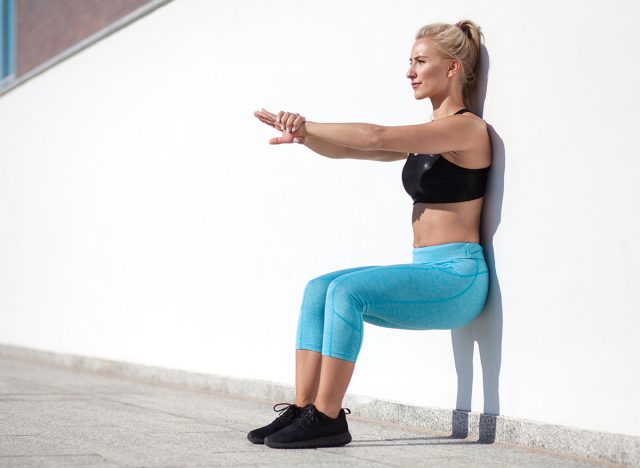
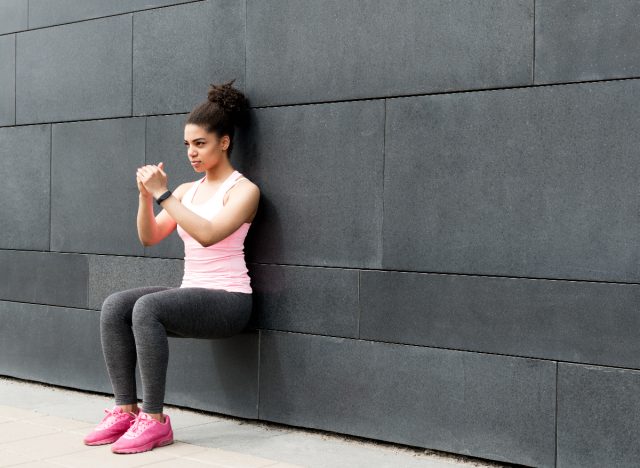
- Stand with your back flat against the wall, feet hip-width apart and about two feet in front of you.
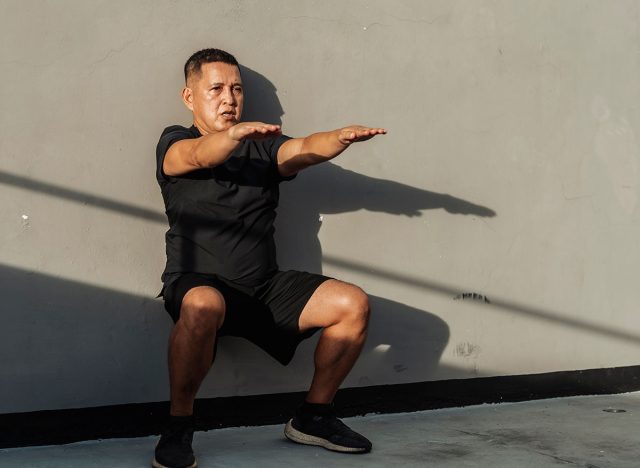
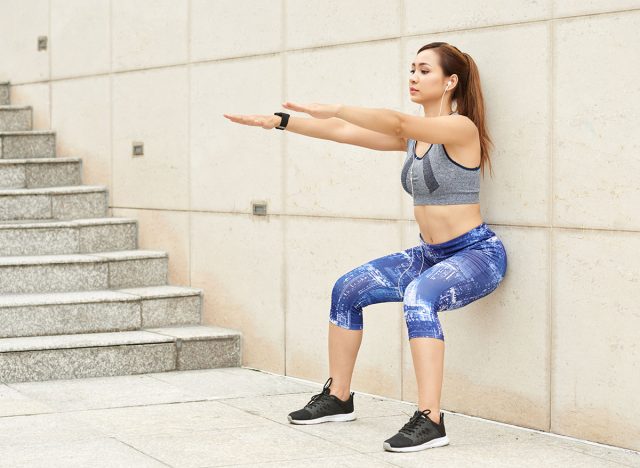
- Slide down the wall until your thighs are parallel to the floor and your knees are at roughly 90 degrees, with your knees sitting directly over your ankles.
- Keep your arms relaxed by your sides or crossed over your chest. Don’t rest your hands on your thighs.
- Start a timer, or ask someone to time you, once you’re settled in position.
- Breathe steadily, counting out loud if that helps.
- Stop the clock when you can’t hold the position any longer, or when your thighs rise noticeably.
- Slide back up the wall, or put your hands on your thighs and walk your feet back in, then stand up slowly.
- Do it once. Don’t repeat it right away.
Avoid These Mistakes:
- Don’t slide up the wall as your legs tire. This is the mistake that catches nearly everybody. As soon as your thighs rise above parallel, the angle is shallower and the hold becomes much easier, so anything after that point doesn’t count. Your valid time ends the moment your thighs first start to drift upward.
- Don’t push your hands on your thighs. It takes weight off the legs.
- Don’t let your feet slide closer to the wall. It shifts your knees in front of your toes and changes the position you’re testing.
Form Tip: Have a friend watch from the side, or place a mirror nearby. It makes all of these mistakes easy to spot.
Your Target Hold Time
- 60 to 64: a good result is 45 seconds.
- 65 to 69: a good result is 35 seconds.
- 70 to 74: a good result is 30 seconds.
- 75 and older: a good result is 20 seconds.
There aren’t official age norms for this test, so these are the benchmarks I use with my own clients. Treat them as a guide. Your training history, your body weight and the state of your knees all shift the picture, so read your time against your own situation as well as your age group.
RELATED: 4 Wall Exercises That Shrink Belly Pooch Faster Than Gym Sessions After 65
What Your Time Means
If you’re below the good time for your age, your legs have lost some endurance. I see that a lot in people who’ve spent years sitting more than they used to. It improves quickly with regular practice, so it’s well worth working on.
If you’re at or above the good time, your legs have the endurance that everyday life asks for. Stairs, standing up from chairs and a decent walk all stay comfortable at that level.
Times That Beat Most Peers
There’s a second set of numbers above those, the ones that put you ahead of most people your age. In my experience, very few people in these age groups can hold the following:
- 60 to 64: 90 seconds or more
- 65 to 69: 75 seconds or more
- 70 to 74: 60 seconds or more
- 75 and older: 45 seconds or more
Legs that can hold your body weight for that long handle stairs, hills and long walks without difficulty.
Whatever your number, watch for anything uneven. If one leg starts shaking well before the other, that often points to a strength difference between the legs. And if your knees ache rather than your thighs burning, get the knees checked by your doctor or a physical therapist before you push the test any harder.
RELATED: I’ve Trained Women Into Their 90s for 20 Years. These 5 Exercises Keep Them Strong
How to Improve
Retest every four weeks, on the same wall and at the same time of day, and avoid doing it right after a walk or a workout. Keeping the conditions the same means you’re comparing apples to apples.
Wall Sit Practice
If you fall short, the first thing I’d do is use the wall sit itself as practice, at a depth you can manage without knee pain. Over a few weeks, this takes you toward the full 90-degree position.
How to Do It:
- Set up against the wall as you would for the test, but only sit as low as you can without knee pain.
- Hold, then slide back up and rest.
- Each week, sit a little lower and hold a little longer.
Avoid These Mistakes:
- Don’t compare a shallow hold with the benchmarks. If knee pain means 90 degrees is out of reach, keep the practice shallow. It still strengthens the legs, but the test is done at 90 degrees.
Sets and Reps: Three or four holds of 15 to 30 seconds, two or three times a week.
RELATED: 5 Bed Exercises That Restore Leg Muscle Faster Than Weight Training After 65
Slow Sit-to-Stands
Alongside the holds, add slow sit-to-stands from a firm chair. They build the strength the hold relies on, and it’s the same movement you use every time you get up from a chair.
How to Do It:
- Sit on a firm chair.
- Stand up, taking about three seconds on the way up.
- Sit back down, taking about three seconds on the way down.
Avoid These Mistakes:
- Don’t use your hands.
- Don’t rush. Keep the three-second pace both ways.
Sets and Reps: Two sets of 10, three times a week.
What to Expect

Give it four weeks, then retest on the same wall at the same time of day. Endurance in these muscles comes back quickly with regular work, so you’ll usually see your hold time move by the four-week mark.
The post If You Can Hold a Wall Sit This Long After 60, Your Leg Strength Is Stronger Than 90% of Peers appeared first on Eat This Not That.


