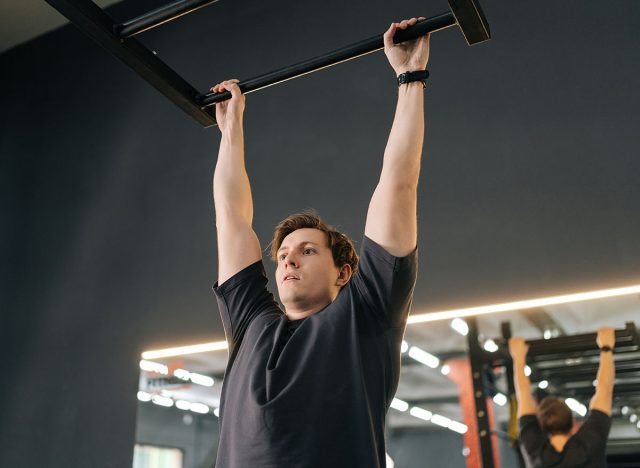
Dead hangs are an excellent addition to your workout routine for building upper-body strength. The reason they’re so popular? They’re pretty simple to do—and highly productive. All you need is a secure pull-up bar to hang onto; it should be high enough so your arms are fully extended and your feet are off the ground.
This movement allows gravity to decompress the spine and stretch the shoulders. Your forearms, hands, back muscles, and shoulders all work together to support your body weight. Needless to say, the dead hang is an excellent way to test how strong your upper body is. In fact, to maximize the benefits of this exercise, we spoke with Gwenn Jones, CPT, a level-4 ACE-certified Personal Trainer of 25 years and the Owner of Auburn Yoga & Fitness who specializes in strength, mobility, and functional training, along with senior and women’s fitness. If you can hold a dead hang this long after the age of 60, know that your upper-body strength is top-tier, Jones says.
Why Dead Hangs Are Effective for Building Upper-Body Strength
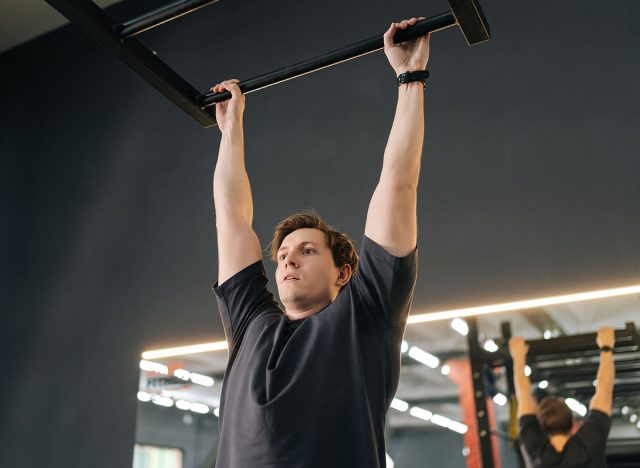
“The dead hang requires multiple muscle groups working in unison. These muscles hold our body weight, which takes power and control,” Jones explains. “Time and consistency bring us to a ferocious upper-body musculature. It’s an accomplishment to take pride in for senior men and women.”
Jones dubs the dead hang a “sleeper exercise” for those 60+. While it’s common to feel intimidated by this bodyweight move, there’s a smart way to ace it and progress.
RELATED: 5 Daily Bodyweight Exercises That Keep You Young After 40
If You Can Hold a Dead Hang This Long After 60, Your Upper-Body Strength Is Top-Tier
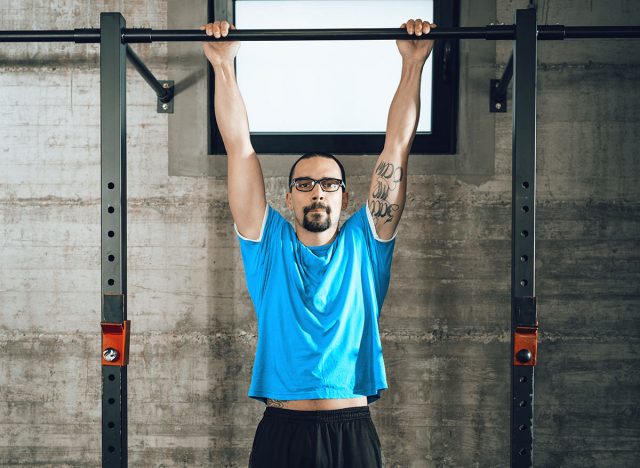
Beginners may tire from holding onto the bar for 10 seconds. But with solid practice, Jones says an impressive dead hang time would be 30 seconds.
“No matter the hold time, the catch here is to do your time, then repeat the hang three times. Whether three times in a day, or three times in succession—it’s all good,” Jones points out.
RELATED: 6 Standing Exercises That Build More Strength Than Traditional Dumbbell Exercises After 40
Form Tips
To practice proper form, use an overhand grip, placing your hands just outside shoulder-width. Keep your chest open and your shoulders down. Your hips should line up under your shoulders and your legs under your hips. Engage your glutes throughout.
“In an unsupported hang, our core muscles must engage to hold us in place and prevent anterior pelvic tilt. The stronger our core, the less our legs swing. The goal in the hang is stillness, the dead part,” Jones stresses.
Now, if you’re a beginner, Jones recommends performing dead hangs with your feet supported. For instance, begin with your feet supported on a sturdy workout bench or chair. You can even hold onto an exercise barre with your arms extended, feet resting on the floor, and hips floating as you get used to it.
RELATED: Over 50? If You Can Do This Many Knee Pushups, Your Upper Body Is Stronger Than Most
How Grip Strength Impacts Dead Hang Performance
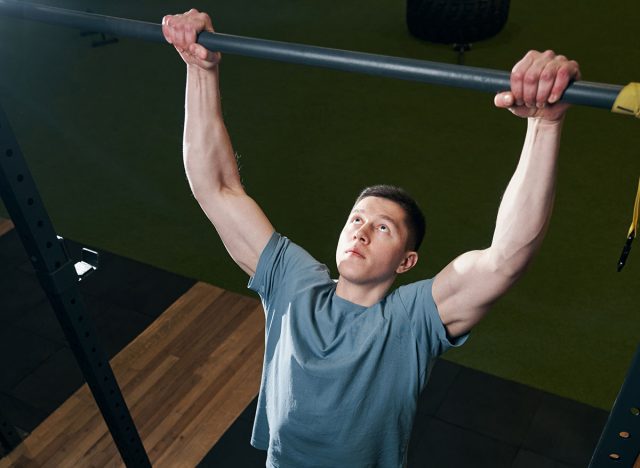
According to Jones, dead hangs directly correlate to grip strength in order to sustain your body weight during the exercise. The stronger your grip is, the longer you’ll be able to hold your dead hang.
“The longer we hold, the more endurance we develop,” Jones says. “In addition, multiple longevity studies involving over 150,000 participants have associated poor grip strength with cognitive decline. The dead hang is a multi-functional power move. When mastered, you’re a rockstar!”
The post If You Can Hold a Dead Hang This Long After 60, Your Upper-Body Strength Is Top-Tier appeared first on Eat This Not That.


