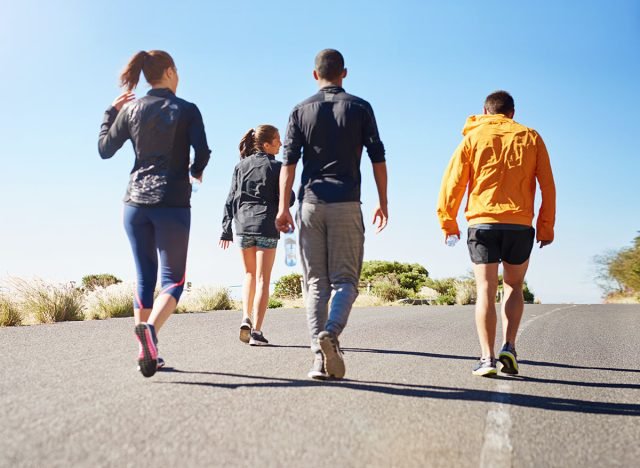
Walking is still one of the most useful things you can do for your health after 70, but piling on more walking doesn’t always fix a stride that has started to feel weaker. If getting up from a chair takes more effort or your legs fade sooner on longer walks, you may need to focus on strength.
A treadmill gives you a predictable place to keep moving and build endurance. Your legs still need enough strength to support each step once you’re away from the machine, especially when the ground changes or you have to climb a curb. Building that strength can help you walk with more confidence and stay active for longer.
I look at this often with older clients. When walking starts feeling harder, I want to know whether your hips can extend well, your calves can still push off strongly, and each leg can support your body on its own. Those are trainable qualities, and you don’t need complicated equipment to work on them.
The five exercises here cover the strength behind your stride from the ground up. They’re simple enough to practice regularly, and each one addresses a different part of walking that can fade with age.
Bodyweight Box Squat
Getting out of a chair is already a small test of walking strength. Your thighs and glutes must produce enough force to bring you upright before you take the first step. Box squats train that exact strength with a clear target behind you, which makes them easy to practice and progress over time.
Muscles Trained: Quads, glutes, hamstrings, core.
How to Do It
- Stand in front of a sturdy chair or box.
- Set your feet about shoulder-width apart.
- Reach your arms forward for balance.
- Bend your knees and sit your hips back.
- Lower until your thighs reach about parallel and lightly touch the box.
- Press through your feet to stand tall.
Recommended Sets and Reps: Perform 2 to 3 sets of 8 to 12 reps. Rest for 45 to 60 seconds.
Best Variations: Higher box squat, slower box squat, supported box squat.
Form Tip: Lightly touch the box before standing again.
RELATED: 4 Morning Exercises That Flatten Tummy Roll Faster Than Crunches After 60
Supported Reverse Lunge
Walking asks one leg at a time to accept your weight and keep you moving forward. Reverse lunges strengthen that single-leg support, while a chair or counter gives you as much balance help as you need. Keep the step short at first and work through a range where the front leg feels strong.
Muscles Trained: Quads, glutes, hamstrings, calves, core.
How to Do It
- Stand beside a sturdy chair or counter.
- Hold the support lightly with one hand.
- Step your right foot backward.
- Bend both knees and lower into a comfortable lunge.
- Press through your left foot to return to standing.
- Complete your reps, then switch sides.
Recommended Sets and Reps: Perform 2 to 3 sets of 6 to 10 reps per side. Rest for 45 to 60 seconds.
Best Variations: Smaller-range reverse lunge, supported split squat, alternating reverse lunge.
Form Tip: Let your front leg bring you back to standing.
Bodyweight Glute Bridge
A stronger stride needs help from the hips. Your glutes extend the hip as you push the ground behind you, and bridges give you a simple way to train that action without loading the knees heavily. This one fits especially well when your hips feel weak after a lot of sitting.
Muscles Trained: Glutes, hamstrings, abs.
How to Do It
- Lie on your back with your knees bent.
- Place your feet flat on the floor about hip-width apart.
- Brace your abs lightly.
- Press through your heels and lift your hips.
- Stop when your hips are level, and your body forms a straight line from shoulders to knees.
- Lower with control and repeat.
Recommended Sets and Reps: Perform 2 to 3 sets of 10 to 15 reps. Rest for 30 to 45 seconds.
Best Variations: Shorter-range bridge, bridge hold, mini-band glute bridge.
Form Tip: Finish each rep with your hips level.
RELATED: 9 Everyday Foods Doctors Say Can Quietly Fuel Inflammation
Incline Plank Hold
Your legs can be strong, and walking can still feel sloppy if your trunk moves all over the place. An incline plank builds the bracing strength that helps keep your torso steady while your arms and legs move. Use a counter, sturdy table, or wall so you can choose an angle that matches your current strength.
Muscles Trained: Abs, shoulders, chest, glutes.
How to Do It
- Place your hands on a sturdy elevated surface.
- Step your feet backward.
- Form a straight line from your head through your heels.
- Brace your abs.
- Keep your spine neutral.
- Hold while breathing normally.
Recommended Sets and Reps: Perform 2 to 3 holds of 20 to 40 seconds. Rest for 30 to 45 seconds.
Best Variations: Higher incline plank, forearm incline plank, wall plank.
Form Tip: Keep your spine neutral for the full hold.
Bodyweight Calf Raise
The last part of each step comes from your calves. They help push you forward as your heel leaves the ground, and weaker calves can make your stride feel flatter or shorter. Calf raises directly target that push-off strength with almost no setup.
Muscles Trained: Calves, ankles, feet.
How to Do It
- Stand with your feet about hip-width apart.
- Hold a chair or counter lightly if needed.
- Press through the balls of your feet.
- Lift your heels as high as comfortable.
- Pause briefly at the top.
- Lower your heels with control.
Recommended Sets and Reps: Perform 2 to 3 sets of 10 to 15 reps. Rest for 30 to 45 seconds.
Best Variations: Supported calf raise, slower calf raise, single-leg supported calf raise.
Form Tip: Rise straight up through the balls of your feet.
RELATED: The 6-Minute Standing Routine That Reverses Knee Stiffness After 60
How to Build Walking Strength Into Your Week After 70
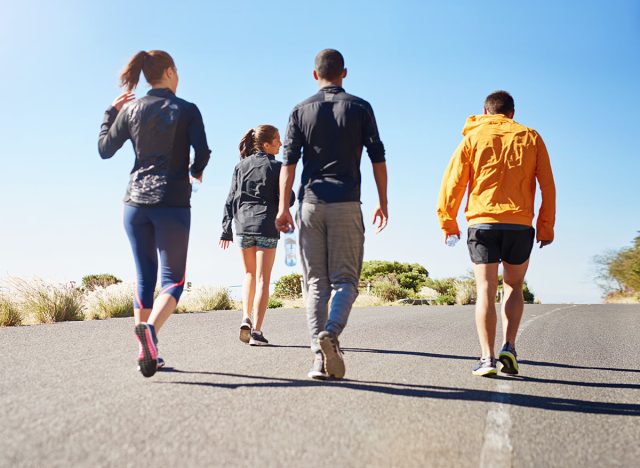
You can practice these exercises often, but every day doesn’t need to be a hard strength workout. Use the full routine two to four times per week, then sprinkle in easier sets or short walks on the days between.
- Keep your regular walks: Strength work should support the walking you already enjoy, so keep comfortable walks in the week.
- Use short practice sessions: One set of squats, bridges, or calf raises can fit into a few minutes when you don’t have time for the full routine.
- Give harder days some space: Leave a recovery day between tougher lower-body sessions when your legs feel tired.
- Add reps before resistance: Build toward the top of the rep range before adding weight or choosing a harder variation.
- Let walking tell you what’s improving: Notice whether curbs feel easier, your stride stays stronger later in a walk, or you need fewer breaks.
- Use support without hesitation: A chair or counter can help you train confidently while your strength catches up.
- Keep the plan consistent for several weeks: Walking strength usually changes through repeated practice, so judge progress over time rather than after one or two sessions.
References
- Ungvari, Zoltan et al. “The multifaceted benefits of walking for healthy aging: from Blue Zones to molecular mechanisms.” GeroScience vol. 45,6 (2023): 3211-3239. doi:10.1007/s11357-023-00873-8
- Lee, Sangyeob et al. “Daily Walking Accompanied with Intermittent Resistance Exercise Prevents Osteosarcopenia: A Large Cohort Study.” Journal of Bone Metabolism vol. 29,4 (2022): 255-263. doi:10.11005/jbm.2022.29.4.255
The post 5 Daily Exercises That Restore Walking Strength Faster Than Treadmills After 70 appeared first on Eat This Not That.


