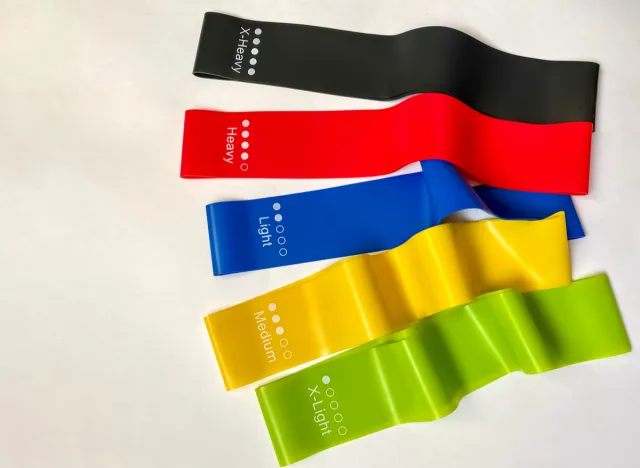
Give someone a good resistance band, and they can complete a strength workout without walking through a gym door. Bands are light, portable, and easy to adjust, which makes them a great fit when you want training to feel simple from the start.
I use bands with clients over 60 because they let us build strength without complicating the setup. You can squat with more hip engagement, row for a stronger back, hinge for the glutes and hamstrings, and train the core with steady tension. The resistance also changes through the rep, so you have to stay in control from start to finish.
Gym machines can help when you want a fixed path and a clear seat position. Bands give you more freedom to train the patterns your body uses during the day. You stand, brace, pull, press, hinge, and move with your own posture in charge.
I’ve set these exercises up to mimic an excellent at-home, resistance band workout. You’ll start with legs, move into the back and hips, then finish with shoulder and core work to round out the routine. Keep the band tension manageable, move with control, and let clean reps do the work.
Mini-Band Squat
Slip a mini-band above your knees, and a regular squat immediately asks your hips to stay more involved. The band gives your outer hips feedback, which helps your knees track better as you sit and stand. You should feel your glutes working along with your thighs. Keep the pressure gentle against the band and make every rep smooth.
Muscles Trained: Glutes, quads, hamstrings, outer hips, core.
How to Do It
- Place a mini-band above your knees.
- Stand with your feet about shoulder-width apart.
- Gently press your knees out against the band.
- Push your hips back and bend your knees.
- Lower to a comfortable depth.
- Press through your feet to stand tall.
Recommended Sets and Reps: Perform 2 to 3 sets of 8 to 12 reps.
Best Variations: Bodyweight squat, box squat with mini-band, slower mini-band squat.
Form Tip: Keep light tension on the band as you lower and stand.
RELATED: 5 Chair Exercises Women Over 75 Need to Stay Strong
Standing Band Row
Rows are one of the quickest ways to wake up the upper back. The standing band row strengthens the muscles that pull your shoulders back and help your posture stay tall. Anchor the band in front of you, pull your elbows toward your ribs, and pause when your shoulder blades squeeze. Keep the rep controlled so your back does the work, not your neck.
Muscles Trained: Upper back, lats, rear delts, biceps.
How to Do It
- Anchor a resistance band at about chest height.
- Hold one end of the band in each hand.
- Step back until the band has light tension.
- Stand tall with your knees slightly bent.
- Pull your elbows back toward your ribs.
- Return your arms forward with control.
Recommended Sets and Reps: Perform 2 to 3 sets of 10 to 15 reps.
Best Variations: Lighter band row, paused band row, single-arm band row.
Form Tip: Pull with your elbows and keep your shoulders relaxed.
Banded Good Morning
Hinging well is one of the most useful strength skills you can build after 60. The banded good morning trains your glutes, hamstrings, and back to work together as your hips move behind you. Stand on the band, keep it anchored across your upper back, and push your hips back until you feel the stretch through the backs of your legs. Then drive through your feet and stand tall.
Muscles Trained: Glutes, hamstrings, lower back, core.
How to Do It
- Stand on the middle of a long resistance band.
- Bring the band behind your shoulders and hold the ends near your chest.
- Set your feet about hip-width apart.
- Soften your knees.
- Push your hips back and hinge forward while keeping your spine long.
- Press through your feet and squeeze your glutes to stand tall.
Recommended Sets and Reps: Perform 2 to 3 sets of 8 to 12 reps.
Best Variations: Bodyweight good morning, lighter-band good morning, slow-tempo good morning.
Form Tip: Push your hips back as your chest moves slightly forward.
RELATED: 4 Kitchen-Counter Exercises That Flatten Waist Thickening Faster Than Crunches After 65
Band Pull-Apart
After rows and hinges, pull-aparts give your shoulders more direct support work. They train the rear delts and upper back, which help the shoulders sit in a stronger position for reaching, lifting, and pressing. Keep the band light enough to control the full rep. If your shoulders start creeping toward your ears, ease the tension and reset.
Muscles Trained: Rear delts, upper back, shoulders, rotator cuff.
How to Do It
- Stand tall and hold a resistance band with both hands.
- Reach your arms straight in front of your chest.
- Set your hands slightly wider than shoulder-width.
- Pull the band apart until your hands move toward your sides.
- Pause when your upper back tightens.
- Return to the starting position with control.
Recommended Sets and Reps: Perform 2 to 3 sets of 12 to 15 reps.
Best Variations: Lighter band pull-apart, palms-up pull-apart, diagonal pull-apart.
Form Tip: Keep the band below your chest line and focus on smooth reps.
Band Pallof Press
The Pallof press trains your abs to hold steady while the band pulls from the side. That makes it a strong core exercise for posture, balance, and everyday movement. Stand sideways to the anchor point, press the band straight out, and keep your torso facing forward. The harder the band pulls, the more your midsection has to brace.
Muscles Trained: Abs, obliques, deep core, shoulders, glutes.
How to Do It
- Anchor a resistance band at chest height.
- Stand sideways to the anchor point.
- Hold the band at the center of your chest.
- Step away until the band has light tension.
- Press your hands straight out in front of your chest.
- Bring your hands back in with control and switch sides.
Recommended Sets and Reps: Perform 2 to 3 sets of 8 to 12 reps per side.
Best Variations: Lighter-band Pallof press, Pallof press hold, seated Pallof press.
Form Tip: Keep your ribs stacked over your hips as you press.
RELATED: A Dietitian Names the Unhealthiest Cheese at the Grocery Store
How to Build More Muscle With Resistance Bands After 60
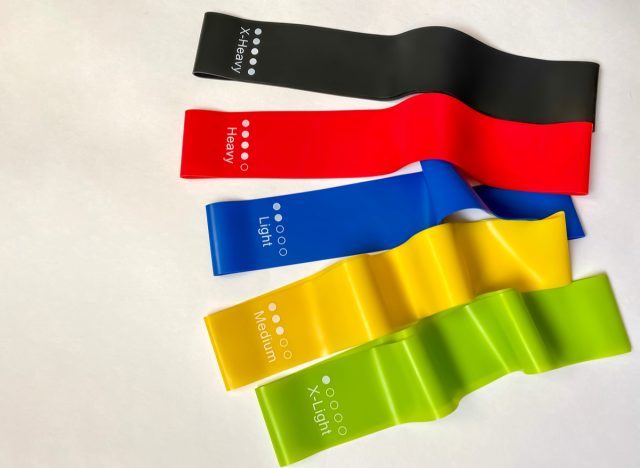
Make the band match your control. The right tension should challenge the muscles without changing your posture or forcing you to rush. Use these exercises three to four days per week, either as a short full-body session or mixed into your routine. Once the reps feel smooth, add a little more band tension, slow the lowering phase, or add another set.
- Choose the right band: Start with a band that lets you finish every rep with clean form.
- Slow down the return: Bands pull you back quickly, so control the lowering phase on rows, pull-aparts, and Pallof presses.
- Keep tension steady: Let the band challenge the muscles through the full rep instead of relaxing between each movement.
- Use a chair or wall when helpful: Support can make squats and hinges feel smoother while you build confidence.
- Train your whole body: Pair lower-body band work with rows, pull-aparts, and core presses for a balanced session.
- Build gradually: Add reps, sets, or tension once the current version feels strong.
References
- Bergquist, Ronny et al. “Muscle Activity in Upper-Body Single-Joint Resistance Exercises with Elastic Resistance Bands vs. Free Weights.” Journal of human kinetics vol. 61 5-13. 23 Mar. 2018, doi:10.1515/hukin-2017-0137
- Roberts, Christian K et al. “Effects of Home-Based Exercise Training Systems, Combined with Diet, on Cardiometabolic Health.” International journal of exercise science vol. 12,2 871-885. 1 May. 2019, doi:10.70252/WEFP3647
The post 5 Resistance Band Exercises That Rebuild Muscle Faster Than Gym Machines After 60 appeared first on Eat This Not That.


