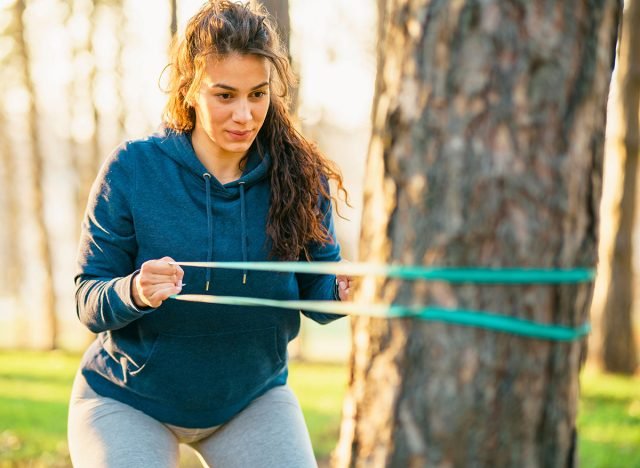
Home workouts can rebuild muscle if you treat them like any other workout. You need enough effort, enough control, and enough consistency for your muscles to get the message. After 65, that simple setup can be a huge advantage because it’s easier to start and repeat.
Muscle loss affects more than how strong you feel during exercise. It can make stairs harder, slow down your walking pace, and chip away at confidence during daily tasks. Keeping muscle on your frame helps you move better, stay more independent, and enjoy the active parts of your life with less hesitation.
Lifting weights can build serious strength, and they’re a great tool when you have access and feel comfortable using them. Home exercises give you another path. Bands, bodyweight, and a raised surface can still challenge your chest, back, legs, hips, and core without needing a full gym setup.
Below are five home exercises that help fight muscle loss after 65 with practical strength work. The focus is pressing, pulling, squatting, hip strength, and core control, so the routine trains the movements you use every day.
Incline Push-Up
Every push from a counter, bench, or sturdy chair asks your upper body to produce force. Incline push-ups build the chest, shoulders, triceps, and core while keeping the movement easier to scale than a floor push-up. That makes them useful for rebuilding muscle because you can choose the angle that lets you train hard without losing control. Stronger push-ups also carry over to getting up from a chair, bracing with your hands, and pushing doors or objects during the day.
Muscles Trained: Chest, shoulders, triceps, abs.
How to Do It
- Place your hands on a sturdy counter, bench, or chair.
- Step your feet back until your body forms a straight line.
- Brace your abs.
- Bend your elbows and lower your chest toward the surface.
- Press through your hands to return to the top.
- Repeat with steady control.
Recommended Sets and Reps: Perform 2 to 3 sets of 6 to 12 reps.
Best Variations: Wall push-up, counter push-up, slower incline push-up.
Form Tip: Keep your body in one straight line.
RELATED: 6 Bodyweight Exercises That Sculpt Abs Faster Than Weights After 50
Standing Band Row
The back needs regular training if you want your upper body to feel strong after 65. Standing band rows strengthen the muscles that pull your shoulders back and support better posture. They also give you a simple way to train pulling strength at home, which many bodyweight routines miss. Use enough band tension that the last few reps feel challenging while your shoulders stay controlled.
Muscles Trained: Upper back, lats, rear shoulders, biceps, core.
How to Do It
- Anchor a resistance band at about chest height.
- Stand tall and hold one end of the band in each hand.
- Step back until the band has light tension.
- Pull your elbows back toward your sides.
- Squeeze your shoulder blades gently.
- Return your arms forward with control.
Recommended Sets and Reps: Perform 2 to 3 sets of 10 to 15 reps.
Best Variations: Seated band row, one-arm band row, slower band row.
Form Tip: Pull your elbows back, then control the return.
Bodyweight Squat
Few movements matter more for lower-body strength than squatting well. Bodyweight squats train your thighs and glutes to lower, stand, and control your body through a range you use every day. They’re a strong choice for fighting muscle loss because you can add difficulty through tempo, depth, or extra reps before adding load. A stronger squat makes chair stands, stairs, and getting up from lower seats feel more reliable.
Muscles Trained: Quads, glutes, hamstrings, core.
How to Do It
- Stand with your feet about shoulder-width apart.
- Reach your arms forward for balance.
- Push your hips back and bend your knees.
- Lower to a comfortable depth.
- Press through your feet to stand tall.
- Repeat with smooth control.
Recommended Sets and Reps: Perform 2 to 3 sets of 8 to 15 reps.
Best Variations: Chair squat, box squat, slow-tempo squat.
Form Tip: Keep your feet planted.
RELATED: 4 Walking Exercises That Strengthen Knees Better Than Gym Equipment After 60
Mini-Band Glute Bridge
Glute strength can fade fast when you spend most of the day sitting. The mini-band glute bridge targets the hips while your core keeps your pelvis steady. Adding the band engages the outer hips, making the bridge more useful for walking, balance, and lower-body control. This is a great at-home muscle-building move because it creates strong tension without heavy equipment.
Muscles Trained: Glutes, hamstrings, outer hips, core.
How to Do It
- Place a mini-band above your knees.
- Lie on your back with your knees bent.
- Set your feet flat on the floor about hip-width apart.
- Gently press your knees out against the band.
- Drive through your heels and lift your hips.
- Lower with control and repeat.
Recommended Sets and Reps: Perform 2 to 3 sets of 10 to 15 reps.
Best Variations: Regular glute bridge, bridge hold, banded bridge with a pause.
Form Tip: Gently push your knees into the band.
Incline Plank with Shoulder Taps
Once you have a solid plank position, shoulder taps turn it into a stronger full-body challenge. Each tap shifts weight into one arm, so your core and shoulders have to keep your body steady. This helps rebuild muscle through the arms, chest, shoulders, and midsection while keeping the setup more approachable than floor work. Use a counter or sturdy chair, move slowly, and make each tap look controlled.
Muscles Trained: Abs, shoulders, chest, triceps, glutes.
How to Do It
- Place your hands on a counter, bench, or sturdy chair.
- Step your feet back into an incline plank.
- Brace your abs.
- Lift your right hand and tap your left shoulder.
- Place your right hand back down.
- Switch sides and continue alternating.
Recommended Sets and Reps: Perform 2 to 3 sets of 6 to 10 taps per side.
Best Variations: Higher-hand shoulder tap, slower shoulder tap, regular incline plank.
Form Tip: Keep your hips facing the floor.
RELATED: 5 Wall Exercises That Restore Hip Strength Faster Than Gym Workouts After 65
How to Reverse Muscle Loss With Home Exercises After 65

Home exercises work when the sets feel purposeful. Choose versions that let you move well, then push close enough to effort that your muscles have a reason to adapt. Pair the routine with daily movement, protein-forward meals, and enough recovery so your body can rebuild between sessions.
- Train close to fatigue: Finish most sets with only a few strong reps left in the tank.
- Use slower reps when bodyweight feels easy: A slower lower makes push-ups, squats, and bridges more challenging.
- Make the band rows tough enough: Step farther from the anchor point when the reps feel too light.
- Keep the chair or counter sturdy: A secure surface helps you focus on strength instead of worrying about slipping.
- Add one small challenge at a time: Increase reps, add a pause, or choose a harder angle.
- Give muscles fuel: Protein at meals helps support muscle repair from training.
- Repeat the routine weekly: Two to four sessions per week gives your body regular strength practice.
References
- Roberts, Christian K et al. “Effects of Home-Based Exercise Training Systems, Combined with Diet, on Cardiometabolic Health.” International journal of exercise science vol. 12,2 871-885. 1 May. 2019, doi:10.70252/WEFP3647
- Wilkinson, D J et al. “The age-related loss of skeletal muscle mass and function: Measurement and physiology of muscle fiber atrophy and muscle fiber loss in humans.” Aging Research Reviews vol. 47 (2018): 123-132. doi:10.1016/j.arr.2018.07.005
The post 5 Home Exercises That Reverse Muscle Loss Better Than Lifting Weights After 65 appeared first on Eat This Not That.


