You can still get a lot stronger after 70. Age changes how quickly you recover and how much muscle you may have held onto over the years, but it doesn’t take away your ability to respond to resistance training. Give your muscles a consistent reason to work harder, and they can still make meaningful progress.
Getting back toward the strength you remember having at 50 starts with rebuilding that capacity gradually. You need exercises that are challenging enough to make the muscles adapt, then a clear way to increase the difficulty as those exercises get easier. That progression matters far more than trying to prove how much weight you can lift on day one.
I’ve seen that play out plenty of times while coaching older adults. The biggest win is usually finding a starting point that lets someone train hard enough to improve without making the session feel like a test. Once the movement feels solid, adding load or choosing a harder variation becomes much easier.
That’s the approach behind these five exercises. You’ll train the major movement patterns with resistance you can adjust to your current strength, then build from there. The goal is to leave yourself room to progress so the same basic routine can keep working as you get stronger.
RELATED: The 10-Minute Standing Routine That Reverses Muscle Loss After 65
Goblet Hold Box Squat
The box squat gives you a reliable place to start rebuilding leg strength. Holding a dumbbell or kettlebell at your chest adds resistance, while the box keeps the depth consistent on every rep. Once you can stand from that position comfortably, add a little weight to keep the exercise progressing.
Muscles Trained: Quads, glutes, hamstrings, core.
How to Do It
- Stand in front of a sturdy box or bench.
- Hold a dumbbell or kettlebell against your chest.
- Set your feet about shoulder-width apart.
- Sit your hips back and bend your knees.
- Lower until you lightly touch the box.
- Press through your feet to stand.
Recommended Sets and Reps: Perform 2 to 3 sets of 6 to 10 reps. Rest for 60 to 90 seconds.
Best Variations: Bodyweight box squat, lower box squat, heavier goblet box squat.
Form Tip: Touch the box lightly without relaxing onto it.
Half-Kneeling Dumbbell Press
Pressing from half-kneeling makes a moderate dumbbell feel more demanding because the lower body can’t contribute much to the rep. Your shoulder handles the press while your core keeps you stable, which makes this a useful way to rebuild overhead strength without starting too heavy.
Muscles Trained: Shoulders, triceps, core.
How to Do It
- Kneel with your right knee on the floor and your left foot in front.
- Hold a dumbbell at your right shoulder.
- Brace your abs.
- Press the dumbbell overhead.
- Lower it slowly to your shoulder.
- Complete your reps, then switch sides.
Recommended Sets and Reps: Perform 2 to 3 sets of 6 to 10 reps per side. Rest for 45 to 60 seconds.
Best Variations: Seated dumbbell press, lighter half-kneeling press, standing single-arm press.
Form Tip: Keep your ribs down as the weight travels overhead.
RELATED: 4 Daily Exercises That Restore Knee Strength Better Than Squats After 65
Incline Push-Up
A floor push-up can be too big of a jump when you’re rebuilding upper-body strength. Raising your hands lets you choose how much body weight you have to press, so the exercise meets you where you are. Lowering the surface over time gives you a built-in progression without changing the movement.
Muscles Trained: Chest, shoulders, triceps, abs.
How to Do It
- Place your hands slightly wider than shoulder-width on a sturdy counter or bench.
- Step your feet backward.
- Brace your abs.
- Bend your elbows and lower your chest toward the surface.
- Stop when your elbows reach about 90 degrees.
- Press through your hands to return to the top.
Recommended Sets and Reps: Perform 2 to 3 sets of 8 to 12 reps. Rest for 45 to 60 seconds.
Best Variations: Wall push-up, lower incline push-up, slow-tempo incline push-up.
Form Tip: Keep your body in one straight line throughout the rep.
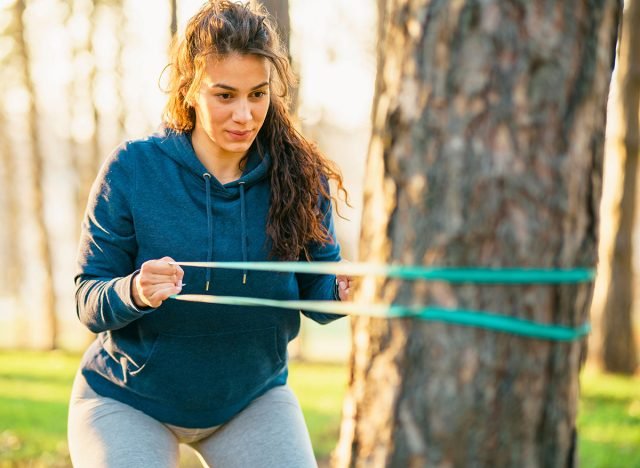
Standing Band Row
Pulling strength deserves its own attention, especially if most of your upper-body work has been pressing. A standing band row trains the upper back with easily adjustable resistance. Step farther from the anchor or move to a stronger band once your current setup stops feeling challenging.
Muscles Trained: Upper back, lats, rear shoulders, biceps.
How to Do It
- Anchor a resistance band around chest height.
- Hold one end in each hand.
- Step backward until the band has light tension.
- Extend your arms in front of you.
- Pull your elbows back toward your sides.
- Return slowly and repeat.
Recommended Sets and Reps: Perform 2 to 3 sets of 10 to 15 reps. Rest for 45 seconds.
Best Variations: Single-arm band row, stronger-band row, paused band row.
Form Tip: Finish the pull without leaning backward.
RELATED: 5 Couch Exercises That Flatten Belly Sag Faster Than Crunches After 65
Kettlebell Deadlift
The kettlebell deadlift gives you a straightforward way to load the hips and legs. Keeping the weight close to your body makes the setup easy to manage, and the movement has plenty of room to grow as your strength comes back. Add weight gradually once the reps feel solid.
Muscles Trained: Glutes, hamstrings, quads, core.
How to Do It
- Place a kettlebell on the floor between your feet.
- Stand with your feet about shoulder-width apart.
- Push your hips backward and bend your knees enough to reach the handle.
- Grip the kettlebell and brace your abs.
- Press through your feet and stand tall.
- Push your hips back to return the kettlebell to the floor.
Recommended Sets and Reps: Perform 2 to 3 sets of 6 to 10 reps. Rest for 60 to 90 seconds.
Best Variations: Elevated kettlebell deadlift, heavier kettlebell deadlift, two-kettlebell deadlift.
Form Tip: Keep the kettlebell close to you from the floor to standing.
RELATED: 6 Coffee Creamers a Dietitian Says to Limit, From Coffee Mate to Oatly
Start Building Strength Back After 70

You don’t have to chase the weights you lifted at 50 on day one. Start with resistance you can control and give yourself somewhere to progress from.
- Train strength regularly: Two to three full-body sessions per week is a solid place to start.
- Add resistance gradually: When every rep feels comfortable, increase the load or choose a harder variation.
- Keep recovery in the plan: Give harder sessions enough space for your muscles to recover.
- Eat enough protein: Adequate protein helps support the muscle you’re working to rebuild.
- Write your numbers down: Tracking weights and reps makes progress easier to see.
- Be patient with the process: Strength can return, but it still takes consistent training over time.
References
- Rodrigues, Filipe et al. “Effects of Muscle Strength, Agility, and Fear of Falling on Risk of Falling in Older Adults.” International Journal of Environmental Research and Public Health vol. 20,6 4945. 11 Mar. 2023, doi:10.3390/ijerph20064945
- Strasser, Barbara et al. “Role of Dietary Protein and Muscular Fitness on Longevity and Aging.” Aging and Disease vol. 9,1 119-132. 1 Feb. 2018, doi:10.14336/AD.2017.0202
The post 5 Exercises That Restore the Strength You Had at 50 After 70 appeared first on Eat This Not That.


