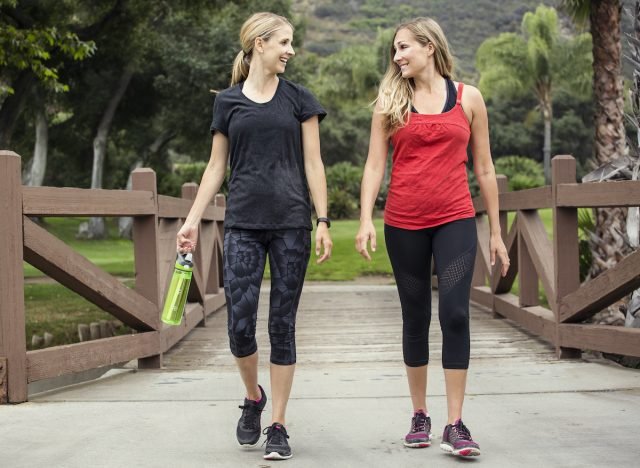
If your steps have gotten shorter and your feet don’t seem to clear the ground as easily, you may have heard it called the “senior shuffle.” It’s a casual term for a walking pattern that can develop as strength and balance decline with age. Stiffness can contribute too, and sometimes a shuffling gait has a medical cause that deserves attention.
Walking more can help you stay active, but it doesn’t always address why your stride has changed. Your hips need enough strength to move the leg forward, your calves help push you into the next step, and each leg has to support your weight as you move over it. When those pieces lose strength, simply adding more walking may leave the same weak links in place.
Core strength belongs in the conversation as well. Your trunk helps keep you upright while your weight moves from one foot to the other, so better control through the middle can make your stride feel steadier. Strength and coordination training have both been shown to improve gait speed in older adults, which is why I like pairing focused exercises with regular walking.
These five exercises target the parts of your stride that often need more attention after 65. You’ll build stronger legs, improve push-off, practice lifting your feet with purpose, and give your core more work while you’re standing.
Bodyweight Box Squat
A stronger stride starts with legs that can handle your body weight well. Box squats build strength through the thighs and hips while giving you a chair or bench as a clear depth target. That strength helps you produce more force with each push, instead of letting your stride get progressively smaller.
Muscles Trained: Quads, glutes, hamstrings, core.
How to Do It
- Stand in front of a sturdy chair or box.
- Set your feet about shoulder-width apart.
- Sit your hips back and bend your knees.
- Lower until your thighs reach at least parallel, if comfortable.
- Lightly touch the box.
- Press through your feet to stand.
Recommended Sets and Reps: Perform 2 to 3 sets of 8 to 12 reps. Rest for 45 to 60 seconds.
Best Variations: Higher box squat, slow-tempo box squat, supported box squat.
Form Tip: Touch the box lightly and come right back up.
RELATED: 5 Daily Exercises That Trim Love Handles Faster Than Treadmill Workouts After 55
Low Box Step-Up
Every step asks one leg to lift and support you before the other catches up. Step-ups exaggerate that job just enough to make the muscles work harder. Start on a low platform and focus on driving through the top leg instead of pushing hard off the floor with the trailing foot.
Muscles Trained: Quads, glutes, hamstrings, calves.
How to Do It
- Stand facing a low, sturdy step.
- Place your right foot fully on top.
- Press through that foot.
- Step up until you’re standing on the platform.
- Step back down with control.
- Complete your reps, then switch legs.
Recommended Sets and Reps: Perform 2 to 3 sets of 6 to 10 reps per side. Rest for 45 to 60 seconds.
Best Variations: Supported step-up, lower step-up, slower step-up.
Form Tip: Let the leg on the step do most of the work.
Supported Calf Raise
Your calves help finish each stride by pushing the ground away as your heel comes up. When that push gets weaker, walking can start to feel flatter and less powerful. Calf raises give that part of the gait cycle direct attention while a chair or counter lets you take balance out of the equation.
Muscles Trained: Calves, ankles, feet.
How to Do It
- Stand behind a sturdy chair or counter.
- Rest your hands lightly on the support.
- Set your feet about hip-width apart.
- Press through the balls of your feet.
- Lift your heels as high as comfortable.
- Lower slowly and repeat.
Recommended Sets and Reps: Perform 2 to 3 sets of 10 to 15 reps. Rest for 30 to 45 seconds.
Best Variations: Slow calf raise, single-leg supported calf raise, seated calf raise.
Form Tip: Lower your heels under control on every rep.
RELATED: 6 Chair Exercises That Regain Muscle Mass Better Than Gym Workouts After 65
Standing March
Sometimes the shuffle improves once you practice lifting your feet with more intention. Standing marches strengthen the muscles that lift the leg while giving the opposite side a chance to support your weight. Hold onto a chair if needed, then gradually use less support as your control improves.
Muscles Trained: Hip flexors, quads, glutes, core.
How to Do It
- Stand tall beside a sturdy chair or counter.
- Hold the support lightly if needed.
- Shift your weight onto your left leg.
- Lift your right knee toward hip height.
- Lower your foot with control.
- Switch sides and continue alternating.
Recommended Sets and Reps: Perform 2 to 3 rounds of 20 to 40 seconds. Rest for 30 to 45 seconds.
Best Variations: Supported march, slower march, goblet hold march.
Form Tip: Pick each foot up clearly before setting it back down.
Pallof Press
Your legs aren’t working alone when you walk. The Pallof press trains your core to keep your torso steady while a band pulls you toward one side. Better trunk control helps you stay more organized with each step instead of letting your upper body sway as your weight shifts.
Muscles Trained: Abs, obliques, shoulders.
How to Do It
- Anchor a resistance band around chest height.
- Stand sideways to the anchor.
- Hold the band against your chest with both hands.
- Step away until you feel steady tension.
- Press your hands straight out.
- Bring them back to your chest and repeat before switching sides.
Recommended Sets and Reps: Perform 2 to 3 sets of 8 to 12 reps per side. Rest for 30 to 45 seconds.
Best Variations: Pallof hold, lighter band press, wider-stance Pallof press.
Form Tip: Keep your chest facing forward as your arms move.
RELATED: 5 Standing Exercises That Firm Sagging Arms Faster Than Gym Classes After 60
Put More Strength Behind Your Stride After 65
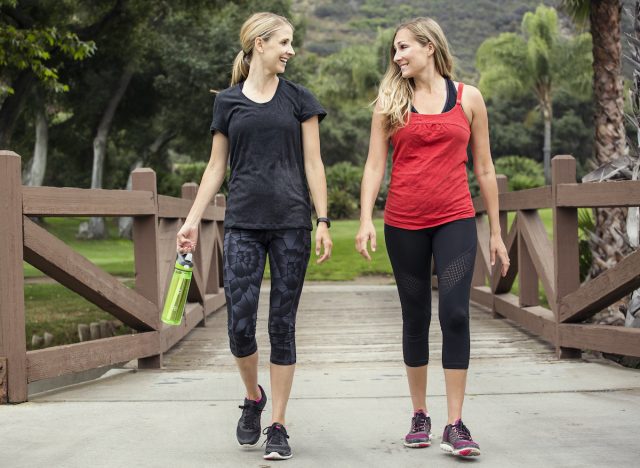
Keep walking. The goal here is to give your walks stronger legs and better control to work with. Use this routine two to three days per week, then notice how your normal stride changes over the next several weeks.
- Practice walking after strength work: A short, comfortable walk lets you use the strength you just trained.
- Build step height gradually: Start low and increase the platform only when your step-ups feel controlled.
- Use support when needed: A chair can help you train harder without letting balance end the set early.
- Give your calves regular work: Stronger push-off can make each step feel more purposeful.
- Notice foot clearance: Pay attention to whether you’re picking your feet up more easily instead of skimming the ground.
- Add pace in short doses: Brief stretches of quicker walking can give you another way to practice a stronger stride.
- Talk with your doctor about a new or worsening shuffle: Especially if it appears suddenly or comes with other changes in balance or movement.
References
- Lee, In-Hee, and Sang-Young Park. “Balance improvement by strength training for the elderly.” Journal of Physical Therapy Science vol. 25,12 (2013): 1591-3. doi:10.1589/jpts.25.1591
- Ungvari, Zoltan et al. “The multifaceted benefits of walking for healthy aging: from Blue Zones to molecular mechanisms.” GeroScience vol. 45,6 (2023): 3211-3239. doi:10.1007/s11357-023-00873-8
The post 5 Exercises That End the Senior Shuffle Faster Than Walking After 65 appeared first on Eat This Not That.


