Most people over 65 who come to me after years of doing nothing usually say two things: they don’t know where to start, and they think they’ve left it too late. Most of them haven’t. The starting point is simpler than they expect.
I’ve worked as a personal trainer for four decades and co-founded TRAINFITNESS, the UK’s leading provider of personal training courses. These five exercises can help you rebuild strength, balance and mobility without a gym.
You need very little equipment for these: a wall, the bottom stair with its banister, a kitchen counter, a firm chair, and a light resistance band for the last one. Start at the easier end of the numbers I give and work up from there.
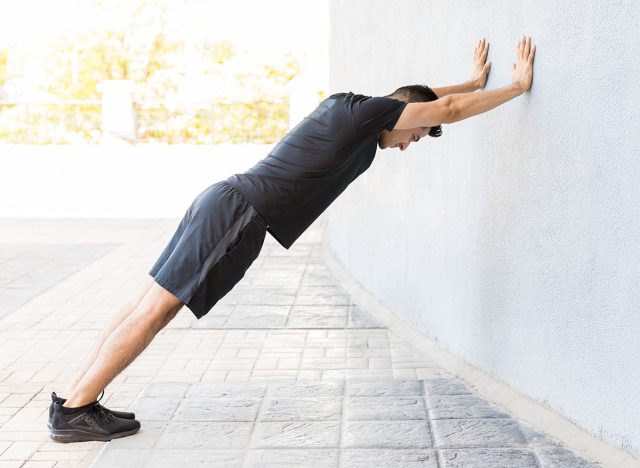
Wall Push-Up
This builds pushing strength in the chest, shoulders and backs of the arms. That’s the strength you use to push yourself up from a chair or the bed, push up off the floor, and shove a heavy door open. The wall takes most of your body weight, so it’s the easiest version to start with.
How to Do It:
- Stand facing a wall, about an arm’s length away.
- Place your hands flat on the wall at shoulder height, a little wider than your shoulders.
- Keeping your body straight from head to heels, bend your elbows and lower your chest toward the wall over 2 to 3 seconds.
- Push back until your arms are straight.
- To make it harder, step your feet further back.
- Later on, move your hands to the kitchen counter, which takes more of your weight.
Avoid These Mistakes:
- Don’t let your hips sag toward the wall or stick out behind. Keep your body in one straight line from head to heels.
- Don’t bend your elbows only a little. If you do, your chest never gets close. Bring your chest almost to the wall before you push back.
Sets and Reps: Do 8 to 12 reps, then rest and do a second set.
RELATED: 5 Morning Exercises That Restore Knee Strength Faster Than Squats After 65
Bottom Stair Step-Ups
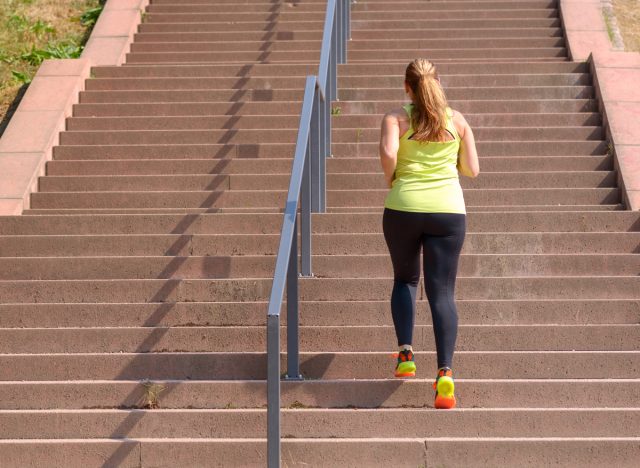
This strengthens each leg on its own, which is what you need for stairs, curbs and getting on a bus, because each leg has to do the work without help from the other. It also trains balance, since your weight has to settle onto one leg every time you step up.
How to Do It:
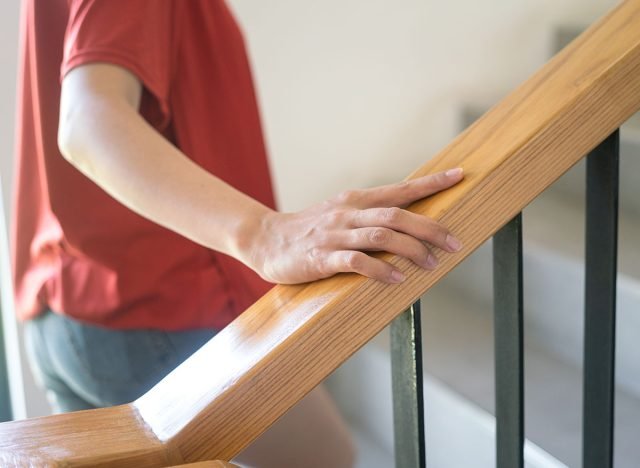
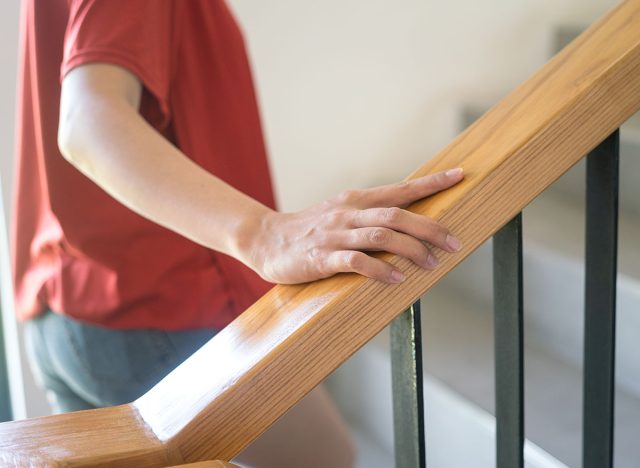
- Stand facing the bottom stair, holding the banister. Use both hands if you need them to start.
- Place your whole right foot on the step.
- Push through the right heel to step up, bringing your left foot up beside it.
- Step down with your left foot first, then bring your right foot down.
Avoid These Mistakes:
- Don’t push off the bottom foot or pull hard on the banister. The leg on the step ends up doing very little. Let the top leg push you up, and keep the whole of your foot on the step while it does.
Sets and Reps: Do 8 to 10 leading with the right leg, then 8 to 10 leading with the left. Rest, then do a second set.
Heel-to-Toe Walk
Putting one foot directly in front of the other narrows your base of support, so the muscles and the small, quick corrections that keep you upright all have to work. Those are the ones that slow down after years of inactivity. It’s also good practice for the real thing: narrow sidewalks, crowded stores and uneven ground.
How to Do It:
- Stand alongside the kitchen counter with one hand resting on it.
- Place your right heel directly in front of your left toes, touching or nearly touching.
- Place your left heel in front of your right toes.
- Keep taking slow steps along the counter until you’ve done 10 to 15.
- Turn around carefully and walk back the way you came.
Avoid These Mistakes:
- Don’t rush. Fast steps let your feet drift apart, and then the walk stops asking much of your balance. Take slow steps.
- Don’t grip the counter too hard. Then the balance muscles don’t have to do anything. Keep the hand light.
Sets and Reps: Do 3 lengths in total.
Form Tip: Look ahead, not at your feet.
RELATED: 5 Home Exercises That Restore Walking Speed Faster Than Treadmills After 70
Seated Trunk Rotation
This brings back the turning movement in the middle of the back, which stiffens up after years of sitting and doing little. You use it every time you look over your shoulder to back up the car, reach into the back seat, or turn to talk to someone beside you.
How to Do It:
- Sit tall on the front of a firm chair, feet flat and hip-width apart.
- Cross your arms over your chest, hands resting on the opposite shoulders.
- Keeping your hips and knees facing forward, slowly turn your shoulders and head to the right as far as is comfortable.
- Hold for 3 seconds.
- Return to the center.
- Turn to the left the same way, hold for 3 seconds, and return.
Avoid These Mistakes:
- Don’t let your knees and hips come around with your shoulders. That takes the movement out of your back and makes it a whole-body twist. Keep your hips square to the front. Only the upper body moves.
Sets and Reps: Do 8 turns each way.
Seated Band Row
This strengthens the upper back and arms for pulling and lifting. It works in the opposite direction from the hunched, forward position that years of sitting lead to, so it helps your posture and makes carrying easier.
How to Do It:
- Sit on the front of a firm chair with your legs out in front, knees slightly bent.
- Loop the middle of a light resistance band around the soles of both feet and hold one end in each hand, arms straight.
- Sit tall and pull your hands back toward your lower ribs, elbows close to your sides.
- Squeeze your shoulder blades together and hold for 2 seconds.
- Return slowly to straight arms.
- If sitting with your legs out doesn’t suit you, loop the band around a sturdy table leg and do the same pull sitting facing it.
Avoid These Mistakes:
- Don’t lean back to pull with your body, and don’t shrug your shoulders up toward your ears. Sit tall, keep your shoulders down and let your elbows lead the movement.
Sets and Reps: Do 10 to 12 reps, then rest and do a second set.
RELATED: 4 Wall Exercises That Firm Loose Upper Arms Faster Than Yoga After 65
What Inactivity Does to You
In my work with clients over 65, the pattern is fairly similar from person to person. The legs are usually the first thing to weaken. Stairs become slow and deliberate, and getting up from a low sofa needs a push off the armrest.
The upper body goes the same way. Pushing yourself up from the floor or out of bed, opening a heavy door, lifting a bag down from a high shelf: all of these become harder because the chest, shoulders and arms have lost strength.
Balance slips too, and it’s often what people worry about most. People walk more cautiously, the steps get shorter, and they spend more time looking down at the ground than they used to.
The spine and hips stiffen up as well. Turning to look over your shoulder, or reaching into the back seat of the car, becomes awkward in a way it never used to be. Plenty of people also run out of breath sooner, from things like carrying heavy bags or walking up a hill.
Confidence drops alongside the physical changes. People start avoiding tasks they used to manage because they don’t trust their balance anymore, and doing less makes the body weaker still.
Why These Beat Yoga

I should say first that I’ve got nothing against yoga. It’s good for flexibility and relaxation, and if you enjoy a class, it’s worth doing.
But after a decade of doing nothing, the biggest losses are strength and balance, and those are the two I’d go after first. Muscles rebuild when you ask a little more of them each week, and yoga isn’t set up to load them that way. Plenty of poses are also hard to get into for someone out of practice, especially the ones done on the floor, and getting down to the floor and back up is often the very thing a person can’t manage yet.
The exercises I use go straight at what’s been lost: pushing, pulling, leg strength, balance and turning. They can all be done standing or seated at home, and each one gets a bit harder as you get stronger. That’s why they tend to pay off faster than yoga for someone who’s been inactive for a decade.
RELATED: 4 Standing Exercises That Flatten Belly Sag Faster Than Crunches After 65
Stay Safe While Starting

Anyone with a heart condition, chest pain, dizziness, uncontrolled blood pressure, or a recent fall or surgery should see their doctor before starting. Stop and get checked out if you get chest pain, unusual breathlessness or dizziness while exercising. And keep the kitchen counter, the banister or a sturdy chair close by to hold on to whenever you need support.
Start well within your limits, so the first few sessions feel easy. It’s normal to feel a little stiff for a day or two afterward. You should be able to hold a conversation while you’re doing them. If you can’t, you’re going too hard.
Your Weekly Routine
Keep it light for the first two weeks. In weeks 1 and 2, do all five every other day, one set of each to start with rather than the full amounts I’ve listed. That’s about 10 to 15 minutes a session.
From week 3, move to three sessions a week and do two sets of each. The heel-to-toe walk and the seated rotation can also be done every day if you want to, because balance and mobility respond well to frequent practice.
Add a short daily walk alongside them and let the distance grow over the weeks. Ten minutes at an easy pace counts at the start.
When an exercise starts to feel easy, increase one thing at a time. Add a couple of reps first, then use less support, then move to a harder version, like a lower surface for the push-ups or a stronger band for the row. Give each change a week or two before you add the next.
RELATED: Trainers Agree: Walking Isn’t Enough After 65. These 5 Exercises Keep Your Legs Strong
What to Expect
In the first 2 to 3 weeks, most people notice the small things first. Stairs feel a bit easier, getting up from a chair takes less effort, and the stiffness starts to ease. Confidence on your feet usually lifts around the same time.
Between 6 and 8 weeks, the changes are easier to see. Arms and legs are noticeably stronger, balance feels steadier, and turning to look over your shoulder is less of a struggle than it was.
Somewhere between 3 and 6 months, a lot of the strength and balance that was lost has come back. Everyday tasks like carrying groceries, working in the yard and getting in and out of the car all feel more manageable.
It takes months, and it has to be kept up, because the strength goes again if you stop. I’d rather see someone doing three short sets of sessions a week for a year than a daily burst for a month.
The post 5 Exercises for Adults Over 65 Who Stopped Exercising Years Ago appeared first on Eat This Not That.


