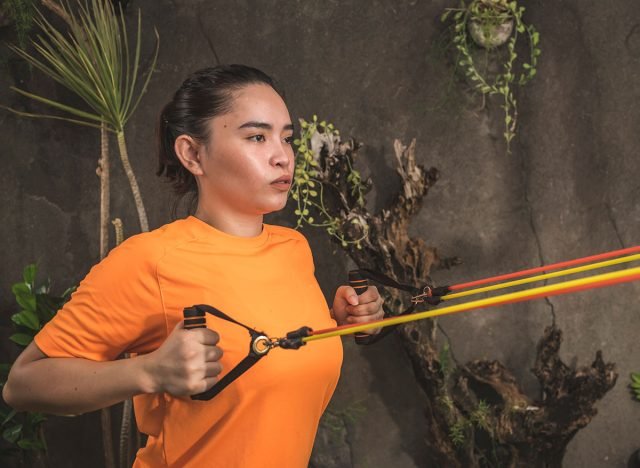
Arm strength shows up in many everyday moments. You feel it when you push yourself out of a chair, carry a heavy bag, reach into a cabinet, or try to move something without your shoulders barking at you.
After 55, rebuilding that strength should feel doable, not intimidating. I’ve coached plenty of adults who wanted stronger arms but felt cautious because their elbows, wrists, or shoulders didn’t tolerate every exercise well. The answer usually came down to picking movements they could repeat, adjust, and load without forcing painful positions.
That’s the value of this routine. You can start push-ups against a wall or counter. Bands make rows and curls easier to control. Carries and presses help rebuild the kind of strength you actually use when you lift, reach, and move through the day.
Use these five exercises as a joint-friendly plan for rebuilding arm strength after 55. The work stays simple, the movements are easy to scale, and your arms still get the consistent challenge they need to feel stronger.
Push-Up
Push-ups earn their spot because you can match them to your joints right away. A wall, counter, bench, or floor all change the challenge, so your wrists and shoulders don’t have to fight a version that feels wrong. The movement builds the pressing strength you use when you get up from a chair, push a door open, or support yourself with your hands. Start with the angle that lets you move well and build from there.
Muscles Trained: Chest, shoulders, triceps, abs.
How to Do It
- Place your hands on a wall, counter, bench, or the floor.
- Step your feet back until your body forms a long line.
- Set your hands slightly wider than shoulder-width.
- Bend your elbows and lower your chest toward the surface.
- Press through your hands to return to the start.
- Repeat with control.
Recommended Sets and Reps: Perform 2 to 3 sets of 6 to 12 reps. Rest for 45 to 60 seconds.
Best Variations: Wall push-up, incline push-up, close-grip incline push-up.
Form Tip: Keep your body in one long line.
RELATED: 5 Standing Exercises That Restore Leg Power Faster Than Lunges After 65
Standing Band Row
Most people think “arm strength” and go straight to curls. Rows deserve just as much attention because your arms work better when your upper back supports them. A standing band row trains pulling strength with smooth resistance that’s easy to adjust at home. Use enough tension to feel your back and biceps work without yanking through the rep.
Muscles Trained: Upper back, lats, biceps, rear shoulders.
How to Do It
- Anchor a resistance band at chest height.
- Hold one end of the band in each hand.
- Step back until the band has light tension.
- Stand tall with your arms extended.
- Pull your elbows back toward your sides.
- Return your arms forward with control.
Recommended Sets and Reps: Perform 2 to 3 sets of 10 to 15 reps. Rest for 30 to 45 seconds.
Best Variations: Lighter band row, single-arm band row, seated band row.
Form Tip: Pull your elbows back without shrugging.
Half-Kneeling Dumbbell Shoulder Press
Overhead strength can feel intimidating when your shoulders don’t love heavy pressing. The half-kneeling press slows everything down. With one knee on a pad and one foot planted, you can focus on a clean press with a lighter dumbbell. This helps rebuild reaching strength while giving you more control than a rushed standing press.
Muscles Trained: Shoulders, triceps, upper back, abs.
How to Do It
- Kneel with your right knee down and your left foot forward.
- Hold a dumbbell in your right hand at shoulder height.
- Keep your torso tall.
- Press the dumbbell overhead.
- Lower it back to your shoulder with control.
- Complete your reps, then switch sides.
Recommended Sets and Reps: Perform 2 to 3 sets of 6 to 10 reps per side. Rest for 45 to 60 seconds.
Best Variations: Seated dumbbell press, standing single-arm press, lighter half-kneeling press.
Form Tip: Press through a range that feels strong.
RELATED: 5 Chair Exercises That Shrink Belly Pooch Faster Than Gym Classes After 50
Overhead Dumbbell Carry
A press proves you can lift the weight once. An overhead carry teaches your arm to stay strong while you move. That matters for reaching, shelving items, and keeping your shoulder stable in motion. Keep this one light at first, and treat each carry like controlled practice rather than a grip-it-and-go challenge.
Muscles Trained: Shoulders, triceps, upper back, abs, grip.
How to Do It
- Hold a light dumbbell in one hand.
- Press the dumbbell overhead.
- Keep your elbow straight without locking hard.
- Walk forward with controlled steps.
- Lower the dumbbell safely after your carry.
- Switch sides and repeat.
Recommended Sets and Reps: Perform 2 to 3 carries of 15 to 30 seconds per side. Rest for 45 to 60 seconds.
Best Variations: Waiter carry, overhead hold, lighter overhead carry.
Form Tip: Keep the weight stacked above your shoulder.
Band Curl
Band curls give your arms direct work without needing heavy weights. That can feel better on the elbows because the resistance builds as you curl, instead of loading the bottom position hard. Stronger biceps help with carrying bags, lifting objects, and pulling items toward you. Keep a light band nearby and use this as a simple arm-strength finisher.
Muscles Trained: Biceps, forearms, grip.
How to Do It
- Stand on the middle of a resistance band.
- Hold one end of the band in each hand.
- Let your arms hang by your sides.
- Curl your hands toward your shoulders.
- Squeeze briefly at the top.
- Lower your hands with control.
Recommended Sets and Reps: Perform 2 to 3 sets of 10 to 15 reps. Rest for 30 to 45 seconds.
Best Variations: Lighter band curl, single-arm band curl, hammer-grip band curl.
Form Tip: Keep your elbows near your sides.
RELATED: 4 Home Exercises That Restore Posture Faster Than Back Braces After 60
How to Rebuild Arm Strength After 55 Without Straining Your Joints
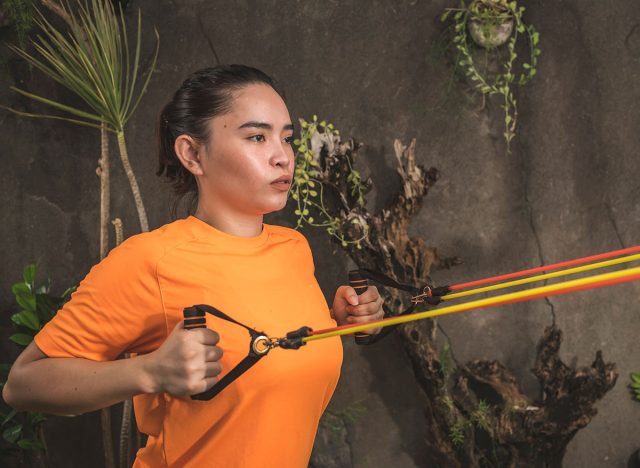
Joint-friendly arm strength comes from repeatable work that your body can recover from. Use these exercises two to four days per week, or pick two moves for a short daily strength break. Your best plan is the one that lets you train consistently without leaving your shoulders, elbows, or wrists irritated the next day.
- Keep a light day in the mix: Use easier push-up angles, lighter bands, or shorter carries when your joints feel tired.
- Build your weekly rhythm first: Two good sessions per week beat one hard workout that knocks you off track.
- Progress one tool at a time: Add reps, band tension, carry time, or dumbbell weight, but avoid changing everything at once.
- Use daily tasks as practice: Carry groceries evenly, reach overhead with control, and notice how your arms feel outside the workout.
- Give sore joints a reason: If one movement keeps irritating the same spot, change the angle or swap to the easier variation for a week.
- Keep bands visible: Leaving a band near your desk, couch, or workout space makes quick rows and curls easier to remember.
- Track what feels better: Notice easier carries, smoother reaches, stronger push-ups, and less hesitation during daily tasks.
References
- Pang, Jing et al. “Age-related change in muscle strength, muscle mass, and fat mass between the dominant and non-dominant upper limbs.” Frontiers in public health vol. 11 1284959. 23 Nov. 2023, doi:10.3389/fpubh.2023.1284959
- Lee-Confer, Jonathan. “Strength in arms: empowering older adults against the risk of slipping and falling-a theoretical perspective.” Frontiers in sports and active living vol. 6 1371730. 8 Mar. 2024, doi:10.3389/fspor.2024.1371730
The post 5 Daily Exercises That Rebuild Arm Strength After 55 Without Straining Your Joints appeared first on Eat This Not That.


