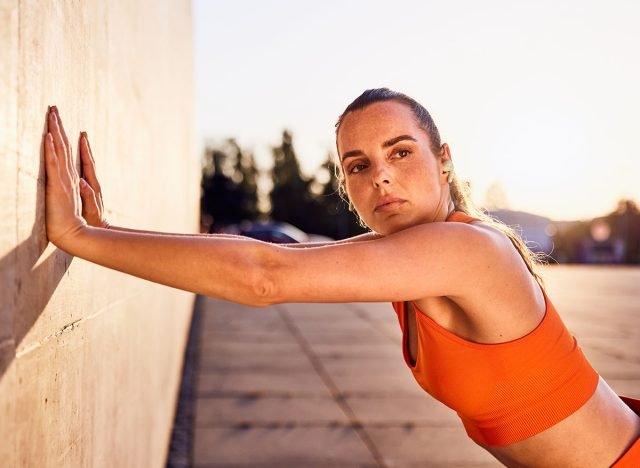
When an older client tells me they want to work on their waist, I guarantee my first thought isn’t “more crunches”. I want the abs getting stronger, but I also want the workout to involve enough muscle that we’re doing something useful for overall body composition. That becomes especially important after 60, when holding onto lean muscle deserves just as much attention as training the midsection itself.
Direct core work still belongs in the plan, as some evidence suggests exercise may influence fat use near the muscles being trained, so I wouldn’t completely dismiss the idea of a local effect. I just wouldn’t rely on it as the main strategy. Your overall daily calorie balance still has a much bigger influence on whether belly fat comes down.
The wall gives you a surprisingly good way to blend those ideas without repeating another plank-heavy routine. You can brace the core from the floor, work it while standing, and bring the legs in once you’re warmed up. That gives you a more complete workout while keeping the setup approachable.
Wall Dead Bug Press
Pressing your feet into the wall gives the abs something to brace against before you even start moving. From there, lowering one arm changes the load while your midsection works to keep your trunk in place. It’s a good way to train abdominal control without relying on repeated spinal flexion.
Muscles Trained: Abs, hip flexors, shoulders.
How to Do It
- Lie on your back facing a wall.
- Place both feet flat against the wall with your hips and knees bent around 90 degrees.
- Gently press your feet into the wall.
- Reach both arms toward the ceiling.
- Lower your right arm overhead while keeping your abs braced.
- Return to the start and alternate arms.
Recommended Sets and Reps: Perform 2 to 3 sets of 8 to 12 reps per arm. Rest for 30 to 45 seconds.
Best Variations: Static wall dead bug press, alternating arm reach, opposite arm and leg press.
Form Tip: Keep your lower back comfortably against the floor as your arm moves.
RELATED: Trainers Agree: Walking Won’t Keep Your Balance Sharp After 70. These 5 Chair Exercises Will
Wall-Supported Cross-Body Knee Drive
This one takes the core work upright and adds more movement to the session. Driving the knee across your body engages the obliques, while the wall gives you enough support to control the pace. Once the movement feels solid, you can speed it up slightly to raise the effort.
Muscles Trained: Abs, obliques, hip flexors, glutes.
How to Do It
- Stand facing the wall with both hands against it.
- Step your feet slightly backward.
- Brace your abs.
- Drive your right knee toward your left side.
- Return your foot to the floor.
- Alternate sides for the full set.
Recommended Sets and Reps: Perform 2 to 3 sets of 10 to 15 reps per side. Rest for 30 seconds.
Best Variations: Slower knee drive, faster alternating knee drive, straight-ahead wall knee drive.
Form Tip: Bring the knee across your body without turning your whole torso with it.
Wall Sit March
The wall sit shifts the focus by keeping the legs working continuously. Once you start marching, your core has to keep you supported while your weight shifts from one foot to the other. That engages more muscle at once without adding impact.
Muscles Trained: Quads, glutes, abs, hip flexors.
How to Do It
- Stand with your back against a wall.
- Walk your feet forward.
- Slide down into a comfortable wall sit.
- Brace your core.
- Lift one foot a few inches from the floor.
- Lower it and alternate sides.
Recommended Sets and Reps: Perform 2 to 3 sets of 6 to 10 marches per side. Rest for 45 seconds.
Best Variations: Higher wall sit march, wall sit hold, longer alternating march.
Form Tip: Pick a wall-sit depth that lets you lift each foot without sliding lower.
RELATED: If You Can Hold a Wall Sit This Long After 60, Your Leg Strength Is Stronger Than 90% of Peers
Wall-Supported Reverse Lunge With Reach
The reverse lunge adds bigger lower-body movement without asking you to give up support. Reaching overhead as you step back engages the trunk and increases the movement in each rep. Use the wall lightly so the legs still handle most of the work.
Muscles Trained: Quads, glutes, hamstrings, core, shoulders.
How to Do It
- Stand beside a wall with one hand resting lightly against it.
- Step your right foot backward.
- Bend both knees into a comfortable reverse lunge.
- Reach your free arm overhead.
- Press through your front foot to return to standing.
- Complete your reps, then switch sides.
Recommended Sets and Reps: Perform 2 to 3 sets of 8 to 10 reps per side. Rest for 45 seconds.
Best Variations: Supported reverse lunge without reach, shorter-range reverse lunge, reverse lunge with a cross-body reach.
Form Tip: Use the wall for balance without pulling yourself back to standing.
RELATED: 5 Exercises a Trainer Gives Every Client Over 65 Who Sits All Day
Make the Waist-Loss Work Add Up
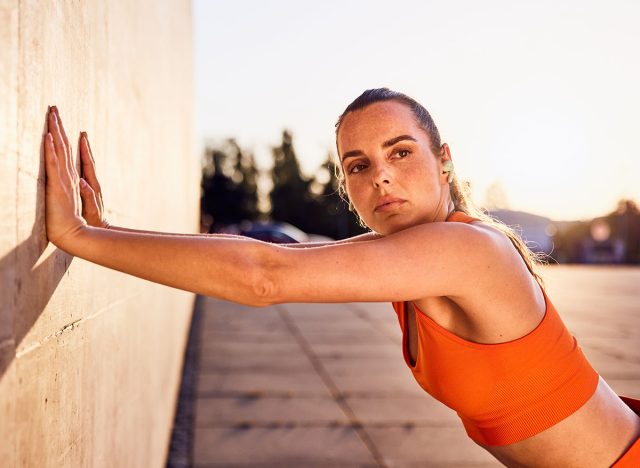
Stronger abs can improve how your midsection feels, but reducing belly overhang still depends heavily on lowering overall body fat. Let the wall routine handle some of the strength work, then support it with what you do during the rest of the day.
- Keep moving outside the workout: Walking and other daily activity can add meaningful energy expenditure across the week without making recovery harder.
- Watch your overall calorie intake: A modest calorie deficit is usually needed to lose body fat. You don’t have to make aggressive cuts for that to work.
- Keep building or maintaining muscle: Resistance training becomes increasingly valuable after 60 because lean tissue supports strength and helps you stay capable of doing more activity.
- Progress the exercises: Add reps or extend the work periods once the current version feels manageable. You can also move the standing drills a little faster as your control improves.
- Keep direct core work in the mix: The wall dead bug and cross-body knee drive give the abs focused work while the rest of your routine handles the larger body-composition goal.
- Judge progress over several weeks: Core strength may improve before you notice much change around the waist, so give the process enough time to add up.
References
- Rodríguez-Perea, Ángela et al. “Core training and performance: a systematic review with meta-analysis.” Biology of Sport, vol. 40,4 (2023): 975-992. doi:10.5114/biolsport.2023.123319
- Brobakken, Mathias Forsberg et al. “Abdominal aerobic endurance exercise reveals spot reduction exists: A randomized controlled trial.” Physiological Reports vol. 11,22 (2023): e15853. doi:10.14814/phy2.15853
The post 4 Wall Exercises That Flatten Belly Overhang Faster Than Crunches After 60 appeared first on Eat This Not That.


