
A gym class can be great when the energy is right, the pace fits you, and the workout actually pushes the body enough to change. The problem is that some classes feel busy without giving you much direction. You move around, sweat a little, and leave wondering if the work matched the goal.
Belly overhang usually needs a routine with more muscle involved and more repeatable effort. Direct ab work can strengthen the muscles underneath, but the visible change comes from the bigger picture: strength training, calorie burn, daily movement, and consistency. Standing exercises fit that goal well because they make your core work while your legs, hips, and upper body stay active too.
For this one, I’d keep the workout short, athletic, and easy to scale. The kettlebell rotation gives your core a direct job, the ski swing brings in the hips and hamstrings, the jump squats add a quick conditioning hit, and the dumbbell thruster finishes with a full-body push. Start with the lowest-impact version that still feels challenging, then build from there.
Use these four standing exercises two to three days per week. Start with the lowest-impact version that still feels challenging, keep the reps sharp, and build the intensity as your body earns it.
Kettlebell Core Rotation
Kettlebell core rotations give your midsection something more useful to do than endless crunches. You’re standing, bracing, turning, and controlling a weight while your hips and ribs stay organized. It’s a simple way to train your abs and obliques in a position that feels closer to real movement. Keep the kettlebell light at first so the rotation stays smooth.
Muscles Trained: Obliques, abs, deep core, shoulders, upper back, glutes.
How to Do It:
- Stand tall with your feet about shoulder-width apart.
- Hold a light kettlebell at chest height with both hands.
- Brace your core and soften your knees.
- Rotate the kettlebell toward your right side.
- Return to the center with control.
- Rotate toward your left side and continue alternating.
Recommended Sets and Reps: Perform 3 sets of 8 to 10 reps per side. Rest for 30 to 45 seconds between sets.
Best Variations: Bodyweight rotations, dumbbell core rotations, slower kettlebell rotations.
Form Tip: Turn through a range you can control and keep your lower back from doing the twisting.
RELATED: 4 Daily Exercises That Rebuild Calf Strength Faster Than Treadmill Workouts After 60
Dumbbell Ski Swing
The dumbbell ski swing brings some athletic rhythm into the routine without needing a huge setup. Your hips create the movement, your arms guide the weights, and your core keeps your torso from collapsing forward. It should feel like a crisp hinge, not a shoulder raise. Done well, it gets your breathing up fast.
Muscles Trained: Glutes, hamstrings, core, upper back, shoulders.
How to Do It:
- Stand with your feet about hip-width apart and hold a light dumbbell in each hand.
- Let your arms hang by your sides.
- Soften your knees and brace your core.
- Push your hips back as the dumbbells swing slightly behind you.
- Drive your hips forward and swing the dumbbells to about chest height.
- Let the weights swing back down as you move into the next rep.
Recommended Sets and Reps: Perform 3 sets of 10 to 15 reps. Rest for 45 to 60 seconds between sets.
Best Variations: Bodyweight hip hinges, kettlebell swings, shorter-range dumbbell ski swings.
Form Tip: Let your hips power the swing and keep the weights light enough that you aren’t muscling them up with your shoulders.
Jump Squat
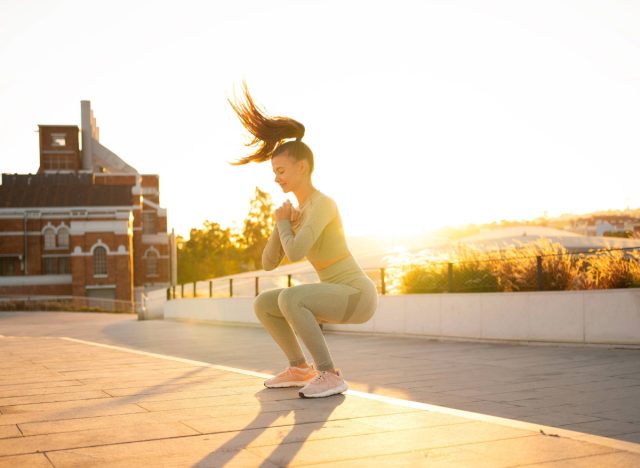
Use jump squats as the quicker conditioning piece in this workout. You don’t need to jump high for them to work. A small, controlled jump can raise your heart rate, train your legs, and make the whole session feel more active. If jumping feels rough on your knees or hips, swap in a squat-to-calf-raise and keep moving.
Muscles Trained: Quadriceps, glutes, hamstrings, calves, core.
How to Do It:
- Stand with your feet about shoulder-width apart.
- Brace your core and lower into a shallow squat.
- Swing your arms naturally as you prepare to jump.
- Jump a few inches off the floor.
- Land softly with your knees slightly bent.
- Move into the next rep with a steady rhythm.
Recommended Sets and Reps: Perform 3 sets of 15 to 20 seconds. Rest for 45 to 60 seconds between sets.
Best Variations: Squat to calf raise, low jump squats, supported jump squats.
Form Tip: Keep the jumps small and quiet. The landing matters more than the height.
RELATED: 4 Home Exercises Every Person Over 60 Should Use Weekly to Restore Abs
Dumbbell Thruster
The dumbbell thruster gives this routine a strong full-body finisher. It blends a squat with an overhead press, so your legs, shoulders, arms, and core all have to contribute. That makes it a better fit for the belly-overhang goal than another isolated ab move because it raises the overall effort of the session while still keeping your midsection engaged. Start light and keep the movement smooth.
Muscles Trained: Quadriceps, glutes, hamstrings, shoulders, triceps, core.
How to Do It:
- Stand with your feet about shoulder-width apart and hold dumbbells at shoulder height.
- Brace your core and keep your chest lifted.
- Lower into a squat you can control.
- Press through your feet to stand tall.
- Use that upward drive to press the dumbbells overhead.
- Lower the weights back to your shoulders and repeat.
Recommended Sets and Reps: Perform 3 sets of 8 to 10 reps. Rest for 60 seconds between sets.
Best Variations: Bodyweight squat to reach, goblet squat to press, alternating dumbbell thruster.
Form Tip: Let your legs start the movement and finish with a controlled press overhead.
RELATED: 5 Chair Exercises That Improve Balance Faster Than Yoga After 65
How to Use These Standing Exercises After 50
Run these exercises as a circuit. Complete one set of each move in order, rest for 60 to 90 seconds, then repeat for two to three total rounds.
- Keep the rotation controlled: The kettlebell shouldn’t pull you around. Your abs should manage the turn.
- Make the swing come from the hips: The ski swing should feel powerful without turning into a shoulder workout.
- Choose the right jump option: Small jumps, squat-to-calf-raise reps, or supported jumps all count when they let you train consistently.
- Let the thruster tie it together: The squat-to-press pattern brings strength and conditioning into one move, which helps the circuit finish with purpose.
- Pair it with daily movement: Walks, active chores, and regular strength work help support the body-composition changes behind the belly-overhang goal.
Flattening belly overhang after 50 takes more than one sweaty class or a few ab moves. A standing routine like this gives you strength, power, and conditioning in a format you can repeat without overcomplicating the workout.
References
- Cox, Carla E. “Role of Physical Activity for Weight Loss and Weight Maintenance.” Diabetes spectrum : a publication of the American Diabetes Association vol. 30,3 (2017): 157-160. doi:10.2337/ds17-0013
- Harris, M Brennan, and Chia-Hua Kuo. “Scientific Challenges on Theory of Fat Burning by Exercise.” Frontiers in physiology vol. 12 685166. 6 Jul. 2021, doi:10.3389/fphys.2021.685166
The post 4 Standing Exercises That Flatten Belly Overhang Faster Than Gym Classes After 50 appeared first on Eat This Not That.


