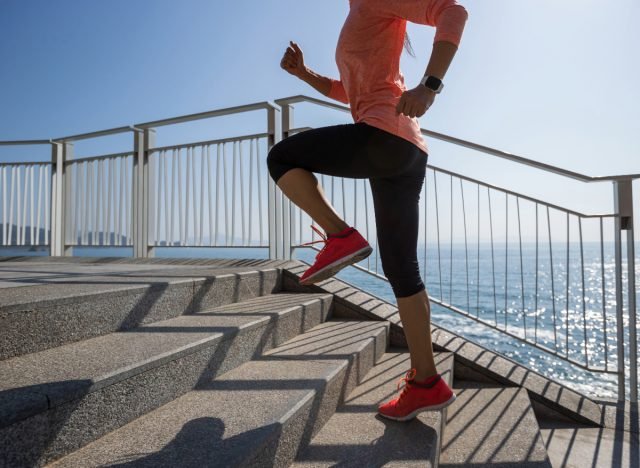
Stairs quickly expose lower-body strength and any lingering weakness. One step asks your leg to push, your knee to stay steady, and your hips to help control the climb. After 60, building that strength can make stairs feel less draining and boost your confidence throughout the day.
No-floor exercises fit this goal well because stair climbing happens on your feet. You’re standing, shifting weight, stepping up, and lowering down with control. A routine that keeps you upright makes the training feel closer to the movement you’re trying to improve.
Lunges can absolutely help, especially when they feel comfortable. These exercises give you other ways to build the same lower-body qualities with more support, clearer targets, and less range when needed. You can train the thighs, glutes, hips, and core without making the workout feel complicated.
Ahead, you’ll get four no-floor exercises that help restore stair-climbing strength after 60. The focus is hip support, step-up strength, single-leg control, and squat power so stairs feel stronger one rep at a time.
Mini-Band Lateral Walk
Before you worry about step height, train the hips that help keep your legs steady. Mini-band lateral walks strengthen the outer glutes, which support your pelvis when one foot is on the ground. That control helps your knees track better during step-ups, squats, and stair climbing. Keep the steps small so the band stays tight and the side of your hips keeps working.
Muscles Trained: Glutes, outer hips, quads, hamstrings, core.
How to Do It
- Place a mini-band above your knees or around your ankles.
- Stand with your feet about hip-width apart.
- Bend your knees slightly.
- Press gently out against the band.
- Step to the right with control.
- Complete your reps, then step back to the left.
Recommended Sets and Reps: Perform 2 to 3 sets of 5 to 8 steps per side. Rest for 30 to 45 seconds.
Best Variations: Band-above-knees lateral walk, smaller lateral steps, supported lateral walk.
Form Tip: Keep tension on the band.
RELATED: 4 Standing Exercises That Trim Thigh Fat Faster Than Running After 55
Box Step-Up
The step-up is the closest match to the job stairs already ask you to do. Plant one foot, drive the front leg, and rise under control. That makes this exercise one of the most useful choices for rebuilding confidence on stairs. Start with a low box or step, use support if needed, and let the working leg do the climbing.
Muscles Trained: Quads, glutes, hamstrings, calves, core.
How to Do It
- Stand facing a sturdy box, step, or low platform.
- Place your right foot fully on the box.
- Hold a wall, railing, or counter if needed.
- Press through your right foot and step up.
- Stand tall at the top.
- Step down with control, then complete your reps before switching sides.
Recommended Sets and Reps: Perform 2 to 3 sets of 6 to 10 reps per side. Rest for 45 to 60 seconds.
Best Variations: Lower step-up, supported step-up, slower step-up.
Form Tip: Place your whole foot on the box.
Split Squat ISO Hold
Holding the bottom portion of a split squat builds strength where many people feel shaky on stairs. Your front thigh stays active, your glute supports the position, and your core keeps you tall. This gives you single-leg strength practice without stepping in and out of a full lunge each rep. Use a chair or counter for balance and hold a range you can control.
Muscles Trained: Quads, glutes, hamstrings, calves, core.
How to Do It
- Stand in a split stance with one foot forward and one foot back.
- Lightly hold a sturdy chair, wall, or counter.
- Bend both knees and lower into a comfortable range.
- Hold the position.
- Keep your front foot planted.
- Stand back up, then switch sides after your hold.
Recommended Sets and Reps: Perform 2 to 3 holds of 15 to 30 seconds per side. Rest for 45 to 60 seconds.
Best Variations: Higher split squat hold, shorter hold, supported split squat reps.
Form Tip: Keep your front foot planted.
RELATED: 5 Chair Exercises That Build Ankle Stability Faster Than Balance Exercises After 60
Goblet Box Squat
Stair climbing needs strong thighs and hips, and goblet box squats give you a simple way to train both. The box gives you a clear target on every rep, while the weight at your chest helps you stay upright. I like this move for people over 60 because it builds the strength needed to stand, climb, and lower with more control. Choose a box height that lets you sit lightly and stand without rocking forward.
Muscles Trained: Quads, glutes, hamstrings, core, upper back.
How to Do It
- Stand in front of a sturdy box, bench, or chair.
- Hold a dumbbell or kettlebell at your chest.
- Set your feet about shoulder-width apart.
- Bend your knees and lower toward the box.
- Lightly touch your hips to the box.
- Press through your feet to stand tall.
Recommended Sets and Reps: Perform 2 to 3 sets of 8 to 12 reps. Rest for 45 to 60 seconds.
Best Variations: Bodyweight box squat, higher box squat, slower goblet box squat.
Form Tip: Touch the box lightly.
RELATED: 5 Morning Exercises That Trim Apron Belly Faster Than 30 Minutes of Cardio After 55
How to Build Stair-Climbing Strength After 60
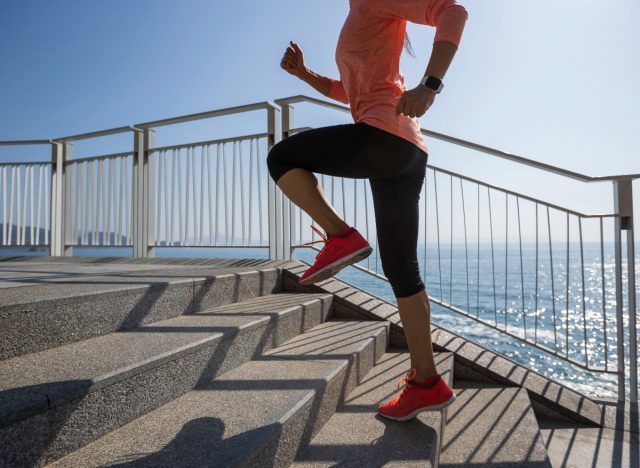
Stairs feel easier when your legs can push, your hips can support each step, and your body can control the lowering phase. Use these exercises two to four days per week, then practice stairs at a comfortable pace when your legs feel fresh. Keep lunges in the mix if they feel good, and use these moves when you want more support or a clearer setup.
- Start with hip work: Mini-band walks help your knees feel steadier before step-ups and squats.
- Use a low step first: A lower box lets you build strength without rushing into a height that changes your form.
- Hold support lightly: Use a chair, wall, or railing to help you balance while your legs do the work.
- Train the lowering phase: Step down slowly so your quads learn to control each descent.
- Keep the split squat hold short: A clean 15-second hold beats a longer hold that turns sloppy.
- Choose a box height you trust: Goblet box squats should feel controlled from the first rep.
- Practice stairs on strong days: Use easy stair climbs to connect the workout back to daily life.
References
- Frith, Emily, and Paul D Loprinzi. “The Association between Lower Extremity Muscular Strength and Cognitive Function in a National Sample of Older Adults.” Journal of lifestyle medicine vol. 8,2 (2018): 99-104. doi:10.15280/jlm.2018.8.2.99
- Sanchez-Lastra, Miguel A et al. “Stair climbing and mortality: a prospective cohort study from the UK Biobank.” Journal of cachexia, sarcopenia and muscle vol. 12,2 (2021): 298-307. doi:10.1002/jcsm.12679
- Liao, Kai-Fang et al. “Effects of unilateral vs. bilateral resistance training interventions on measures of strength, jump, linear and change of direction speed: a systematic review and meta-analysis.” Biology of sport vol. 39,3 (2022): 485-497. doi:10.5114/biolsport.2022.107024
The post 4 No-Floor Exercises That Restore Stair-Climbing Strength Faster Than Lunges After 60 appeared first on Eat This Not That.


