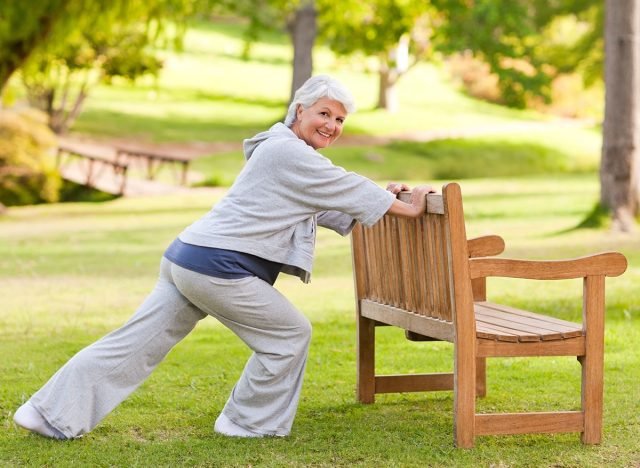
The kitchen counter can turn an ordinary part of the house into a steady training station. You already stand there during the day, so it’s an easy place to add a few focused hip reps. The height gives you support without making the exercises feel like a big setup.
Restoring hip strength after 60 helps daily movement feel smoother. Stronger hips can support walking, standing from a chair, climbing stairs, and keeping your balance during quick changes in position. A counter gives you a safe place to train those patterns while staying upright.
Gym machines have value, especially for building muscle in a controlled setting. Counter exercises add something different because your hips work while your feet stay on the floor and your body manages balance. That carryover can make the work feel more connected to how you move outside the gym.
The four exercises below use the kitchen counter for support while your hips do the work. You’ll train side-hip strength with band abductions, rebuild the squat pattern, strengthen each leg with reverse lunges, and finish with marching for hip control.
Standing Band Hip Abductions
Outer-hip strength plays a big role in how steady you feel when you walk or stand on one leg. Standing band hip abductions target that area without needing a machine. The counter gives you enough support to stay tall while the band adds resistance through each side lift. Keep the range modest at first so the working hip stays in charge of the rep.
Muscles Trained: Outer hips, glutes, hip stabilizers, core.
How to Do It
- Place a mini-band above your knees or around your ankles.
- Stand beside a sturdy kitchen counter.
- Rest one hand lightly on the counter.
- Shift your weight onto the leg closest to the counter.
- Lift your outside leg out to the side.
- Lower with control and repeat before switching sides.
Recommended Sets and Reps: Perform 2 to 3 sets of 10 to 15 reps per side.
Best Variations: Band-above-knees abduction, smaller-range abduction, side taps.
Form Tip: Keep your toes facing forward as you lift your leg.
RELATED: 5 Chair Exercises That Shrink Belly Pooch Faster Than Gym Classes After 50
Supported Squats
A squat feels better when the body has a clear place to organize itself. With your hands on the counter, you can lower into a comfortable range and focus on pressing through the floor as you stand. Your hips and thighs share the work, making this movement useful for rebuilding lower-body strength at home. Use the counter lightly so your legs still handle the effort.
Muscles Trained: Glutes, quads, hamstrings, core.
How to Do It
- Stand facing a sturdy kitchen counter.
- Place both hands lightly on the counter.
- Set your feet about shoulder-width apart.
- Push your hips back and bend your knees.
- Lower to a comfortable depth.
- Press through your feet to stand tall.
Recommended Sets and Reps: Perform 2 to 3 sets of 8 to 12 reps.
Best Variations: Smaller-range squat, slow-tempo supported squat, supported squat with a pause.
Form Tip: Keep your hands light on the counter so your legs do most of the work.
Supported Reverse Lunge
Single-leg strength often needs extra attention after 60, and the reverse lunge is a smart way to build it. Stepping back keeps the movement controlled while the front hip and thigh do the main work. Holding the counter helps you stay balanced, so you can focus on a clean lunge instead of fighting the wobble. Start with a short step and build from there.
Muscles Trained: Glutes, quads, hamstrings, hip stabilizers, core.
How to Do It
- Stand beside the counter with one hand resting lightly on it.
- Stand tall with your feet under your hips.
- Step one foot back.
- Bend both knees to a comfortable depth.
- Press through your front foot to return to standing.
- Complete your reps, then switch sides.
Recommended Sets and Reps: Perform 2 to 3 sets of 6 to 10 reps per side.
Best Variations: Step-back taps, smaller-range reverse lunges, supported split squats.
Form Tip: Keep your front foot planted as you return to standing.
RELATED: 4 Home Exercises That Restore Posture Faster Than Back Braces After 60
Supported Marching
Marching is simple, but it gives the hips a useful job. Each knee lift strengthens the front of the hip while the standing side keeps you steady. The counter helps you stay upright so the movement stays clean from rep to rep. Move slowly enough to pause at the top before setting the foot back down.
Muscles Trained: Hip flexors, glutes, quads, core.
How to Do It
- Stand facing the counter.
- Place both hands lightly on the counter.
- Stand tall with your feet under your hips.
- Lift one knee toward hip height.
- Pause briefly at the top.
- Lower your foot and switch sides.
Recommended Sets and Reps: Perform 2 to 3 sets of 20 to 30 seconds.
Best Variations: Smaller knee lift, paused marching, banded supported marching.
Form Tip: Stay tall through your torso as each knee lifts.
RELATED: 5 Chair Exercises That Build a 6-Pack in 21 Days After 60
How to Keep Restoring Hip Strength at Home

Kitchen-counter exercises work well when they feel easy to start and strong enough to be effective. Use these moves three to five days per week, especially on days when your hips feel stiff, or your balance needs a little practice. Start with two rounds, then add a third once the reps feel smooth. The counter can stay part of the plan as you get stronger, even if you gradually use less pressure through your hands.
- Use the counter lightly: Keep your fingertips on the surface for balance while your hips and legs handle the work.
- Start with a smaller range: A shorter lunge, squat, or leg lift can still build strength when the movement stays controlled.
- Pause when you can: Holding the top of a march or side lift for one second helps you feel the working hip.
- Train both sides with focus: Give each side clean reps, especially if one hip feels less steady.
- Walk most days: Walking gives your hips more practice supporting you through regular movement.
- Progress gradually: Add reps, band tension, or another round once the current version feels smooth.
References
- Gafner, Simone C et al. “Hip muscle and hand-grip strength to differentiate between older fallers and non-fallers: a cross-sectional validity study.” Clinical interventions in aging vol. 13 1-8. 21 Dec. 2017, doi:10.2147/CIA.S146834
- Lanza, Marcel B., et al. “Systematic Review of the Importance of Hip Muscle Strength, Activation, and Structure in Balance and Mobility Tasks.” Archives of Physical Medicine and Rehabilitation, vol. 103, no. 8, 2022, pp. 1651–1662. https://doi.org/10.1016/j.apmr.2021.12.008.
The post 4 Kitchen-Counter Exercises That Restore Hip Strength Faster Than Gym Machines After 60 appeared first on Eat This Not That.


