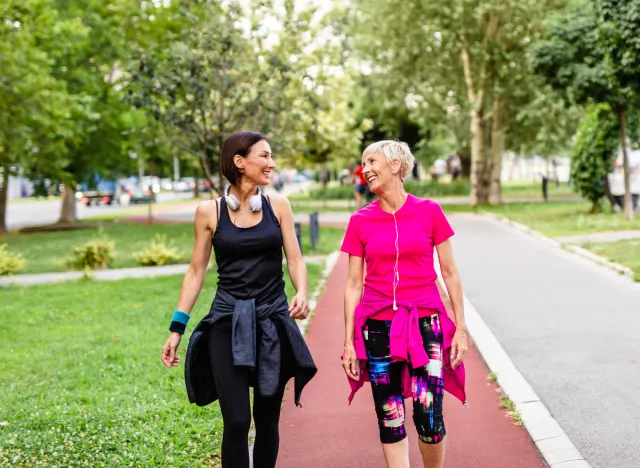
Walking gives you a lot of return for something you already do every day. Keeping up a regular walking habit supports your health and gives you an easy way to stay active without needing much equipment or planning. After 60, being able to keep walking comfortably can also open the door to doing more of the things you enjoy outside of exercise.
Walking speed deserves some attention, too. A slower pace can creep in as leg strength drops and each step starts requiring a little more effort. Improving the strength behind your stride can help you cover ground more comfortably and keep a pace that feels natural, instead of working harder just to keep moving.
Mobility is tied closely to that. Your hips need enough freedom to move through each step, while your ankles have to let you roll forward and push into the next one. You can’t literally turn your mobility clock back 10 years, but training those qualities can help you move with more strength and freedom as you age.
That’s where these four home exercises come in. Each one strengthens a part of the walking pattern that can lose some ground after 60, and none requires a complicated setup. Work them into your week alongside regular walks and give your body a stronger base for picking up the pace.
Bodyweight Box Squat
Walking faster takes more leg strength than most people realize. Your thighs and glutes have to support your body and produce force repeatedly, and box squats give those muscles a straightforward strength challenge. The chair or box also gives you a consistent depth to work toward as your legs get stronger.
Muscles Trained: Quads, glutes, hamstrings, core.
How to Do It
- Stand in front of a sturdy chair or box.
- Set your feet about shoulder-width apart.
- Sit your hips back and bend your knees.
- Lower until your thighs reach at least parallel, if comfortable.
- Lightly touch the box.
- Press through your feet to stand.
Recommended Sets and Reps: Perform 2 to 3 sets of 8 to 12 reps. Rest for 45 to 60 seconds.
Best Variations: Higher box squat, slower box squat, goblet box squat.
Form Tip: Touch the box lightly instead of sitting back and relaxing.
RELATED: 5 Standing Exercises That Restore Leg Strength Faster Than Gym Machines After 70
Supported Reverse Lunge
Every step puts you on one leg for a moment, so walking well depends on each side being able to support you. Reverse lunges build that single-leg strength while giving your hips a chance to move through a bigger range than they usually get during a short stride. Hold a chair or counter so you can focus on the legs without turning the exercise into a balance test.
Muscles Trained: Quads, glutes, hamstrings, calves, core.
How to Do It
- Stand beside a sturdy chair or counter.
- Hold it lightly with one hand.
- Step your right foot backward.
- Bend both knees and lower into a comfortable lunge.
- Press through your front foot to return to standing.
- Complete your reps, then switch sides.
Recommended Sets and Reps: Perform 2 to 3 sets of 6 to 10 reps per side. Rest for 45 to 60 seconds.
Best Variations: Smaller-range reverse lunge, supported split squat, alternating reverse lunge.
Form Tip: Use your front leg to bring yourself back to standing.
Standing March
If your stride has started feeling shorter, practicing a strong knee lift can help bring some intention back to the walking pattern. Standing marches train the hip flexors while the opposite leg supports your weight. Start slowly, then gradually make the movement more rhythmic as your control improves.
Muscles Trained: Hip flexors, quads, glutes, core.
How to Do It
- Stand beside a chair or counter for support if needed.
- Set your feet about hip-width apart.
- Shift your weight onto your left leg.
- Lift your right knee toward hip height.
- Lower your foot with control.
- Continue alternating sides.
Recommended Sets and Reps: Perform 2 to 3 rounds of 20 to 40 seconds. Rest for 30 to 45 seconds.
Best Variations: Supported march, slower high-knee march, faster alternating march.
Form Tip: Stand tall as each knee comes up.
RELATED: 5 Wall Exercises That Trim Tummy Roll Faster Than Crunches After 60
Bodyweight Calf Raise
The calves help finish each step by pushing you forward as your heel leaves the ground. When that push-off gets weaker, walking speed can take a hit even if the rest of your legs feel reasonably strong. Calf raises give you an easy way to train that part of your stride at home, and a chair or counter can handle the balance piece while you focus on getting stronger.
Muscles Trained: Calves, ankles, feet.
How to Do It
- Stand with your feet about hip-width apart.
- Hold a chair or counter lightly if needed.
- Press through the balls of your feet.
- Lift your heels as high as comfortable.
- Pause briefly at the top.
- Lower with control.
Recommended Sets and Reps: Perform 2 to 3 sets of 10 to 15 reps. Rest for 30 to 45 seconds.
Best Variations: Slower calf raise, single-leg supported calf raise, seated calf raise.
Form Tip: Lower your heels under control on every rep.
RELATED: 5 Exercises That End the Senior Shuffle Faster Than Walking After 65
How to Keep Your Walking Speed and Mobility Moving Forward
Strength exercises give you more capacity, but you still need to use it. Keep walking throughout the week, and give yourself occasional chances to move faster when you feel comfortable.
- Train these exercises two to three days per week: Leave some recovery time between harder strength sessions.
- Add short faster walks: Pick a brief stretch of your normal route and walk at a quicker, controlled pace.
- Keep your walks varied: Different routes can naturally expose you to changes in pace and terrain.
- Progress the strength work: Add reps or a little resistance once the bodyweight versions feel easy.
- Use support when you need it: A chair or counter can help you work through a fuller range with better control.
- Notice your normal pace: Pay attention to whether you’re covering familiar walks more comfortably over the next several weeks.
- Stay consistent with mobility: Regular movement through comfortable ranges helps keep your hips and ankles from spending most of the day in the same positions.
References
- Ungvari, Zoltan et al. “The multifaceted benefits of walking for healthy aging: from Blue Zones to molecular mechanisms.” GeroScience vol. 45,6 (2023): 3211-3239. doi:10.1007/s11357-023-00873-8
- La New, Jacquelyn M, and Katarina T Borer. “Effects of Walking Speed on Total and Regional Body Fat in Healthy Postmenopausal Women.” Nutrients vol. 14,3 627. 31 Jan. 2022, doi:10.3390/nu14030627
- Ferrucci, Luigi et al. “Age-Related Change in Mobility: Perspectives From Life Course Epidemiology and Geroscience.” The journals of gerontology. Series A, Biological Sciences and Medical Sciences, vol. 71,9 (2016): 1184- 94. doi:10.1093/gerona/glw043
The post 4 Home Exercises That Restore the Walking Speed and Keep Your Mobility 10 Years Younger After 60 appeared first on Eat This Not That.


