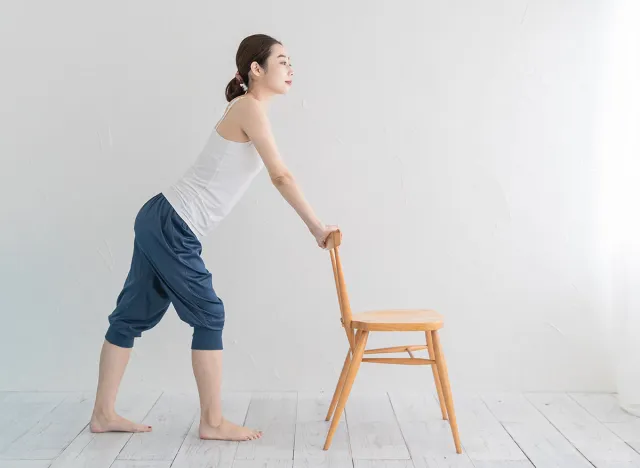
A sturdy chair can give your back of the arm a surprisingly good workout. You don’t need a packed class or a long circuit to make the triceps work hard. With a little resistance and the right exercise choices, you can focus more on the area you want to strengthen.
That focus matters after 60 because triceps can lose size when they stop being challenged regularly. Adding muscle there can give the upper arm more shape, while changes in body fat also influence how defined the area looks. Loose skin is a separate part of the picture, so exercise can improve the muscle underneath without promising to change the skin itself.
A general gym class has to spread its attention across the whole body. This short routine gives the triceps more direct work and makes progression easy to track from week to week. The chair provides a stable setup so you can focus on strengthening your arms.
Seated Dumbbell Overhead Triceps Extension
The overhead position puts the triceps under tension through a long range of motion. That makes it a strong choice when you want focused work through the back of the arm. Use a weight that feels challenging near the end of the set without forcing your shoulders or elbows into an uncomfortable position.
Muscles Trained: Triceps, shoulders.
How to Do It
- Sit tall near the front of a sturdy chair.
- Hold one dumbbell with both hands.
- Press the dumbbell overhead.
- Bend your elbows and lower the weight behind your head.
- Extend your elbows to raise the dumbbell.
- Repeat without letting your elbows flare far outward.
Recommended Sets and Reps: Perform 2 to 3 sets of 8 to 12 reps. Rest for 45 to 60 seconds.
Best Variations: Single-arm overhead extension, lighter dumbbell extension, slower overhead extension.
Form Tip: Keep your upper arms pointed mostly forward as the elbows bend.
RELATED: 5 Exercises That Restore the Core Strength You Had at 40 After 65
Chair Incline Push-Up
Bodyweight pressing challenges the triceps differently than dumbbell work. Using a chair reduces how much of your body weight you have to move, so you can focus on clean reps and build volume without starting on the floor. A slightly narrower hand position keeps more emphasis on the arms as you press.
Muscles Trained: Triceps, chest, shoulders, abs.
How to Do It
- Place your hands on the edge or seat of a sturdy chair that won’t slide.
- Step your feet backward.
- Keep your hands around shoulder-width apart.
- Bend your elbows and lower your chest toward the chair.
- Stop when your elbows reach about 90 degrees.
- Press through your hands to return to the top.
Recommended Sets and Reps: Perform 2 to 3 sets of 8 to 12 reps. Rest for 45 seconds.
Best Variations: Wall push-up, higher incline push-up, narrow-grip incline push-up.
Form Tip: Keep your elbows closer to your sides as you lower.
Seated Dumbbell Triceps Kickback
Kickbacks finish the routine with a movement that emphasizes fully straightening the elbow. The seated setup keeps you supported so you can focus on the triceps doing the work. Light dumbbells are usually plenty here, especially when you pause briefly at the end of each rep.
Muscles Trained: Triceps, rear shoulders.
How to Do It
- Sit near the edge of a sturdy chair with a dumbbell in each hand.
- Lean forward slightly while keeping your back neutral.
- Bend your elbows and pull your upper arms beside your torso.
- Extend your elbows until your arms straighten behind you.
- Pause briefly.
- Bend your elbows to return the weights and repeat.
Recommended Sets and Reps: Perform 2 to 3 sets of 10 to 15 reps. Rest for 30 to 45 seconds.
Best Variations: Single-arm kickback, lighter kickback, paused triceps kickback.
Form Tip: Keep your upper arms in place while your forearms move.
RELATED: 5 Daily Exercises Women Over 65 Need to Keep Their Muscles Strong
Build More Shape Through Your Upper Arms
Give the triceps enough resistance to make the last few reps feel challenging, then allow them time to recover before training them hard again. Two to three focused sessions per week is plenty for most people.
- Increase the load gradually: Move up in weight once the current dumbbells stop challenging you.
- Keep the reps controlled: Slower reps can make light resistance much more effective.
- Train the rest of your body too: Full-body resistance work helps preserve muscle as you get older.
- Get enough protein: Consistent protein intake supports muscle repair and growth.
- Stay active outside these sessions: Regular movement can support overall body-composition changes.
- Judge progress over weeks: Stronger sets and heavier dumbbells often appear before visible changes do.
References
- Briand, Marguerite et al. “Body composition and aging: cross-sectional results from the INSPIRE study in people 20 to 93 years old.” GeroScience vol. 47,1 (2025): 863-875. doi:10.1007/s11357-024-01245-6
- Strasser, Barbara et al. “Role of Dietary Protein and Muscular Fitness on Longevity and Aging.” Aging and Disease vol. 9,1 119-132. 1 Feb. 2018, doi:10.14336/AD.2017.0202
The post 3 Chair Exercises That Smooth Bat Wings Faster Than Gym Classes After 60 appeared first on Eat This Not That.


