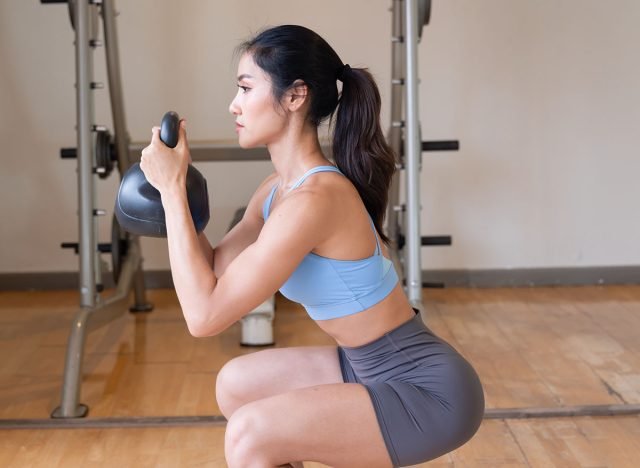
When someone over 60 tells me they’re ready to start training again, I usually begin with something simple and useful. I want an exercise that feels familiar, lets me see how they move, and can be adjusted without changing the whole setup. That’s why I keep coming back to the goblet box squat.
Squatting is one of the basic movements you use every day. You sit down, stand back up, lower yourself toward something, and push through your legs to get moving again. Training that pattern gives you a straightforward way to rebuild lower-body strength while also working on the mobility and control that often slip after a long break.
The box is what makes this version especially useful for someone starting over. Raise it, and the squat becomes easier. Lower it as mobility and strength improve, or add a little more weight when you’re ready for a bigger challenge. You can keep the same exercise around for a long time while the difficulty grows with you.
I also like what it sets up later. Once someone can squat well to a box with a manageable load, it’s much easier to move into heavier goblet squats, step-ups, lunges, or other lower-body exercises. You’ve already built a solid base to work from.
RELATED: 5 Compound Exercises That Build Visible Abs After 60
The Goblet Box Squat
The goblet box squat gives you a clear depth target while keeping the weight close to your body. That makes it easier to learn how to sit back, bend the knees, and stand with control after time away from training.
It also gives you plenty of room to progress. You can adjust the box height to match your current mobility and use a light dumbbell or kettlebell while you get comfortable with the movement. From there, adding load or gradually lowering the target keeps the exercise moving forward.
The biggest reason I like it is how much it covers with one basic movement. Your legs produce the force to stand, your hips move through a useful range of motion, and your trunk supports the weight in front of you. That gives you a strong foundation for the exercises that come next.
Muscles Trained: Quads, glutes, hamstrings, core.
How to Do It
- Stand in front of a sturdy box or bench.
- Hold a dumbbell or kettlebell against your chest.
- Set your feet about shoulder-width apart.
- Sit your hips back and bend your knees.
- Lower until you lightly touch the box.
- Press through your feet and return to standing.
Recommended Sets and Reps: Perform 2 to 3 sets of 8 to 12 reps. Rest for 60 seconds.
Best Variations: Bodyweight box squat, supported box squat, lower-box goblet squat, heavier goblet box squat.
Form Tip: Lightly touch the box and keep tension through your legs as you stand back up.
Why I Keep It in the Program

The goblet box squat gives you a clear starting point and plenty of room to grow. You can make small adjustments as your strength, mobility, and confidence improve, which makes it an easy exercise to keep in your program for a long time.
That’s what I want when someone is starting over. A movement that feels manageable now and still has somewhere to go a few months from now.
- Adjust the box height: A higher surface gives you a shorter range of motion, and you can lower it gradually as your mobility improves.
- Start with a light load: Give yourself time to get comfortable with the movement and build confidence through clean reps.
- Build consistency: Repeating the same movement well from week to week gives you a strong base to progress from.
- Progress one variable at a time: Add a little weight or lower the box when you’re ready for the next challenge.
- Use it as a stepping stone: Strong, confident box squats set you up well for more challenging lower-body exercises later.
References
- Zolfaghari, Samaneh et al. “Evaluating muscle aging during relaxed standing, squats and lunges through electrical bioimpedance.” Scientific Reports vol. 15,1 39359. 10 Nov. 2025, doi:10.1038/s41598-025-27187-3
- Frith, Emily, and Paul D. Loprinzi. “The Association between Lower Extremity Muscular Strength and Cognitive Function in a National Sample of Older Adults.” Journal of Lifestyle Medicine vol. 8,2 (2018): 99-104. doi:10.15280/jlm.2018.8.2.99
The post I’m a Strength Coach and This Is the First Exercise I Teach Anyone Starting Over After 60 appeared first on Eat This Not That.


