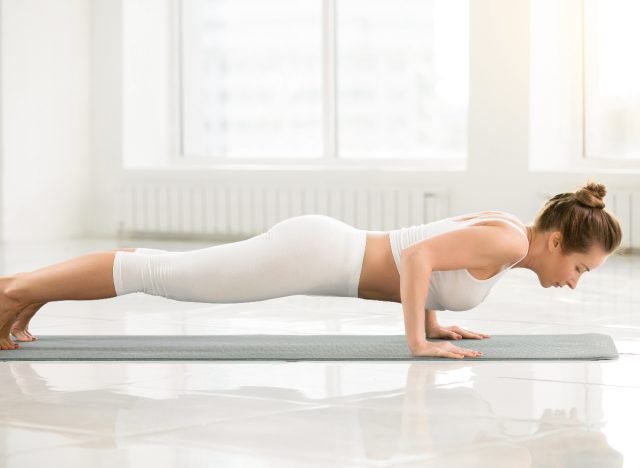
Sagging arms after 60 linger for one simple reason, the triceps lose muscle and get little challenge during daily life. The triceps sit on the back of the upper arm, and that muscle shrinks when you rarely press or carry anything heavy. Firm arms come from building muscle plus losing arm fat across your whole body, rather than from working one spot alone. I’ve coached adults over 60 for years, and arms trained with weights too light to change anything keep hanging the same way. The triceps kickback deserves credit for isolating the back of the arm, but the tradeoff is load. A light dumbbell swung back carries little resistance and trains one muscle. Your arms need a heavier job than that.
Your body is the heaviest thing your arms can press at home, and the push-up lets you choose how much of it they carry. Raise your hands and the load lightens. Lower them and the load rises. For a benchmark, see how many push-ups signal strong upper-body strength after 60 and notice how much that one test tells you.The wall-to-floor ladder below gives you five clear rungs from light to hard. Each rung asks your arms to carry a bigger share of your weight. Pick your rung today and keep the tempo controlled.
Why the Push-Up Beats Every Other Arm Exercise After 60
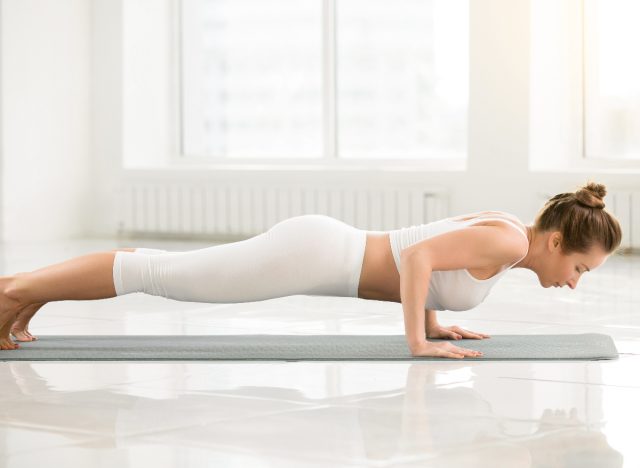
Push-ups, even modified ones done from the knees, grew the back of the arm about as much as bench pressing, about 10% in eight weeks in one study. Push-ups are truly one of the best muscle-building exercises for every age group.
The ladder gives you five clear steps with no gear needed. Raise your hands and the share of body weight your triceps press drops. Lower your hands or move to the floor and it rises. That scalability keeps the challenge real for years while you keep the same movement pattern. Your chest, front shoulders, and trunk get worked as well.
I pick this move for clients over 60 because it carries real load, scales without equipment, and fits in any kitchen. You can start where you are today and still have a harder rung waiting.
RELATED: 5 Morning Exercises for Men Over 65 Who Hate the Gym
How to Do a Push-Up Properly
Set up on a stable surface that cannot slide or tip. Use a wall, a kitchen counter, or a table pushed against a wall, and never anything on wheels. Wear non-slip shoes. Place your hands just outside shoulder width, flat with fingers spread. If your wrists ache, grip the counter edge or make fists on the floor and keep each wrist straight.
Keep your body in one line from head to heels, or from head to knees. Bend the elbows back about 45 degrees, not straight out to the sides. Lower for 3 seconds, as deep as possible with good form. Each rep involves a 1-second pause just short of the surface, then a press away in about 1 second. Exhale on the press and stop at any sharp pain in the shoulder, elbow, or wrist.
Once a rung feels easy, you can bring your thumbs just inside shoulder width and let your elbows brush your ribs. That narrower position shifts more of the work onto the back of the arm. Keep the hands apart.
How to Do It
- Place hands on a stable surface
- Step feet back into one line
- Lower for 3 seconds, elbows back
- Pause, then press away
- Keep your body straight throughout
- Do 3 sets of 8–15 reps
Find Your Rung on the Push-Up Ladder

The ladder runs from the wall down to the floor, and each rung fits a different stage:
- Wall push-up: start here if joints complain
- Kitchen counter: once the wall gets easy
- Sturdy table or stair: steady surface, rail nearby
- Knees on the floor: when kneeling feels comfortable
- Full floor: the hardest rung
Start on the lowest rung where you can do 8 clean reps with the 3-second lowering. Move down a rung after 3 sets of 15 clean reps with that same lowering. Expect fewer reps on the new rung. Move back up a rung if your hips sag or your depth shrinks before 8 reps. I use this rule with clients over 60 because it keeps form honest while strength builds.
Before the knee rung, practice getting down to the floor and up again with a sturdy chair beside you. Kneel on a mat or folded towel. That preparation keeps the change safe and calm.
RELATED: How Many Days a Week Should You Lift Weights After 60 to Rebuild Muscle?
Common Mistakes That Keep Your Arms Soft

Letting the hips sag or pike breaks the line and steals work from the triceps. Fix it by bracing your core and squeezing your glutes before you bend the elbows. Flaring the elbows straight out shifts stress to the shoulders and weakens the press. Keep them back about 45 degrees.
Cutting reps short leaves the triceps half trained, so lower as far as your shoulder stays pain-free. Dropping fast or bouncing off the bottom removes tension where the muscle should work hardest. Own the 3-second lowering and the brief pause, then press up without momentum.
Holding your breath or jutting your head forward tightens the neck. Exhale on the press up and keep your chin tucked. Staying on the wall forever stalls progress, and so does rushing to the floor before the counter is easy. I’d rather you advance by using the rep rule. Control beats speed on every rep.
RELATED: 4 Exercises That Flatten Your Midsection Without Getting on the Floor After 65
How Often to Do Push-Ups After 60

Train 2–3 days a week with at least 1 rest day between sessions. Rest 1–2 minutes between sets and end a set when a rep loses form. Check your rung against the advance rule weekly. I like that weekly check because it turns progress into a clear yes or no.
That steady practice carries into daily life over time. Pushing up from the floor or out of a low chair feels smoother. A heavy door moves more easily, and the back of your arm firms as muscle builds underneath.
The post If You Only Do One Exercise for Sagging Arms After 60, Make It This One appeared first on Eat This Not That.


