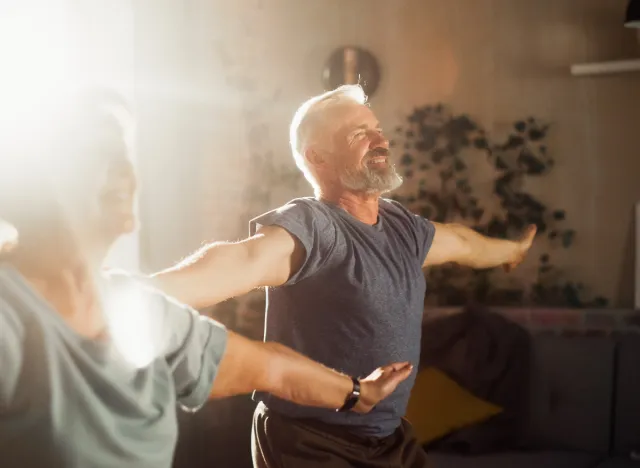
Walking is great for staying active, but your waistline may respond better if you add strength training and a little more intensity to your week. After 65, exercises that build more muscle can help you burn more energy while helping you hold onto the lean tissue that supports your metabolism.
That doesn’t mean you need a hard workout every day. Short bouts of squats, lunges, or faster intervals can add up when you repeat them consistently. Pair that with solid nutrition and plenty of movement outside the workout, and you’ve got a much stronger fat-loss setup than simply adding more easy-paced steps.
Your midsection also benefits when the core has to work while the rest of the body moves. Marching with a load or holding a lunge upright asks your abs to stabilize you while your legs keep working. That gives the session more overall demand than a walk alone.
For this routine, you’ll move between lower-body strength and short conditioning intervals. The goal is to get more work done in less time, keep the exercises easy to scale, and give you something you can repeat throughout the week without a gym.
Bodyweight Squat
Squats are a good place to start because they recruit a lot of lower-body muscle in every rep. Your thighs and glutes do most of the work, while your core helps keep you steady as you lower and stand. That makes it useful when you want to engage more muscle than a simple walk.
Muscles Trained: Quads, glutes, hamstrings, core.
How to Do It
- Stand with your feet about shoulder-width apart.
- Reach your arms forward.
- Sit your hips back.
- Bend your knees and lower toward the floor.
- Descend to at least parallel if comfortable.
- Press through your feet to stand.
Recommended Sets and Reps: Perform 2 to 3 sets of 10 to 15 reps. Rest for 30 to 45 seconds.
Best Variations: Supported squat, box squat, slow-tempo squat.
Form Tip: Keep your feet planted as you stand back up.
RELATED: 5 Daily Exercises Men Over 70 Need to Keep Their Balance Sharp
Jumping Jack Intervals
This is where you can raise the pace. Jumping jacks move your arms and legs together, quickly raising your heart rate and giving you a short burst of conditioning without needing much space. Keep the interval brief and use the low-impact version whenever jumping feels like too much.
Muscles Trained: Calves, quads, glutes, shoulders, core.
How to Do It
- Stand tall with your feet together.
- Jump your feet apart as your arms travel overhead.
- Land with your knees slightly bent.
- Jump your feet back together.
- Lower your arms.
- Continue at a pace you can control.
Recommended Sets and Reps: Perform 3 to 5 rounds of 20 to 30 seconds. Rest for 30 to 45 seconds.
Best Variations: Step-out jumping jack, low-impact jack, shorter interval.
Form Tip: Use a step-out version if repeated jumping bothers your knees or ankles.
Supported Reverse Lunge
Reverse lunges give one leg more work at a time, which can make a short set feel pretty demanding. Using a chair or counter for support lets you focus on your legs instead of worrying about balance, and you can keep the range short as you build strength.
Muscles Trained: Quads, glutes, hamstrings, calves.
How to Do It
- Stand beside a sturdy chair or counter.
- Rest one hand lightly on the support.
- Step your right foot backward.
- Bend both knees into a comfortable lunge.
- Press through your front foot to return to standing.
- Complete your reps, then switch sides.
Recommended Sets and Reps: Perform 2 to 3 sets of 6 to 10 reps per side. Rest for 45 to 60 seconds.
Best Variations: Smaller-range reverse lunge, supported split squat, alternating reverse lunge.
Form Tip: Let the front leg bring you back to standing.
RELATED: 5 Exercises That Undo 10 Years on the Couch Faster Than Walking After 60
Goblet Hold Marching Intervals
Holding a weight in front of your chest quickly changes a simple march. Your core has to brace while each leg takes a turn supporting your body, and the added load makes the legs work harder than they would during normal walking. Keep the weight light enough to stay upright and move smoothly.
Muscles Trained: Abs, quads, glutes, hip flexors, shoulders.
How to Do It
- Hold a light dumbbell or kettlebell in front of your chest.
- Stand tall with your feet about hip-width apart.
- Brace your abs.
- Lift your right knee.
- Lower your foot with control.
- Switch sides and continue marching.
Recommended Sets and Reps: Perform 3 to 4 rounds of 20 to 40 seconds. Rest for 30 to 45 seconds.
Best Variations: Bodyweight march, lighter goblet hold, slower marching interval.
Form Tip: Keep the weight close to your chest as you march.
RELATED: 5 Exercises That Restore the Walking Speed You Had at 50 After 75
Give Your Waistline More Than Extra Steps

Walking should still stay in your week. These exercises simply give you another way to increase the amount of work your body does while building strength at the same time.
- Use the harder intervals strategically: The jumping jacks and loaded marches don’t need to be all-out to work.
- Keep the strength work consistent: Squats and lunges help you hold onto muscle while you work on fat loss.
- Walk on top of the routine: Daily steps still help raise your total activity.
- Pay attention to your food intake: A sustainable calorie deficit drives waist-size changes.
- Progress slowly: Add reps, time, or load once your current version feels comfortable.
- Use low-impact options when needed: Step-out jacks and bodyweight marching still give you useful work.
References
- Briand, Marguerite et al. “Body composition and aging: cross-sectional results from the INSPIRE study in people 20 to 93 years old.” GeroScience vol. 47,1 (2025): 863-875. doi:10.1007/s11357-024-01245-6
- Newman, Anne B et al. “The Health, Aging, and Body Composition (Health ABC) Study-Ground-Breaking Science for 25 Years and Counting.” The journals of gerontology. Series A, Biological Sciences and Medical Sciences, vol. 78,11 (2023): 2024- 2034. doi:10.1093/gerona/glad167
The post 4 Daily Exercises That Shrink Your Waistline Faster Than Walking After 65 appeared first on Eat This Not That.


