
Sore feet are one of the most common reasons clients over 65 tell me they’ve started walking less, and most of them assume it’s just part of getting older. They stop walking to the store first, then drop the longer weekend walks, and within a year they’re walking far less than they used to.
I’ve worked as a personal trainer for four decades and co-founded TRAINFITNESS, the UK’s favorite fitness education company, back in 1998. What most of my clients don’t realize is that your feet have muscles like anywhere else in your body, and those muscles respond to training at any age. These four simple exercises can help you get back to walking without the ache.
Why Feet Hurt After 65

By far the most common problem I see is heel pain with the first few steps in the morning, or after getting up from a chair. That’s usually plantar fasciitis, irritation of the strong band of tissue running from the heel to the toes. Plenty of my clients describe hobbling to the coffee maker each morning until the heel loosens up enough to take their full weight.
Next comes arch ache: the foot feels fine in the morning but is sore, and visibly flatter, by the end of the day. I also see a lot of stiff, sore big toe joints, bunions, and pain under the ball of the foot as the natural padding there thins with age. Tired calves and stiff ankles run alongside all of these.
Shoes play their part too. Slippers all day, narrow sneakers, flat slip-ons: most of the shoes people live in squeeze the toes together or leave the foot working on a thin, hard sole. A wide toe box and some cushioning under the heel make a difference to how the whole day feels.
What worries me more than any one problem is how people adapt to it. They take shorter, shuffling steps to stop the sore foot rolling through, and they walk less because walking hurts. A few months of that and everything is weaker, so the same walk hurts more than it did before, and they walk even less.
RELATED: 4 Home Exercises That Restore Muscle Definition Faster Than Lifting Weights After 60
Why Stronger Feet Walk Easier
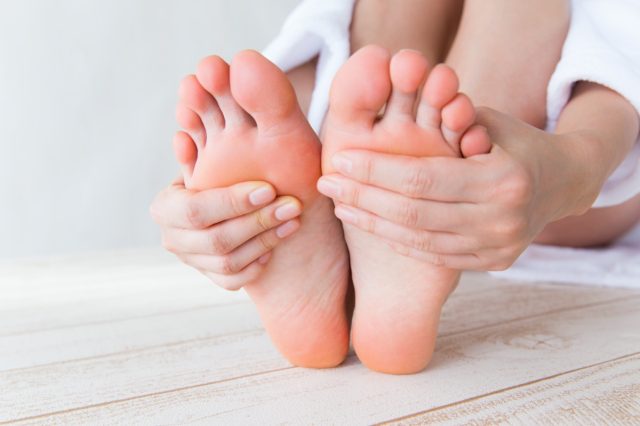
There are small muscles inside the foot itself. They hold the arch up and control the toes, and they’re working the whole time you stand or walk. Sitting above them, the calf and ankle muscles absorb the impact of every step and control how the foot rolls through it.
Aging and years in supportive or tight shoes weaken both sets. When they’re weak, the load passes to the plantar fascia, the fat pad under the heel, and the joints around the big toe, which is exactly where most people feel their pain. Strengthening the muscles shares that load back out across the whole foot and lower leg.
Stiffness matters as much as weakness. If the ankle can’t bend forward, the foot rolls in or the heel lifts early, and the front of the foot takes a pounding it shouldn’t be taking. I pair calf work with an ankle stretch for nearly every client who comes to me with arch or forefoot pain, because between them they deal with both problems.
Exercise helps a lot of everyday foot pain, but not all of it. Sudden pain or swelling, pain at night or at rest, numbness or tingling (particularly if you have diabetes), or a foot that’s changed shape all need a doctor or a podiatrist before you start loading the foot. Get that checked first.
All four of the exercises below are done at home, barefoot, either sitting in a chair or standing at the kitchen counter. You need a wall and a counter and nothing else.
Toe Yoga (Toe Lifts)
This retrains the small muscles that move the big toe separately from the other four. When you walk, the big toe needs to press down firmly to push you off, and most people over 65 have lost that control. The foot then rolls a little with every step, and the front of the foot takes the strain instead.
I’ve had clients in their eighties who couldn’t move the big toe on its own at all on day one. Most of them have it back within two weeks.
How to Do It:
- Sit in a chair with your bare feet flat on the floor.
- Lift your big toe while pressing the other four toes into the floor; hold for 3 seconds.
- Press the big toe down and lift the other four toes; hold for 3 seconds.
- If the toes won’t separate at first, use a finger to hold the other toes down while you practice.
Avoid These Mistakes:
- Don’t cheat with the ankle. If you roll the foot or lift the heel a fraction to get the big toe up, nothing is being trained.
- Don’t give up after a day because it feels impossible. This is a coordination skill, not a strength test, and it improves with a few minutes of practice each day.
Sets and Reps: 10 of each movement, on both feet.
Form Tip: Keep the heel and ankle still. Only the toes should move.
RELATED: 4 Wall Exercises That Rebuild Core Stability Faster Than Planks After 65
Arch Doming (Short Foot Exercise)
This works the muscles under the arch, which act as a natural support for the foot. A stronger arch holds its shape under your weight, which takes strain off the plantar fascia and the heel with every step.
How to Do It:
- Sit with your bare feet flat on the floor.
- Keep the toes long and flat on the floor throughout.
- Draw the ball of the foot toward the heel, so the arch lifts into a small dome.
- Hold the dome for 5 seconds, then relax.
- Progress to doing it standing, then to standing on one leg holding the counter.
Avoid These Mistakes:
- Don’t curl or claw your toes. If the toes grip the floor, the toe muscles are doing the work and the arch stays exactly where it was.
Sets and Reps: 10 reps on each foot.
Form Tip: Keep the toes long and flat, even if the dome is barely visible to begin with.
Slow Heel Raises
This strengthens the calf and the Achilles, which take a big share of the load every time your foot hits the ground. Rising onto the toes also loads the plantar fascia in a controlled way, which helps it toughen up rather than stay irritated. The slow lowering is where most of the benefit sits, so the tempo matters as much as the height.
How to Do It:
- Stand facing the kitchen counter with your fingertips on it for balance, feet hip-width apart.
- Rise up onto the balls of your feet as high as you can, keeping the weight over the big toe and second toe.
- Pause for 1 second at the top.
- Lower slowly, taking a full 3 seconds to come down.
- Progress to one leg at a time, then to standing with your toes on a rolled-up towel.
Avoid These Mistakes:
- Don’t let your ankles roll out so the weight drops onto the little toes. Keep the weight through the big toe side of the foot.
- Don’t thud back down fast. Take the full three seconds on the way down.
- If you can’t control the way down, do fewer reps until you can.
Sets and Reps: 10 to 15 reps, for 2 to 3 sets.
Form Tip: The lowering matters more than the height. Count a slow three every time.
RELATED: 5 Morning Exercises That Rebuild Lower-Body Power Faster Than Lifting Weights After 65
Knee-to-Wall Ankle Stretch
This restores the ankle’s ability to bend forward. That lets the foot roll through each step properly, instead of the arch flattening or the heel lifting early, and it takes pressure off the front of the foot. A stiff ankle sits behind more arch and forefoot pain than people realize.
How to Do It:
- Stand facing a wall with one foot about a hand’s width from it, the other foot behind for balance.
- Put your hands on the wall.
- Keeping the front heel on the floor, bend the front knee toward the wall.
- Hold for 2 seconds, then come back.
- As it gets easier, move the front foot back a little at a time.
Avoid These Mistakes:
- Don’t let your heel lift off the floor. That takes the stretch straight out of the exercise.
- Don’t let your knee collapse inward. That flattens the arch instead of opening the ankle.
Sets and Reps: 10 reps, then swap sides.
Form Tip: Keep the knee in line with the second toe throughout. The heel stays down and the knee tracks over the toes.
How Often to Do This

Toe yoga and arch doming are your daily work: about five minutes in total, done sitting in a chair. They slot into something you’re doing anyway, so most of my clients do them in front of the TV or after a bath, while their feet are warm.
Heel raises are different. Do them three times a week, every other day, so the calf and the Achilles get a recovery day in between. The knee-to-wall stretch is a daily one, and it’s especially useful before a walk or first thing in the morning, when the ankle is at its stiffest.
Some mild aching during the exercises is fine. Sharp pain, or pain that’s worse the next morning than it was the day before, means you’ve done too many reps. Drop the numbers back down and build up again from there.
Keep walking through all of this, but build gradually. Shorter walks more often beat one long one while the feet adapt, so if two miles hurts where one mile doesn’t, do the mile twice and add distance a bit at a time.
RELATED: 4 Doorway Exercises That Flatten Belly Pooch Faster Than Sit-Ups After 65
What to Expect
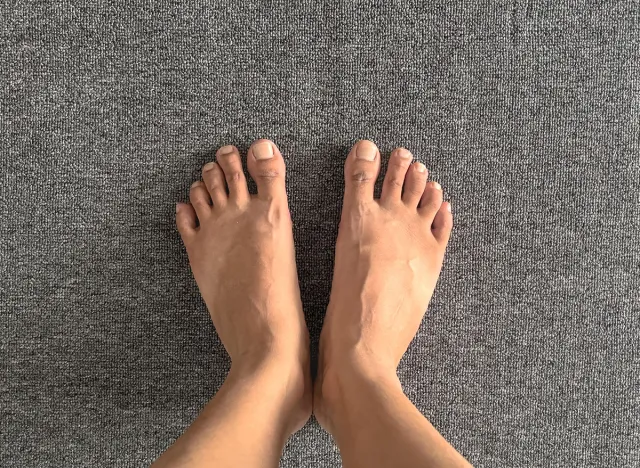
In the first week or two, the changes are small: better control of the toes and the arch, and feet that feel less tired by the end of the day. The toe yoga is usually the first thing to click, when the big toe finally lifts without the others following it.
Between three and six weeks, the calves are noticeably stronger and steps feel springier. For a lot of people, those first steps in the morning start to ease somewhere in this window.
From six to twelve weeks, most people are walking farther with less pain. Heel pain from plantar fasciitis often takes this long or longer, sometimes several months, so stick with it. Plenty of my clients whose heels were the slowest to settle were doing everything right. They just needed more time.
If there’s no improvement after six to eight weeks, or the pain is getting worse rather than better, that’s the time to see a doctor or a podiatrist.
The post 4 Foot Exercises That Make Walking Pain-Free Again After 65 appeared first on Eat This Not That.


