Muscle tone is the firm look and feel you get when your muscles have enough strength and size to show shape. Body fat, nutrition, and consistency all play a role, but the muscles still need regular work. After 60, that work becomes even more important because muscle is tied closely to strength, independence, and how capable your body feels.
Many people want more muscle tone because they want to feel stronger in their arms, legs, hips, and core. It can also make daily movement feel better. Standing from a chair, pushing up from a seated position, walking with more control, and climbing steps all feel easier when your muscles are trained.
Weights can help build muscle, and they’re a great tool when you feel comfortable using them. Chair exercises give you a lower-barrier way to train with intent. The chair adds support, gives you a clear target, and helps you create enough tension to make simple exercises feel productive.
This article shows how to use a chair for focused strength work after 60. You’ll train pushing strength, core control, leg strength, and single-leg stability with exercises that fit a home routine and still challenge the muscles that shape your body.
Chair Plank
A chair plank trains more than your abs. Your shoulders, arms, glutes, and core all have to stay active while you hold your body in position. That full-body tension helps with muscle tone because the exercise teaches you to brace and support your own bodyweight. It also gives you a more approachable way to build plank strength without getting down on the floor.
Muscles Trained: Abs, shoulders, chest, triceps, glutes.
How to Do It
- Place both hands on the seat or back of a sturdy chair.
- Step your feet back until your body forms a long line.
- Keep your arms straight.
- Brace your abs.
- Hold the position while breathing steadily.
- Step forward to exit the plank safely.
Recommended Sets and Reps: Perform 2 to 3 holds of 20 to 40 seconds.
Best Variations: Higher-hand chair plank, chair forearm plank, counter plank.
Form Tip: Keep your ribs and hips lined up.
RELATED: 6 Home Exercises That Restore Hip Strength Faster Than Gym Sessions After 60
Chair Dip
Chair dips directly target the triceps, one of the areas many people notice when they want firmer-looking arms. They also train the shoulders and chest through a pushing pattern you use during the day. Include this exercise because it builds the strength you need to push up from a chair or support yourself with your hands. Start with a small range of motion and let the back of your arms do the work.
Muscles Trained: Triceps, shoulders, chest, core.
How to Do It
- Sit on the front edge of a sturdy chair.
- Place your hands on the edge beside your hips.
- Walk your feet forward slightly.
- Slide your hips just off the chair.
- Bend your elbows and lower a few inches.
- Press through your hands to return to the top.
Recommended Sets and Reps: Perform 2 to 3 sets of 6 to 10 reps.
Best Variations: Smaller-range chair dip, bent-knee chair dip, bench dip.
Form Tip: Keep your elbows pointing back.
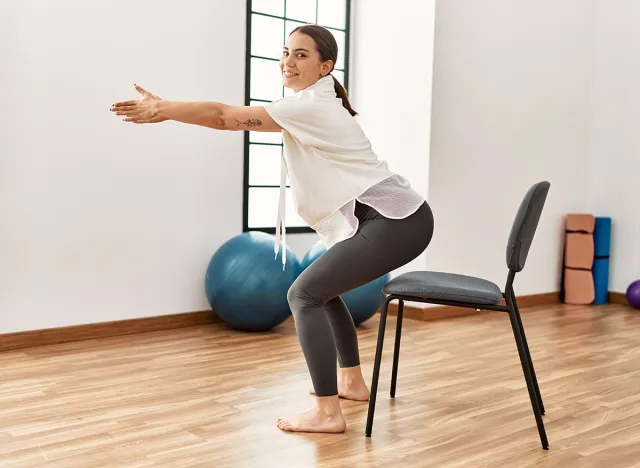
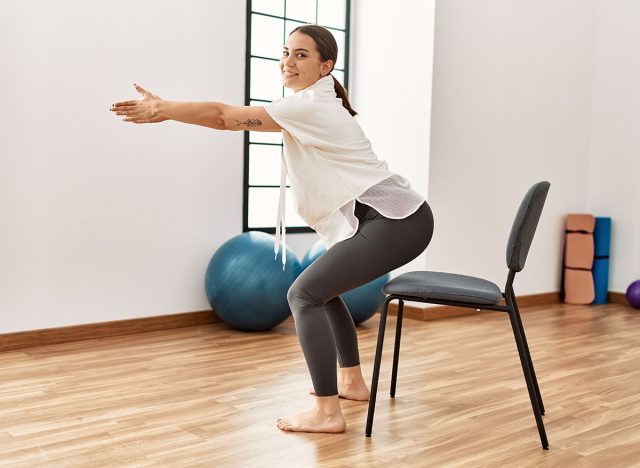
Box Squat
Box squats are one of the most practical ways to rebuild leg tone. The chair gives you a target, and every rep trains the thighs and glutes to lower and stand with control. I like this exercise after 60 because it connects directly to daily life. If you want stronger legs, better chair stands, and more confidence getting up from seated positions, this move belongs in the routine.
Muscles Trained: Quads, glutes, hamstrings, core.
How to Do It
- Stand in front of a sturdy chair.
- Place your feet about shoulder-width apart.
- Reach your arms forward for balance.
- Bend your knees and lower toward the chair.
- Lightly touch the chair with your hips.
- Press through your feet to stand tall.
Recommended Sets and Reps: Perform 2 to 3 sets of 8 to 12 reps.
Best Variations: Higher chair squat, slow box squat, box squat with a light dumbbell.
Form Tip: Lightly touch the chair and stand back up.
RELATED: 5 Standing Exercises That Firm Your Midsection Faster Than Gym Classes After 60
Chair-Supported Reverse Lunge
Reverse lunges train each leg to work on its own, which helps build more balanced lower-body strength. The chair gives you support so you can focus on the working leg instead of worrying about balance the whole time. This is a strong choice for improving muscle tone because it challenges the quads, glutes, and hamstrings while standing. Keep the step short at first and make the front leg drive the rep.
Muscles Trained: Quads, glutes, hamstrings, calves, core.
How to Do It
- Stand beside a sturdy chair.
- Hold the chair lightly with one hand.
- Set your feet under your hips.
- Step your right foot back.
- Bend both knees and lower into a comfortable lunge.
- Press through your front foot to stand, then switch sides after your reps.
Recommended Sets and Reps: Perform 2 to 3 sets of 6 to 10 reps per side.
Best Variations: Smaller-range reverse lunge, supported split squat, bodyweight reverse lunge.
Form Tip: Push through the front foot to stand.
RELATED: If You Can Hold a Wall Sit This Long After 65, Your Leg Strength Is Elite
How to Get More Muscle Tone From Chair Exercises
Chair exercises work when you treat them like strength training. Move with control, create tension in the working muscles, and choose a version that lets you complete clean reps. For more visible tone, pair the workouts with protein-forward meals, daily walking, and enough recovery to let your muscles adapt.
- Train close to effort: The last few reps should feel challenging while your form still looks solid.
- Use the chair as a tool, not a crutch: Hold it just enough to stay steady, then let your muscles do the work.
- Control the lowering phase: Slower lowers make squats, dips, and lunges more effective.
- Keep the routine balanced: Pair upper-body moves with lower-body work so the whole body gets a training signal.
- Repeat the same exercises long enough to improve: Give yourself two to four weeks before changing the routine.
- Add challenge with small changes: Use a slower tempo, hold planks longer, squat deeper, or take slightly longer lunges.
- Support tone with food choices: Muscle looks firmer when strength training is paired with enough protein and consistent eating habits.
References
- Siparsky, Patrick N et al. “Muscle changes in aging: understanding sarcopenia.” Sports health vol. 6,1 (2014): 36-40. doi:10.1177/1941738113502296
- Klempel, Natalie et al. “The Effect of Chair-Based Exercise on Physical Function in Older Adults: A Systematic Review and Meta-Analysis.” International journal of environmental research and public health vol. 18,4 1902. 16 Feb. 2021, doi:10.3390/ijerph18041902
The post 4 Chair Exercises That Restore Muscle Tone Faster Than Weight Training After 60 appeared first on Eat This Not That.


