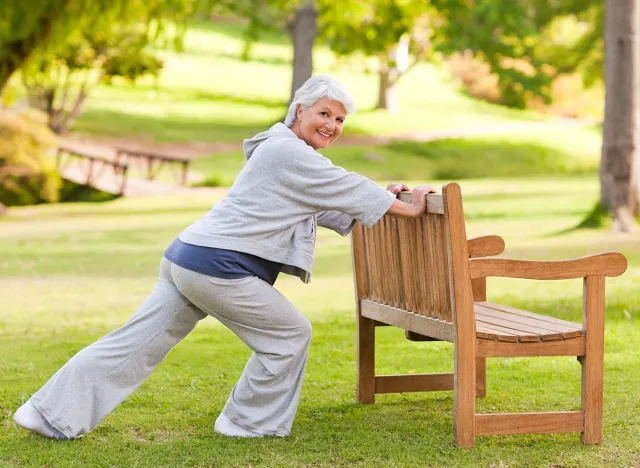
Getting yourself up from the floor is a useful ability to hold onto after 70. You may need it after kneeling to grab something, spending time with family, or taking an unexpected fall. Having enough strength to work your way back to standing can make those situations feel much less intimidating.
That ability also says a lot about independence. Once getting low feels difficult, it’s easy to start avoiding activities that might put you there in the first place. Staying comfortable with floor-level movement gives you more freedom to keep doing things on your own, which supports the active lifestyle tied so closely to healthy aging.
The strength behind that skill is trainable. Your legs do most of the work as you rise, while your arms and core can help you support yourself during the transition. Stronger muscles also give you more control when you stumble and may help you recover your balance before you hit the ground, although no exercise can remove fall risk completely.
You don’t have to practice full floor transfers every workout to improve them. Squats and lunges build the leg strength you need to stand, while incline exercises prepare your upper body to support and push your weight when necessary. Together, they give you a practical starting point.
RELATED: 5 Couch Exercises That Rebuild Shoulder Strength Faster Than Weights After 60
Bodyweight Box Squat
Getting off the floor eventually comes down to whether your legs can bring you back to standing. Box squats strengthen your thighs and glutes through a motion you already use every time you get out of a chair. The box also provides consistent depth, making it easy to see progress as your legs get stronger.
Muscles Trained: Quads, glutes, hamstrings, core.
How to Do It
- Stand in front of a sturdy chair or box.
- Set your feet about shoulder-width apart.
- Sit your hips back and bend your knees.
- Lower until your thighs reach at least parallel, if comfortable.
- Lightly touch the box.
- Press through your feet to stand up.
Recommended Sets and Reps: Perform 2 to 3 sets of 8 to 12 reps. Rest for 45 to 60 seconds.
Best Variations: Higher box squat, supported box squat, slower box squat.
Form Tip: Lightly touch the chair before standing again.
Assisted Lunge
A floor transfer rarely keeps both legs working equally. You’ll often move through a split stance or kneeling position before you stand, and lunges prepare your legs for that uneven setup. Hold a chair or counter for balance so you can focus on building strength through the front leg.
Muscles Trained: Quads, glutes, hamstrings, calves, core.
How to Do It
- Stand beside a sturdy chair or counter.
- Hold the support lightly with one hand.
- Step one foot backward into a split stance.
- Bend both knees and lower as far as comfortable.
- Press through your front foot to rise.
- Complete your reps, then switch sides.
Recommended Sets and Reps: Perform 2 to 3 sets of 6 to 10 reps per side. Rest for 45 to 60 seconds.
Best Variations: Smaller-range assisted lunge, supported split squat, assisted reverse lunge.
Form Tip: Use the support for balance while your legs do the work.
RELATED: 4 Chair Exercises That Restore Muscle Tone Faster Than Weight Training After 60
Incline Push-Up
Your arms can help when you need to push away from the floor, or you can use a sturdy piece of furniture to stand on. Incline push-ups build that pressing strength without requiring you to start on the ground. A wall or high counter works well at first, and you can lower the surface as your chest and triceps get stronger.
Muscles Trained: Chest, shoulders, triceps, abs.
How to Do It
- Place your hands slightly wider than shoulder-width on a sturdy elevated surface.
- Step your feet backward.
- Brace your abs.
- Bend your elbows and lower your chest toward the surface.
- Stop when your elbows reach about 90 degrees.
- Press through your hands to straighten your arms.
Recommended Sets and Reps: Perform 2 to 3 sets of 8 to 12 reps. Rest for 45 to 60 seconds.
Best Variations: Wall push-up, higher incline push-up, slower incline push-up.
Form Tip: Keep your body in one straight line as you lower.
Incline Plank Hold
Changing positions near the floor takes more than strong legs. Your midsection has to keep you steady while your arms and legs reposition, especially when you’re using a chair or another surface for support. An incline plank lets you practice that control from a more approachable height before you ever need it on the floor.
Muscles Trained: Abs, shoulders, chest, glutes.
How to Do It
- Place your hands or forearms on a sturdy elevated surface.
- Step your feet backward.
- Form a straight line from your head through your heels.
- Brace your abs.
- Keep your spine neutral.
- Hold while breathing normally.
Recommended Sets and Reps: Perform 2 to 3 holds of 20 to 40 seconds. Rest for 30 to 45 seconds.
Best Variations: Wall plank, forearm incline plank, lower incline plank.
Form Tip: Keep your ribs stacked over your hips.
RELATED: 6 Home Exercises That Restore Hip Strength Faster Than Gym Sessions After 60
Build the Strength to Stay Independent After 70

You can start working on floor-transfer strength long before getting up becomes a struggle. Train these exercises consistently and use everyday movements, like standing from a chair or lowering yourself with control, as simple ways to notice progress.
- Train two to three days per week: Give your muscles enough practice while leaving time to recover.
- Use support freely: A sturdy chair or counter lets you work through lunges with more confidence.
- Lower the squat target over time: Moving to a slightly lower chair can increase the challenge as your legs improve.
- Keep walking regularly: Walking helps maintain the endurance you need once you’re back on your feet.
- Practice getting low with control: Use comfortable kneeling or half-kneeling positions when they fit into your day.
- Keep training your arms: Stronger pressing muscles give you more options when you need support.
- Notice what feels easier: Smoother chair stands, or more confidence near the floor are meaningful signs of progress.
References
- Montero-Odasso, Manuel et al. “Fall risk stratification in older adults: low and not-at-risk status still associated with falls and injuries.” Age and Aging vol. 54,3 (2025): afaf064. doi:10.1093/ageing/afaf064
- Rodrigues, Filipe et al. “Effects of Muscle Strength, Agility, and Fear of Falling on Risk of Falling in Older Adults.” International Journal of Environmental Research and Public Health vol. 20,6 4945. 11 Mar. 2023, doi:10.3390/ijerph20064945
The post 4 Exercises That Help You Get Up Off the Floor Without Help After 70 appeared first on Eat This Not That.


