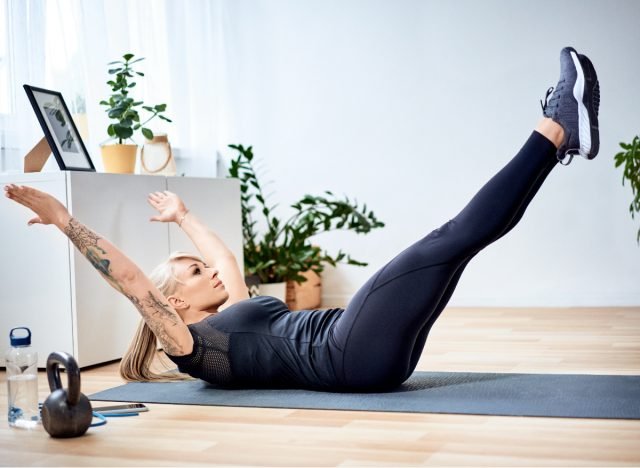
If you read that headline and immediately pictured a plank, you’re probably right. This time, though, the challenge happens on your back. The hollow hold asks you to press your lower back into the floor, lift your shoulders, and keep your body braced while your arms and legs extend away from your center. Sixty seconds there feels very different from sixty seconds standing around with a stopwatch.
Core strength becomes increasingly useful after 55 because your midsection supports almost everything else you ask your body to do. A stronger core gives your arms and legs a more stable base, which can improve how you lift and move through daily life. It also helps you manage force through your trunk when you’re carrying something heavy or getting yourself off the floor.
Endurance is a big piece of that equation. Your core rarely gets to brace once and call it a day. It has to stay involved while the rest of you keeps moving. I see this with clients all the time: someone can create a strong brace for a few seconds, then the position slowly starts to change as fatigue sets in. Training the ability to hold tension longer gives that strength more staying power.
That’s also why I like reassessing exercises like the hollow hold every few weeks. There’s something satisfying about coming back to the same test and realizing that 20 seconds has turned into 35, then 45. For this challenge, the goal is 60 clean seconds. Below, we’ll cover why the hollow hold is such a useful core test, how to perform it correctly, what your time says about your strength, and how to build toward the full minute.
RELATED: 4 Towel Exercises That Make Reaching Behind Your Back Easy Again After 65
Why the Hollow Hold Is Such a Tough Core Test
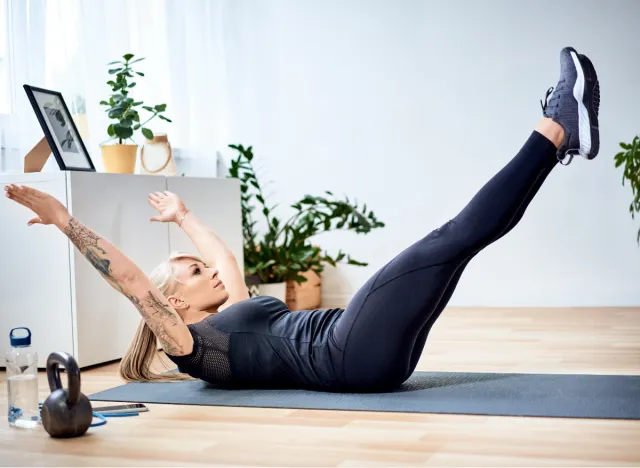
The hollow hold challenges your core by increasing the distance between your arms, legs, and center of mass. As you reach farther away from your torso, your abs have to work harder to keep your pelvis from tipping forward and your lower back from lifting off the floor.
That makes positioning the heart of the exercise. Your rectus abdominis does much of the visible work, while deeper abdominal muscles help maintain the brace. The hip flexors contribute as your legs extend, so the challenge quickly climbs once you move from a bent-knee version into the full hold.
Core endurance becomes obvious here because there’s nowhere to hide once fatigue sets in. Your legs may start rising higher, or your lower back may peel away from the floor. Holding the same position for a full minute shows you can maintain strong trunk tension for an extended effort.
How to Perform a Hollow Hold
Start with a version you can control. A bent-knee hollow hold is already useful, and it gives you a great place to learn the position before extending your legs farther away.
How to Do It:
- Lie on your back with your knees bent.
- Press your lower back firmly into the floor.
- Lift your shoulders and upper back slightly.
- Raise your feet off the floor.
- Extend your arms overhead as far as you can while keeping your back in place.
- Gradually straighten your legs to increase the challenge.
- Hold while breathing steadily.
Movement Standard: Your hold counts as long as your lower back stays pressed into the floor and your shoulders remain lifted. Bring your knees closer or move your arms forward if your back begins to arch.
Muscles Trained: Abs, deep core muscles, hip flexors.
Recommended Sets and Reps: Perform 3 sets of 20 to 40 seconds. Rest for 45 to 60 seconds.
Best Variations: Bent-Knee Hollow Hold, Arms-Down Hollow Hold, Single-Leg Hollow Hold, Full Hollow Hold.
Form Tip: Point your toes away from your body and squeeze your quads.
RELATED: 4 Chair Exercises Women Over 65 Need to Keep Their Legs Strong
What Your Hollow Hold Time Says After 55
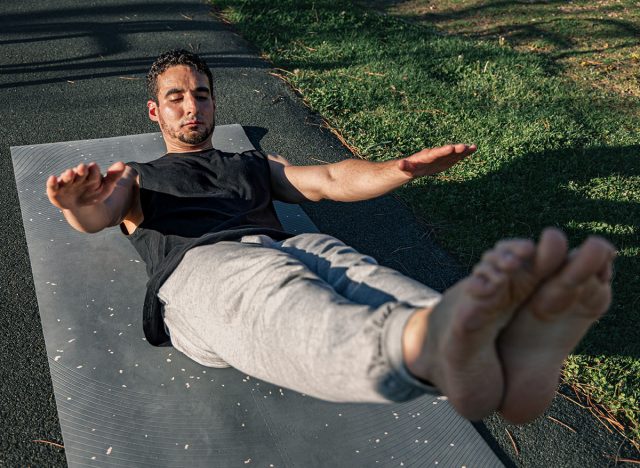
Use the hardest variation you can perform while meeting the movement standard. Your time ends when your lower back loses contact with the floor, even if you feel like you could keep hanging on.
- Under 20 seconds: Building Your Base
You’ve got a useful starting point. Work with bent knees or keep your arms closer to your body to learn the brace and gradually extend your time. - 20 to 39 seconds: Solid Core Strength
You can maintain good tension long enough for the exercise to become challenging. Keep building time before making the body position harder. - 40 to 59 seconds: Strong Core Endurance
You’re getting close to the full benchmark here. Holding the position this long takes good abdominal strength and enough endurance to maintain your lower-back position as fatigue builds. - 60+ seconds: Top 10% Core Strength
A clean one-minute hollow hold after 55 is an impressive effort. Your core can maintain a demanding position for an extended period, and you’ve built the endurance to keep that strength working from start to finish.
RELATED: 4 Daily Exercises That Build a 6-Pack in 21 Days After 65
How to Build Toward a 60-Second Hollow Hold
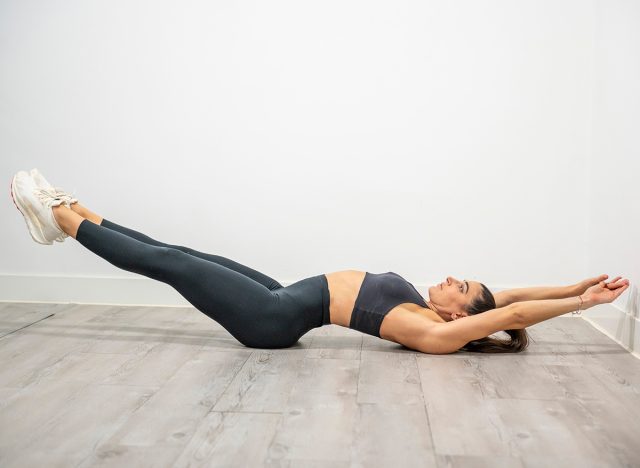
You can make fast progress on the hollow hold once you find the right starting variation. The goal is to accumulate quality time in the position without letting your back arch just to squeeze out a few extra seconds. Build the hold first, then make the leverage harder.
- Start with bent knees: Keep your thighs closer to your torso until you can hold the position comfortably.
- Move your arms next: Reach farther overhead as your brace improves.
- Extend one leg at a time: This bridges the gap between bent knees and the full hollow position.
- Use shorter repeated holds: Several 15- to 20-second sets can build endurance before you attempt one long effort.
- Practice two to three times per week: Frequent exposure gives you plenty of practice without testing your max every session.
- Keep breathing: Take controlled breaths while maintaining the brace instead of holding your breath through the entire set.
- Retest every few weeks: Use the same variation each time so you can see whether your hold time is actually improving.
The hollow hold gives you a simple goal and plenty of ways to work toward it. Reach 60 seconds with your lower back planted and your body under control, and you’ve built some serious core endurance after 55. If you’re still building toward the minute, every cleaner and longer hold gives you something worth chasing the next time you test.
References
- García-Jaén, Miguel et al. “Influence of Abdominal Hollowing Maneuver on the Core Musculature Activation during the Prone Plank Exercise.” International Journal of Environmental Research and Public Health vol. 17,20 7410. 12 Oct. 2020, doi:10.3390/ijerph17207410
- Schaeffer, Beth H et al. “Differences in Abdominal Muscle Thickness, Strength, and Endurance in Persons Who Are Runners, Active, and Inactive.” Sports Health vol. 16,6 (2024): 950-957. doi:10.1177/19417381231212471
The post If You Can Hold This Position for 60 Seconds After 55, Your Core Strength Is Top 10% appeared first on Eat This Not That.


