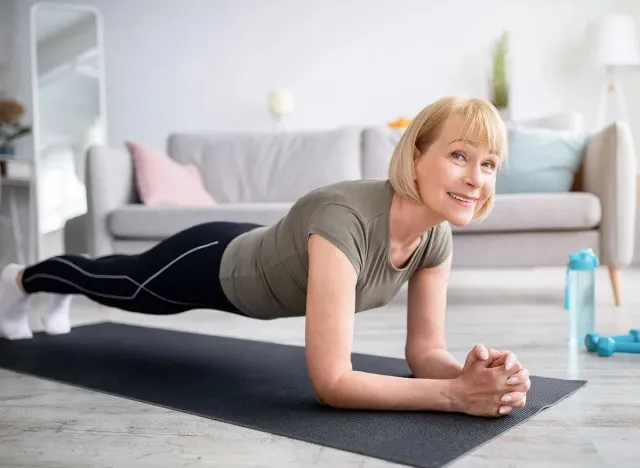
There’s a reason that trainers always recommend planks for building core strength. Unlike a crunch, which works a narrow slice of your abs, research shows that doing a proper plank engages your entire core at once, including your abs, the muscles along your back, your hips, and your shoulders. That makes it one of the truest tests of core endurance you can perform, and after 60, core endurance is essential for healthy aging.
A strong core is what keeps you stable when you walk, turn, reach, and prevent yourself from falling, which is a major risk factor as you get older. As you age, studies reveal that stability tends to decline, and with it goes some of the balance and confidence that keep common daily movements feeling easy. The good news? Testing how long you can hold a clean plank gives you a simple, equipment-free snapshot of how strong your core is, so that you can work to improve it and enhance your quality of life for years to come.
To learn more, we spoke with James Brady, CPT, a certified personal trainer at OriGym, about how long a plank should realistically last after 60, why maintaining proper plank form is crucial, and what a strong hold says about your core. Let’s get started.
(Next up: Be sure to check out these 5 Home Exercises That Flatten Lower Belly Faster Than Sit-Ups After 60.)
How Long Should You Be Able to Hold It?
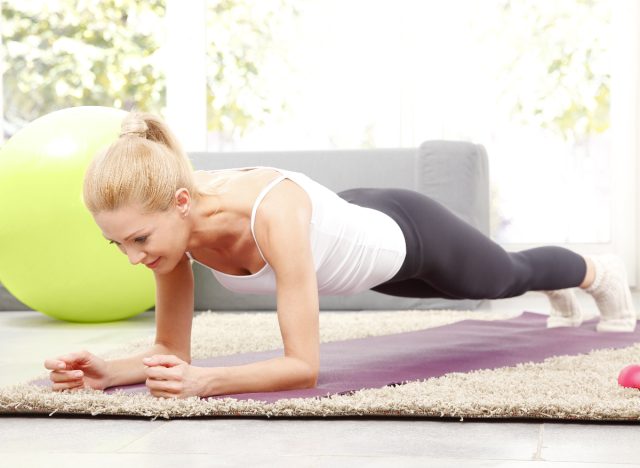
“If you can hold a strict forearm plank for around 60 seconds after 60, I would consider that an excellent level of core endurance,” says Brady. “However, there’s no official age-specific benchmark that makes 60 seconds a magic number, but maintaining good form for a full minute requires considerable control from the abdominals, back, hips and shoulders.” Essentially, treat a full minute as an excellent target time to aim for, not a formal standard, and remember that a clean hold with proper form is what makes it count.
How to Properly Perform a Plank
“Your body should form a straight line from your shoulders to your heels, with the hips neither dropping nor lifting, while you continue to breathe normally,” Brady explains. “The moment that line starts to break, your time is up.”
How to do it:
- Rest on your forearms with your elbows under your shoulders.
- Extend your legs behind you while resting on your toes.
- Form a straight line from your shoulders to your heels.
- Keep your hips from dropping or lifting and breathe normally.
- Hold the position until your form starts to break, then note your time.
Why Maintaining Proper Plank Form is Crucial
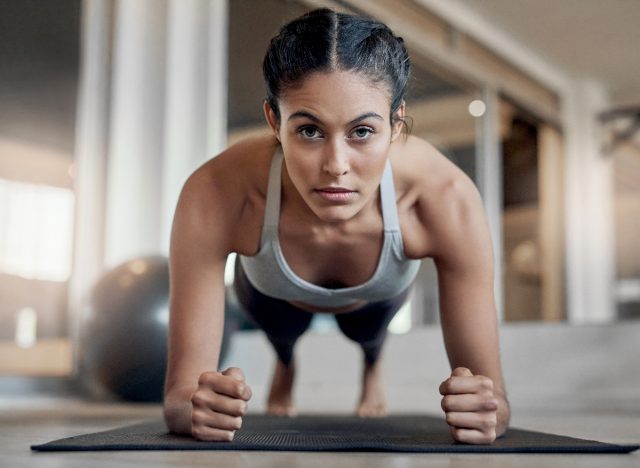
It’s tempting to raise your hips or let them sag in order to grind out a few extra seconds in your plank hold time, but Brady is clear that technique and form are what matter most. “If your form starts to break down after 30 seconds, stopping there is more beneficial than holding on for another minute with poor technique,” he says. “A shorter, clean hold builds real strength and protects your back; a long, sagging one does neither.”
If you stay consistent with planking by testing it three to four times per week, your efforts will pay huge dividends. Your core strength will improve and once you reach 60 seconds, you’ll be in the elite tier for your age bracket. If you can’t hold a plank for one minute yet, start where you are, retest every few weeks, and watch the number and your quality of life climb.
The post If You Can Hold a Plank This Long After 60, Your Core Strength Is Top-Tier appeared first on Eat This Not That.


