
I’ve spent almost 40 years as a personal trainer, and 25 of them as co-founder of TRAINFITNESS, the UK’s leading fitness education company, helping older clients keep the strength that lets them live independently. One of the changes that worries people over 65 the most is losing the ability to get out of a chair without help, because it touches everything: the sofa, the car, the loo. I understand that fear.
But this strength comes back with the right practice, and you don’t need a gym or heavy weights to rebuild it. These four chair exercises can get you there.
Why This Strength Fades

In my experience, the biggest problem I see is that people stop using the movement. They get up less often, and when they do, they’ve got into the habit of hauling on the armrests or pushing off the table. The leg muscles simply don’t get asked to do the work any more.
I also see a lot of fear. Once someone has had a wobble or a fall, they tense up, and that tension makes the movement harder. They lean too far forward, or they rush it, and neither helps.
The other common issue is that they’re dropping back into the chair rather than lowering themselves under control. That’s a sign the muscles have lost the strength to hold the weight on the way down.
RELATED: 5 Exercises That Restore the Walking Speed You Had at 40 After 65
Why Chair Work Beats Squats
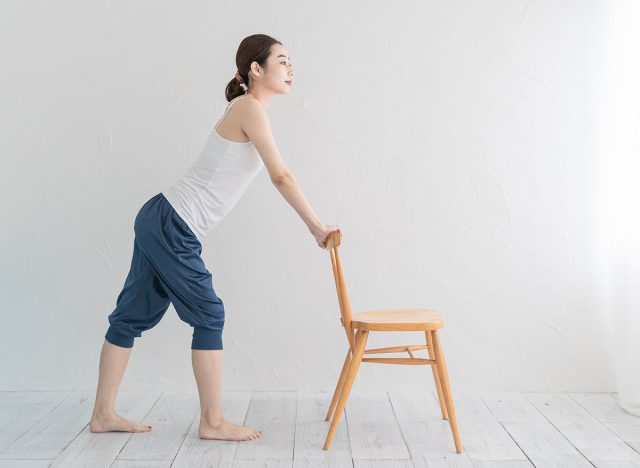
Chair exercises work because they rehearse the exact movement you’re trying to get back. When you rise from a chair, your body learns to lean forward, push through the heels and straighten the legs in one smooth pattern. Training that same pattern from the same position is the most direct way to improve it.
Lots of people assume they need to squat. And squats are a fine exercise, honestly. But for someone over 65 who already struggles to stand, a loaded squat can be too much load, and it carries a real risk of a fall or a strain. It also doesn’t rehearse the specific movement of rising from a chair.
What chair work gives you is that precise movement at a load you can manage, with the seat behind you as a safety net. You can push yourself without the fear of landing on the floor. That makes it both safer and more specific for this goal at this age.
Sit-to-Stand
This rehearses the exact movement you want back, and it strengthens the thighs and bottom in the range they actually work when you stand up. It’s the most specific thing you can do.
How to Do It:
- Sit tall towards the front of a sturdy chair, feet flat and slightly back under your knees.
- Lean your chest forward over your toes, then push up through your heels to stand tall.
- Lower slowly back down under control.
- To make it easier to start, use a higher, firmer chair or a cushion, and use your hands on the armrests if needed.
- As you improve, lower the seat height, then drop your hands, then slow the lowering right down.
- When that feels solid, add a pause just above the seat before you lower.
Avoid These Mistakes:
- Don’t drop back into the chair. Lower yourself under control instead of letting gravity finish the rep for you.
- Don’t haul yourself up with your arms. Let your legs do the work.
Sets and Reps: 8 to 10 reps.
RELATED: The 12-Minute Routine That Undoes 8 Hours of Sitting After 60
Chair-Supported Mini-Squat
It overloads the exact standing range in a controlled way, using the chair behind you as a depth guide and a safety net.
How to Do It:
- Stand in front of the chair, feet hip-width apart, holding a worktop or the chair back for balance if needed.
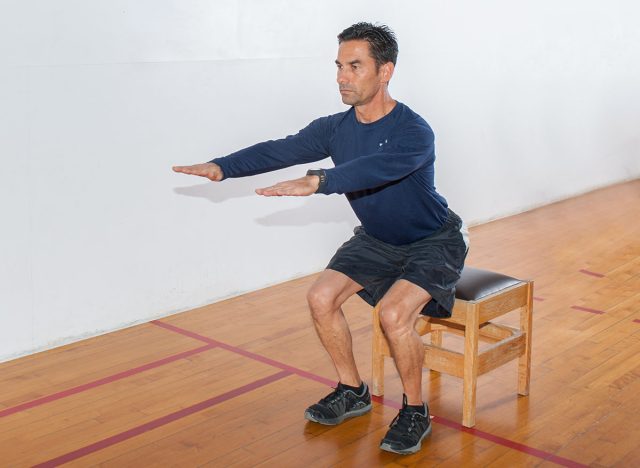
- Push your hips back and bend your knees to lower halfway towards the seat, hovering just above it.
- Push back up to stand tall.
Avoid These Mistakes:
- Don’t let your knees roll inward. Keep them tracking over your toes.
- Don’t lower too fast and thump onto the seat. Stay in control the whole way down.
Sets and Reps: 8 to 10 reps.
Seated Knee Extension
It builds the thigh muscle at the front, the quadriceps, which is the main muscle that straightens the leg to lift you out of the chair.
How to Do It:
- Sit tall with your feet flat on the floor.
- Straighten one leg out in front until it’s level with your other knee.
- Hold for 2 seconds, then lower under control.
- Alternate legs, or do all your reps on one side and then swap.
Avoid These Mistakes:
- Don’t swing your leg up with momentum. Lift it slowly and control it on the way up and down so your thigh does the work.
Sets and Reps: 10 to 12 reps on each leg.
Form Tip: Hold that 2-second pause at the top of every rep. That’s what makes your quads do the work instead of momentum.
RELATED: 5 Daily Exercises That Improve Balance Better Than Walking After 65
Standing Calf Raise
Standing up and staying steady on your feet needs strong calves and ankles. This builds the push and the balance that stop you feeling wobbly as you rise.
How to Do It:
- Stand behind the chair with your hands resting on the back for balance.
- Rise up onto the balls of your feet, lifting your heels as high as is comfortable.
- Lower slowly.
Avoid These Mistakes:
- Don’t lean heavily on the chair or let your arms do the lifting. Use the chair only for balance and push up through your feet.
Sets and Reps: 12 to 15 reps.
How Often to Do This

Three or four times a week is plenty, with a rest day between sessions. Strength is built during recovery, not during the workout, so the rest is where the progress happens.
Start with one set of each exercise and see how that feels. Build up to two sets, then three, over a few weeks. The whole session should take about 10 to 15 minutes, so it’s easy to fit in.
Pick times when you’re feeling steady, and make sure the chair you use is solid and doesn’t slide. If anything hurts beyond a normal working feeling, stop and check with a professional.
RELATED: 5 Morning Exercises That Flatten Waist Thickening in 21 Days After 60
What to Expect
Be patient and be honest with yourself. In the first 2 to 3 weeks, most of the gains come from your nervous system learning to use the muscle you already have. That means standing up often starts to feel steadier surprisingly early.
By 6 to 8 weeks, the muscle itself is getting stronger. You’ll notice that getting up from low chairs and sofas is easier, and you’re not relying on the armrests the way you were.
The important thing is to keep going. Strength fades again if you stop practicing, which is a hard truth but an important one. Make it part of your week and it will hold.
The post 4 Chair Exercises That Restore Sit-to-Stand Strength Faster Than Squats After 65 appeared first on Eat This Not That.


