
After 55, a decade in a desk chair leaves its mark: the hips tighten, the shoulders round forward, the lower back stiffens, and standing up from a chair becomes harder than it should be. I’ve seen it play out again and again over almost 40 years as a personal trainer, the last 25 of which I’ve spent running TRAINFITNESS, the UK’s leading fitness education provider.
The chair itself can be the tool that undoes much of that damage. You don’t need a gym, a mat or a change of clothes. These five exercises fit into the day you already have.
Why Sitting Wrecks Your Body

The most common problems I see are weak glutes, tight hip flexors, rounded shoulders and a stiff lower back. After years at a desk, the muscles at the back of the body switch off and the ones at the front shorten. That combination makes standing, walking and even sitting tall feel like more effort than it should.
People over 55 also tend to lose the habit of moving through their full range. They get up from a chair by pushing off the arms, they reach for things by rounding the back, and they hold tension in the neck and shoulders. None of that is a lost cause, but it does need addressing directly.
RELATED: 5 Kitchen-Counter Exercises That Trim Love Handles Faster Than Crunches After 60
Why Chair Beats Yoga
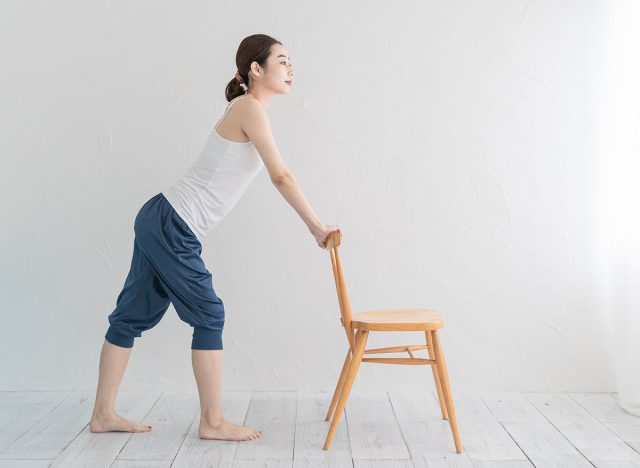
Chair exercises have one advantage that a yoga class can’t match: you can do them in the chair you already sit in, through the working day, without changing clothes or setting aside a separate session. That means they interrupt the sitting itself, at the times the damage is happening. Yoga is worthwhile, and I’d never discourage anyone from it, but it’s usually a separate class you do occasionally. It doesn’t break up the eight hours you spend in the chair.
To be completely honest, you can’t fully undo ten years of sitting. But you can reverse most of the stiffness and weakness with consistency. The chair exercises work because they target the exact muscles that sitting deactivates, and they do it on the spot, every day, without any extra planning.
Chair Sit-to-Stand
Sitting weakens the glutes and thigh muscles you need to stand, walk and climb stairs. Standing up and sitting down under control rebuilds those muscles and breaks the sitting pattern at the same time.
How to Do It:
- Sit tall towards the front of a sturdy chair, feet flat and hip-width apart.
- Stand all the way up without using your hands.
- Lower slowly back down under control.
Avoid These Mistakes:
- Don’t flop back down into the chair. Lower with control instead.
- Don’t push off your thighs with your hands. Let your legs do the work.
Sets and Reps: 10 to 12 reps
Form Tip: Keep the lowering phase slow so your legs do the work, not your hands.
RELATED: 4 Wall Exercises That Trim Muffin Top Faster Than Gym Machines After 60
Seated Shoulder-Blade Squeeze
Sitting rounds the shoulders forward. This strengthens the muscles across the mid-back that pull the shoulders back where they belong.
How to Do It:
- Sit tall, arms bent at your sides with elbows close to the body.
- Draw both shoulder blades together behind you, as if holding a pencil between them.
- Hold for 3 to 5 seconds, then release.
Avoid These Mistakes:
- Don’t shrug your shoulders up towards your ears.
Sets and Reps: 12 to 15 reps
Form Tip: Keep your shoulders low and focus the squeeze in your mid-back.
Seated Chest Opener
Years of hunching shorten the muscles across the front of the chest, which pulls the shoulders forward. Opening the chest lets the shoulders sit back.
How to Do It:
- Sit tall towards the front of the chair.
- Clasp your hands behind your lower back.
- Gently straighten your arms and lift your chest, drawing your shoulders back until you feel a stretch across the front.
- Hold for 20 to 30 seconds.
Avoid These Mistakes:
- Don’t arch your lower back or push your ribs forward.
Form Tip: Stay tall and keep the stretch across the front of your shoulders.
RELATED: 5 Bed Exercises That Restore Spine Mobility Faster Than Chiropractic Visits After 60
Seated Pelvic Tilts
Slumped sitting flattens the natural curve in the lower back. Tilting the pelvis back and forth restores movement to a stiff lower back and wakes the muscles that hold a neutral spine.
How to Do It:
- Sit tall, feet flat.
- Slowly roll your pelvis forward to gently arch your lower back.
- Roll it back to round your lower back.
- Move smoothly between the two.
Avoid These Mistakes:
- Don’t move your whole upper body or force the range.
Sets and Reps: 10 slow rolls
Form Tip: Keep the movement small and let it come from your pelvis, not your shoulders.
Seated Hamstring Stretch
Sitting keeps the hamstrings short, which tugs on the pelvis and adds to lower-back tightness. Lengthening them eases the pull.
How to Do It:
- Sit towards the front of the chair.
- Straighten one leg out with your heel on the floor and toes up.
- Keep your back long and hinge forward gently from the hips until you feel a stretch down the back of your thigh.
- Hold for 20 to 30 seconds, then swap legs.
Avoid These Mistakes:
- Don’t round your back to reach further.
Form Tip: Keep your chest lifted and your back flat, hinging from your hips.
RELATED: 4 Morning Exercises That Restore Neck Strength Faster Than Massage After 55
Fitting This Into Your Day
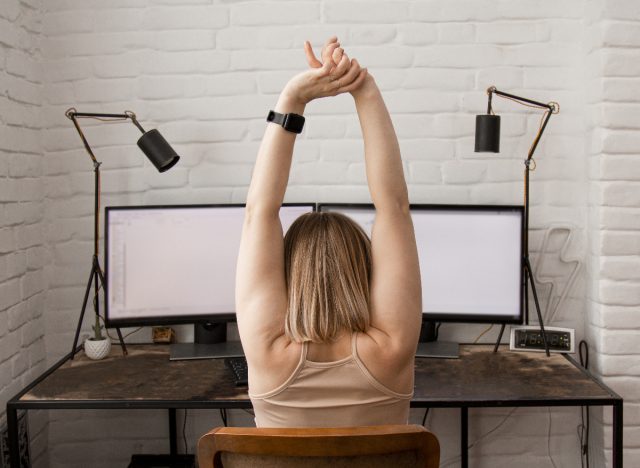
These are gentle enough for daily use, and the whole set takes under ten minutes. I’d suggest scattering them through the working day at your desk rather than saving them for one block. Do the sit-to-stand when you get up for a coffee, the shoulder-blade squeeze while you’re reading an email, the pelvic tilts when you feel your back stiffen.
The habit that matters most is standing up every 30 to 45 minutes, even if it’s just for a minute. The exercises work best when they interrupt the sitting, not when they’re tacked onto the end of a long day.
RELATED: 3 Standing Exercises That Firm Arm Jiggle Faster Than Bicep Curls After 60
What to Expect

In the first week or two you’ll notice less stiffness when you stand up, and getting out of a chair will feel easier. By four to six weeks your legs and mid-back are noticeably stronger, and sitting tall takes less effort. You’ll catch yourself slumping less often because the muscles holding you upright are doing their job again.
I won’t pretend a decade of sitting is fully undone. But most of the stiffness and weakness does reverse with consistency, and that makes a real difference to how you move through the day. Stick with it and the chair stops being the thing that holds you back.
The post 5 Chair Exercises That Undo 10 Years of Sitting Faster Than Yoga After 55 appeared first on Eat This Not That.


