A treadmill can help you build a steady walking habit, especially when weather, time, or confidence gets in the way. Standing strength work adds something different. It trains the muscles that help each step feel stronger once you’re back on regular ground.
After 65, walking strength can change in small ways before it feels obvious. Curbs may take more focus. Longer walks may feel harder to finish. Your stride may feel shorter or less powerful than it used to. Focused strength work helps rebuild the control behind those steps.
I like standing exercises here because they keep the training close to how you actually move. You can use a chair, wall, or counter for support while practicing knee lift, push-off strength, and balance. That makes the work approachable without taking away the challenge.
This article covers five standing exercises that help restore walking strength after 65. You’ll build stronger steps and better control so daily walks feel steadier outside the gym.
Standing March
A stronger walk starts with a clean knee lift. Standing marches train the hip flexors, quads, and core so each step feels easier to lift and place. This is useful after 65 because shuffling often starts when the hips lose strength or the body stops trusting single-leg support. Hold a chair or counter if needed, then lift each knee with control.
Muscles Trained: Hip flexors, quads, glutes, calves, core.
How to Do It
- Stand tall with your feet under your hips.
- Hold a chair, wall, or counter if needed.
- Lift your right knee to a comfortable height.
- Pause briefly at the top.
- Lower your right foot with control.
- Switch sides and continue alternating.
Recommended Sets and Reps: Perform 2 to 3 sets of 8 to 12 reps per side.
Best Variations: Supported march, slower march, high-knee march.
Form Tip: Stand tall as each knee lifts.
RELATED: 5 Chair Exercises That Undo 10 Years of Sitting Faster Than Yoga After 55
Supported Reverse Lunge
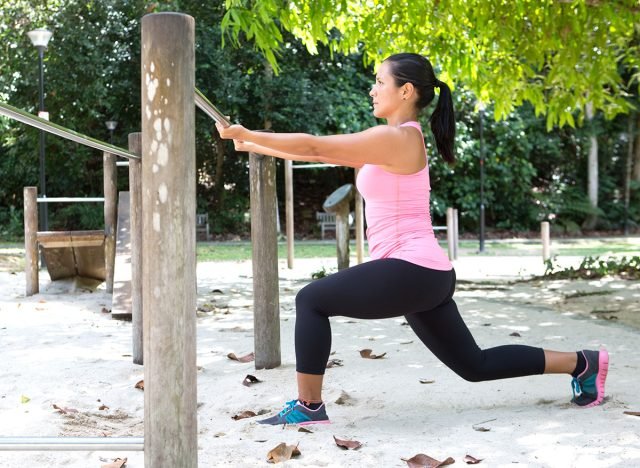
Stepping backward builds the strength and control that walking needs. The front leg lowers your body, then pushes you back to standing. That trains the quads and glutes in a way that carries over to longer strides, hills, stairs, and getting up from lower seats. Use support so balance stays manageable while the working leg handles the rep.
Muscles Trained: Quads, glutes, hamstrings, calves, core.
How to Do It
- Stand beside a sturdy chair, wall, or counter.
- Hold the support lightly with one hand.
- Set your feet under your hips.
- Step your right foot back.
- Bend both knees and lower into a comfortable range.
- Press through your front foot to stand, then switch sides after your reps.
Recommended Sets and Reps: Perform 2 to 3 sets of 6 to 10 reps per side.
Best Variations: Smaller-range reverse lunge, supported split squat, bodyweight reverse lunge.
Form Tip: Push through your front foot.
Standing Calf Raise
Calves help finish every step. When they’re stronger, pushing off the ground feels more natural, and walking can feel less flat-footed. Calf raises also train ankle strength, which helps your lower leg feel steadier during daily walks. Move through each rep slowly enough to feel the lift and the lower.
Muscles Trained: Calves, ankles, feet.
How to Do It
- Stand tall near a chair, wall, or counter.
- Hold the support lightly.
- Keep your feet about hip-width apart.
- Press through the balls of your feet and lift your heels.
- Pause briefly at the top.
- Lower your heels with control.
Recommended Sets and Reps: Perform 2 to 3 sets of 10 to 15 reps.
Best Variations: Supported calf raise, single-leg assisted calf raise, slow calf raise.
Form Tip: Lift and lower without bouncing.
RELATED: 5 Kitchen-Counter Exercises That Trim Love Handles Faster Than Crunches After 60
Mini-Band Lateral Walk
Walking forward still needs strong side hips. Mini-band lateral walks train the outer glutes, which help keep your pelvis steady when one foot is on the ground. That extra hip support can make your steps feel cleaner and reduce the side-to-side wobble many people notice with age. Keep the steps small so the band tension stays on the right muscles.
Muscles Trained: Glutes, outer hips, quads, hamstrings, core.
How to Do It
- Place a mini-band above your knees or around your ankles.
- Stand with your feet about hip-width apart.
- Bend your knees slightly.
- Press gently out against the band.
- Step to the right with control.
- Continue for your reps, then step back to the left.
Recommended Sets and Reps: Perform 2 to 3 sets of 5 to 8 steps per side.
Best Variations: Band-above-knees lateral walk, smaller steps, supported lateral walk.
Form Tip: Keep tension on the band.
Heel-to-Toe Walk
A strong stride needs balance as much as leg strength. Heel-to-toe walking narrows your base, so your feet, ankles, hips, and core have to guide each step. This helps you practice placing your foot with more control, which can make regular walking feel steadier. Stay close to a wall or counter so you can touch it when needed.
Muscles Trained: Calves, ankles, glutes, core.
How to Do It
- Stand tall beside a wall or counter.
- Place one foot directly in front of the other.
- Let the heel of your front foot touch the toes of your back foot.
- Take a slow step forward in the same pattern.
- Continue walking heel to toe.
- Turn around carefully and repeat.
Recommended Sets and Reps: Perform 2 to 3 rounds of 8 to 12 steps.
Best Variations: Wider heel-to-toe walk, supported heel-to-toe walk, pause-step walk.
Form Tip: Take slow, controlled steps.
RELATED: 4 Wall Exercises That Trim Muffin Top Faster Than Gym Machines After 60
How to Rebuild Walking Strength After 65

Walking gets better when you train the parts of the stride that need support. Use these exercises two to four days per week, then keep regular walks in your routine so the strength carries over. Start with support, move with control, and let the reps build confidence before adding more challenge.
- Train before an easy walk: A short strength routine can help your legs feel more prepared for walking practice.
- Use support early: A chair, wall, or counter lets you focus on better reps instead of fighting for balance.
- Build the knee lift: Marches help reduce shuffling by training the muscles that lift the leg.
- Keep lunges short: A smaller step makes the reverse lunge easier to control.
- Strengthen push-off: Calf raises help your stride feel stronger at the end of each step.
- Train side-hip control: Mini-band walks help your hips stay steadier when one foot is on the ground.
- Practice foot placement: Heel-to-toe walks build balance and control at a slow, safe pace.
References
- Ungvari, Zoltan et al. “The multifaceted benefits of walking for healthy aging: from Blue Zones to molecular mechanisms.” GeroScience vol. 45,6 (2023): 3211-3239. doi:10.1007/s11357-023-00873-8
- Keller, Karsten, and Martin Engelhardt. “Strength and muscle mass loss with the aging process. Age and strength loss.” Muscles, ligaments and tendons journal vol. 3,4 346-50. 24 Feb. 2014
The post 5 Standing Exercises That Restore Walking Strength Faster Than Treadmills After 65 appeared first on Eat This Not That.


