Keeping stress at bay is sometimes much easier said than done. After all, life is typically filled to the brim with bills to pay, errands to run, deadlines to meet, and, at times, challenging situations to address. That said, your overall physical and mental well-being depends on establishing healthy ways to manage stress. If you don’t, chronic stress could lead to depression, heart disease, digestive issues, sleep challenges, and even a weakened immune system.
The key is implementing a practical, convenient routine you can count on when you start feeling stressed. After all, physical exercise releases endorphins and serotonin that help boost your mood while reducing tension.
“One of the immediate benefits of exercise is that it gives your brain something else to do. Your attention shifts away from the stressor and toward breathing, effort, coordination and what your body is doing right now. There’s a large body of research supporting exercise not only for stress reduction, but also for anxiety and depression,” explains Cheryl McColgan, NASM Certified Personal Trainer, E-RYT Certified Yoga Instructor, and the Founder and Editor in Chief of Heal Nourish Grow, who has over 30 years of experience in fitness, nutrition, yoga, and healthy living. “Exercise also changes what’s happening physiologically during the stress response. I sometimes describe it simply as helping interrupt that stress cycle rather than just sitting there continuing to think about whatever is bothering you.”
One popular modality to try is an old-fashioned garage workout. This workout might include bodyweight movements, compound lifts, functional work, and conditioning movements that are perfect additions to your regimen.
We spoke with experts and are here with four garage exercises you can do to help relieve stress faster than a standard spin class after 45. They’re user-friendly moves for this age bracket that can be done in the convenience of your own home with minimal equipment.
Boxing

“Boxing would definitely be my first choice for this. There’s something about having to focus on your stance, your hands, and the combination you’re throwing that makes it difficult to keep thinking about whatever was stressing you out five minutes earlier,” explains McColgan. “There’s also some research supporting non-contact boxing for mental health. One review found improvements in anxiety, mood and perceived stress.”
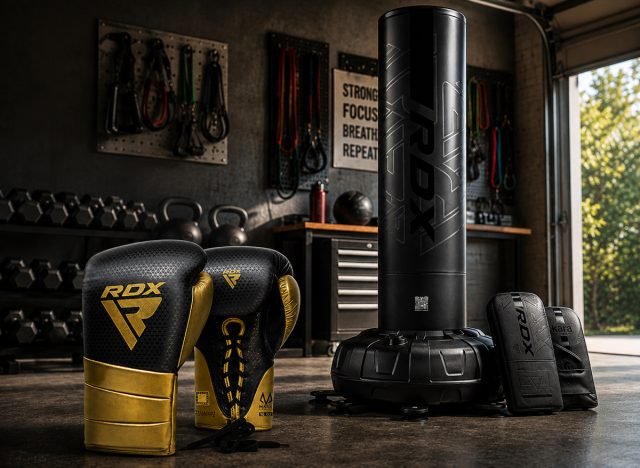
The best part? You don’t need a heavy bag in order to get started. Mastering shadowboxing works just fine. As you progress, consider investing in a bag like RDX F6 6ft Kara Black Free-Standing Punch Bag with Mitts Set, complete with the RDX Mark Pro Training Boxing Gloves, 14 oz. (We here at Eat This, Not That! have tried both personally and highly recommend them for garage gym enthusiasts.)
After all, McColgan says training with a heavy bag can be so much fun—and enjoying your workout makes it much more sustainable for the long-term.
For beginners, start with 30 seconds of easy punches, followed up with 30 to 60 seconds of resting. Repeat for 5 to 10 rounds. Focus on simple combinations like jab-cross, jab-cross-jab, or jab-cross then a lateral step. Make sure your knees are soft, your torso is tall, and your hands stay near your face.
If training with a punching bag, Domenic Angelino, MS, MPH, CSCS, CPT, Chief Exercise Scientist at FitCraft, recommends aiming for bouts of 30 seconds of fast-paced punches. Then, take a rest for 30 seconds. Repeat for two to 10 minutes, based on your current fitness level.
“When you punch, you should be careful about keeping your wrist straight, so that your hand is aligned with your forearm. Otherwise, you’ll increase your risk of injury,” Angelino stresses.
RELATED: 5 Home Exercises That Build More Muscle Than Gym Workouts After 50
Burpees
Burpees are excellent for stress-relief, considering they help your body release those feel-good hormones when performed at the right intensity and duration.
“The explosive nature of burpees [and] the large number of muscles used throughout your entire body provide a really strong stimulus. Since burpees essentially involve you emphasizing totally different subsets of muscles during each phase—like your lower body while jumping and upper body during the pushup phase—muscular fatigue takes longer to limit your performance than in other resistance-training exercises. This allows burpees to have a more potent cardiovascular effect, which downstream can help with stress relief,” Angelino explains.
Here’s how to do burpees:
- Stand tall with your feet shoulder-distance apart.
- Lower into a squat and place your hands on the ground.
- Jump your feet back to assume a high plank.
- Perform a pushup.
- Jump your feet up toward your hands.
- Explode upward, reaching both arms overhead.
- Land and immediately transition into a squat.
- Aim for 3 sets of 30 to 60 seconds with about 45 to 60 seconds of rest between sets.
RELATED: If You Can Do These 4 Bodyweight Exercises After 50, You’re Stronger Than 90% of Your Peers
Planks
Planks help alleviate tension on muscles that tend to hold stress. Plus, they’re pretty simple to do. All you need is your body weight to get started.
If you’re a beginner, Angelino recommends doing planks on your forearms. If you’re more advanced, do planks on your hands in a pushup position.”You want to make sure your hips don’t sag and your torso and legs are in a straight line,” Angelino instructs. “Squeeze your glutes and abs to keep your body in the appropriate position. Then simply hold that position for the entire duration of the set.”
Here’s how to do planks:
- Place your hands under your shoulders. Press into the pads of your fingers and hug your inner arm toward your armpit.
- Alternatively, start with your forearms on the mat.
- Walk your feet out to hip-width.
- Engage your abs, squeeze your buttocks, and pull upward through your quads.
- Hold your plank.
- Perform 3 sets of 30 to 45 seconds with 60 seconds of rest between each set.
RELATED: The 60-Second Standing Challenge That Predicts Your Longevity
Cat-Cow
You may not consider yoga-style workouts when focused on garage-themed exercises. But not everything you do needs to be high intensity in order to effectively alleviate stress.”There are different benefits that you can gain from doing slow and less-demanding exercises. Exercises that stretch tight muscles can lead to reductions in tension,” Angelino points out. “The cat-cow exercise is great because it stretches muscles on both the front and back of your core. And, most people’s lower back tends to be pretty tight. If you reduce tightness temporarily, you could lower daily discomfort caused by your lower back. Naturally, it’ll lead to your day being less stressful if your back is in a more comfortable state.”
Here’s how to do cat-cow:
- Assume a tabletop position on your hands and knees.
- For cow pose, breathe in, drop your belly toward the floor, concave your back, and gaze upward.
- Hold for 5 seconds before releasing.
- For cat pose, breathe out, round your back, tuck your chin in toward your chest, and tuck your tailbone.
- Hold for 5 seconds before releasing.
- Perform 1 to 2 sets of cat-cow for 10 to 12 reps each, resting for 45 to 60 seconds between each set.
The post 4 Garage Exercises That Relieve Stress Faster Than a Spin Class After 45 appeared first on Eat This Not That.


