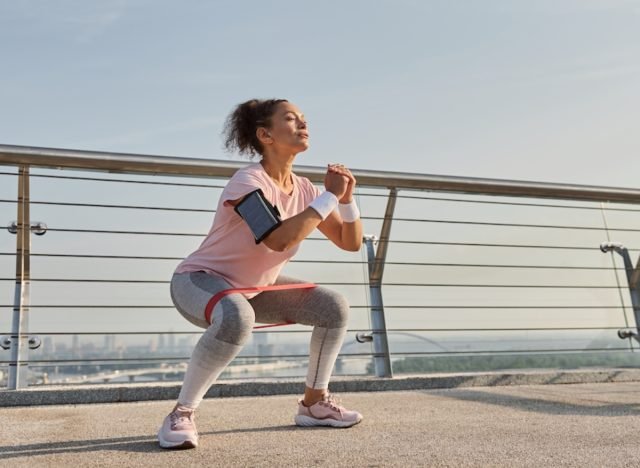
One of the best and most popular ways to build lower-body strength is by including squats in your workout routine. Squats can help increase muscle mass, burn calories, improve balance, build functional strength, and work your core. This move is considered a compound exercise, meaning it engages several joints and muscle groups simultaneously, including your glutes, quads, calves, and hamstrings.
Chantelle Stryker, Personal Trainer and Fitness Expert on the ClassPass Corporate team, gave us a great test to learn about your fitness. Stryker explains that, if you can do this many squats after 60, you’re in great shape.
“The squat is one of our fundamental movement patterns. Every time you sit down and stand back up, you’re performing a version of a squat. Climbing stairs requires many of the same major muscle groups, including the quadriceps, glutes and muscles surrounding the hips. Getting up from the floor requires an even greater combination of leg strength, mobility, balance, and coordination—exactly what squat repetition challenges and builds,” Stryker explains.
Why Lower-Body Strength Is Especially Important for Older Adults
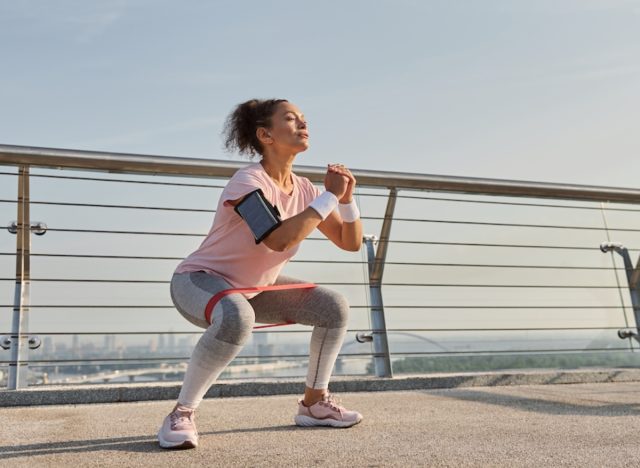
Lower-body strength becomes even more crucial as you age because strong legs are essential to maintain balance, mobility, confidence, and independence.
“As we age, we naturally lose muscle mass, strength and power, which can make everyday movements more challenging if we aren’t actively working to maintain them. Strengthening the major muscles of the legs and hips also supports joint stability, balance and our ability to react,” Stryker explains.
RELATED: If You Can Do These 8 Lower-Body Moves, Your Leg Strength Is Elite
What Daily Tasks Can Be Supported by Strong Leg Muscles?
Essentially every movement you do throughout the day calls for a strong, stable lower body. Strong legs allow you to stand up from a chair, walk longer, climb stairs, carry grocery bags, maintain balance, and step over obstacles.
“It is also important for the ability to react quickly. Catching yourself after a stumble, stepping off a curb unexpectedly or regaining your balance all require strength, coordination and stability from the lower body. That lower-body strength is ultimately about maintaining physical freedom,” Stryker adds.
RELATED: If You Can Pass These 4 Strength Tests After 45, Your Body Is Ahead of Its Time
How to Safely Perform a 60-Second Squat Test at Home
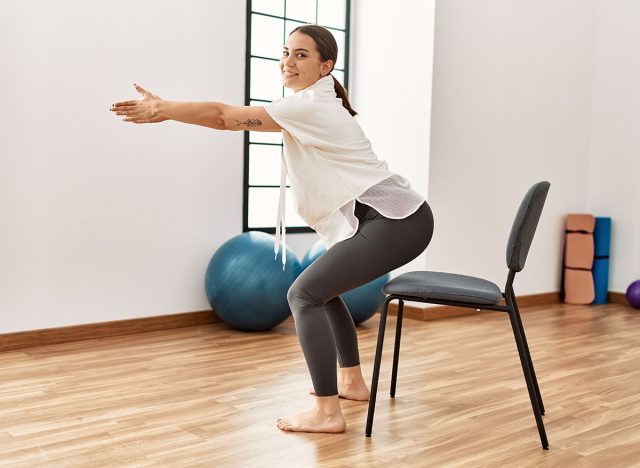
When performing squats at home, form and safety are key. Stryker recommends starting with a sturdy chair positioned against a wall so it’s unable to move.
“The chair provides both a reference point and an added layer of confidence for balance,” she says.
Here’s what to do:
- Stand in front of the chair with your feet hip- to shoulder-distance apart.
- Maintain a tall chest and braced core.
- Press your hips back while bending your knees to lower into a squat.
- Drive through your feet to rise back up.
“If balance, mobility or joint pain is a concern, begin with a limited range of motion-almost like practicing the first portion of sitting down. Only descend as far as you can while remaining controlled, balanced and pain-free,” Stryker says. “Most importantly, listen to your body. Muscle fatigue and exertion are normal, but sharp or sudden pain is a signal to stop. The goal of the test isn’t simply to achieve the highest number possible; it’s to assess and build the strength and movement capacity that helps you stay active and independent.”
RELATED: 5 Standing Exercises That Trim Inner Thighs Better Than Gym Machines After 50
The Squat Benchmark To Aim For
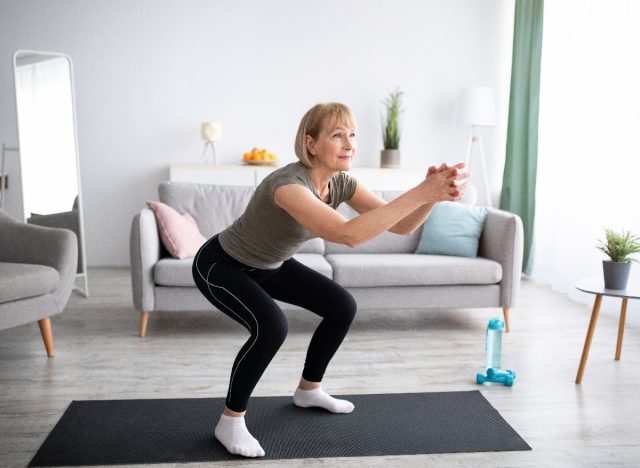
According to Stryker, for individuals over 60, a strong squat benchmark would be performing 20+ squats in 60 seconds.
“Limit the range of motion to start. For both strong and newer individuals, these should be controlled, pain free reps that do not compromise their balance or joints. Quality of movement matters more than quantity,” she explains.
The post If You Can Do This Many Squats in 60 Seconds After 60, You’re in a Great Shape appeared first on Eat This Not That.


